The Village That Moved Itself Uphill
Isle de Jean Charles got the money, the land and the new houses. What it couldn't move was the community that stayed behind.
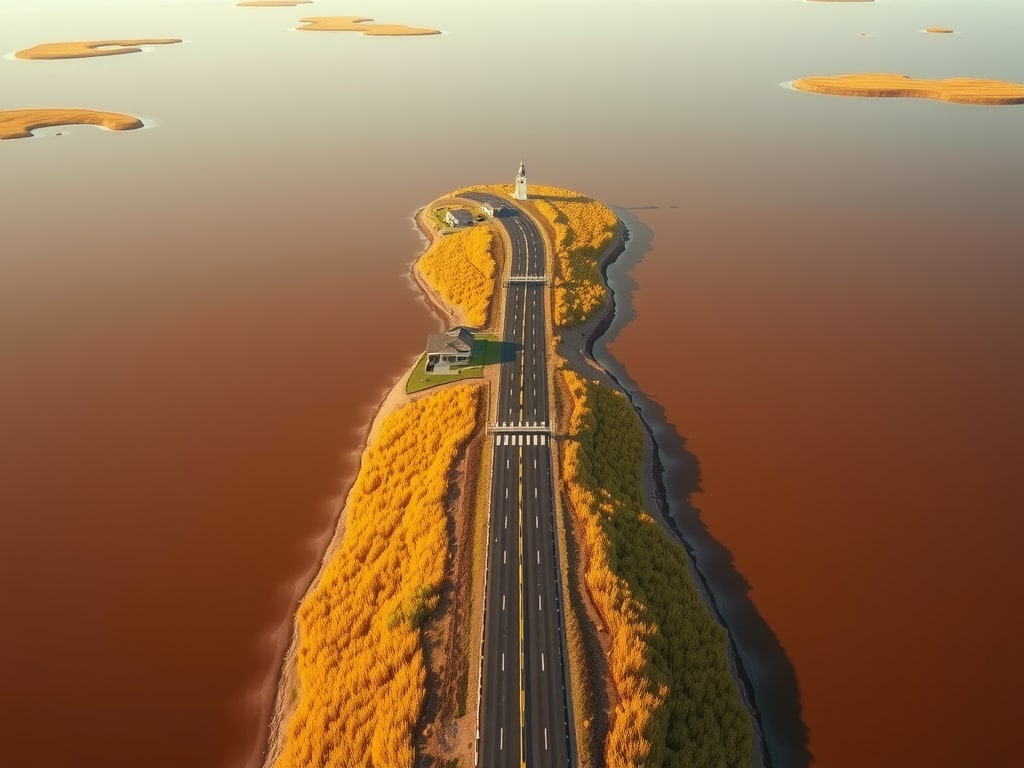
The island used to be more than 22,000 acres. By the time the federal government wrote the cheque, it was about 320 — chewed down by erosion, storms, man-made canals and sea-level rise, according to Inside Climate News. Isle de Jean Charles, a narrow strip of land in Terrebonne Parish, Louisiana, had been home to the Biloxi-Chitimacha-Choctaw Indians since the 1830s. In 2016, Louisiana received $48.3 million in Community Development Block Grant money to relocate 37 residents or families. It was the first time Washington fully funded the relocation of an entire community.[11][13]
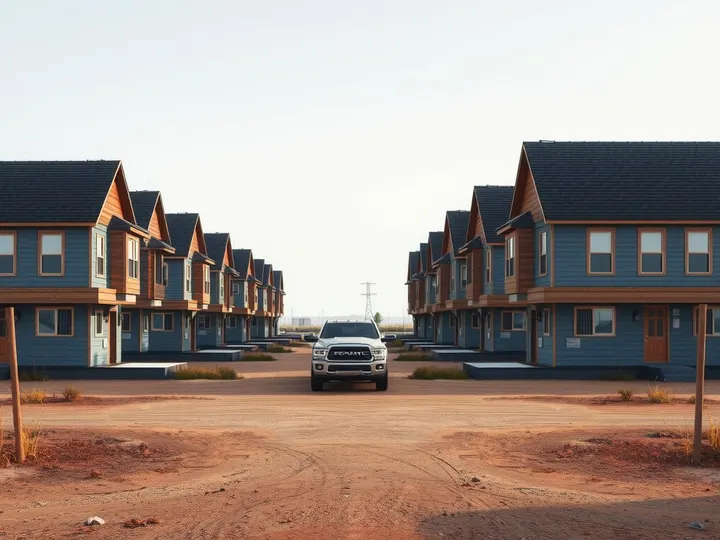
Most of the island's population was moved 40 miles north, to a new development called New Isle. On paper, it is the model case. On the ground, former residents told Inside Climate News their new homes were substandard — rainwater seeping through doorways, appliances malfunctioning, yards flooding, repairs piling up. Chris Brunet left the island three years before that reporting, saying he felt he had no other choice.[11][13]
The Numbers Nobody Budgets For
Relocation is the least studied of the three forms of climate mobility — migration, displacement and planned relocation, per the UNFCCC framework — and the least politically comfortable, writes Elizabeth Ferris in a December 2024 Baker Institute issue brief. A mapping exercise turned up more than 400 planned relocation cases in 78 countries, across every inhabited continent, with flooding the most common trigger. Most climate-driven movement, Ferris notes, will happen inside national borders and end in cities, not across frontiers. And nobody who moves because of a flood or a creeping shoreline qualifies as a refugee under the 1951 Refugee Convention.[1][2]
That legal gap matters because it leaves the money and the authority with national and local governments — which, in most documented cases, is exactly where relocation starts. In Asia, according to the Forced Migration Review mapping, relocations after disaster displacement were more often initiated by government actors, and disproportionately in urban rather than rural areas. The Maldives case is typical of the pattern: the 2004 Indian Ocean tsunami immediately precipitated the move from Kandholhudoo to Dhuvaafaru Island, though the community had already lived with floods and land degradation before the wave came.[2]
What a Community Can Do Alone
The self-organized version exists, and it is older than the climate crisis. Niobrara, Nebraska, is the earliest well-documented wholesale flood relocation in the United States: after an 1881 ice dam flooded the town, residents elected to move the entire settlement, and within two months buildings were jacked off their foundations and dragged upslope by horse teams to a site a mile and a half away. By January 1882, most homes and all the commercial structures were in place. In 1971, 90 percent of residents voted to move the town again; the third Niobrara was rededicated in July 1977 at a cost of $14.5 million, according to Issues in Science and Technology.[6]
Other American towns wrote their own versions. Leavenworth, Indiana, was adopted by the American Red Cross for relocation off the Ohio River floodplain, and New Leavenworth was complete by the end of 1938. Shawneetown, Illinois, moved in what Issues in Science and Technology calls a fractious collaboration between town leaders and the Works Progress Administration — locals derided the WPA designers as "high-salaried outsiders." Community-led does not mean friction-free; it means the friction happens closer to home.[6]
"The vast majority of residents accepted the need to relocate and did so with council assistance and compensation" — while one Matatā resident rejected both the process and the need to move, and became the neighbourhood's sole remaining occupant.
The Neighbours Who Stayed
New Zealand has run the experiment in public. After two climate-related landslides in 2005, the Whakatane District Council began planning migration of the Matatā township over the following decade, and most residents took the council's assistance and compensation. As of October 2021, one resident had rejected both the process and the need to move and was the neighbourhood's last occupant. NIWA coastal hazards expert Rob Bell told reporters the retreat question is primarily socio-political rather than technocratic — which is a polite way of saying the engineering is the easy part.[7]
Alaska shows the cost of doing it slowly. Newtok, a Central Yup'ik village of roughly 400 on the Ninglick River, voted in 2003 to relocate nine miles to higher ground on Nelson Island. The Newtok Traditional Council had started weighing the move back in 1994, evaluated six sites, and settled on Mertarvik; the Native Corporation negotiated a land exchange inside the Yukon Delta National Wildlife Refuge, agreed by the U.S. Fish and Wildlife Service in 2003 after lobbying and legal counsel. A planning group formed in 2006. Funding arrived in pieces — an $800,000 Economic Development Administration grant for a barge ramp, dock and staging area, a Denali Commission grant for the water and sewage layout. By summer 2018 there was a 6,000-square-foot community center and eight houses; the first residents arrived in 2019.[8][14]
The bill for finishing Newtok is estimated at $80–130 million, about $2 million per household, according to the U.S. Climate Resilience Toolkit, and funding constraints have repeatedly slowed it. As of late 2024, Newtok's population was zero, down from 321 in 2000.[8][14]
The Church, the Cemetery, the Half-Mile of Asphalt
Some places move their sacred things intact. Kiruna, in Sweden's far north, is shifting thousands of people and buildings over 30 years because iron ore mining has made the ground unstable — and LKAB, the mine company and the city's biggest employer, is covering the relocation, estimated at $1 billion, according to San. A 113-year-old, 741-ton church dating to 1912 was moved fully intact along a three-mile route expected to take two days. Streets were widened by 24 meters; lamp posts, traffic lights and a bridge already slated for demolition were cleared from the path.[4]
Not every building survives the trip whole. In New Zealand, a 110-year-old Wanaka Presbyterian Church was cut in half horizontally — just under the roof line, not down the middle — and trucked 172 kilometers to Queenstown, where its buyers planned to turn it into offices. They had wanted a historic building rather than a church specifically; a church simply offered the longer, bigger space that breaks neatly into individual rooms.[3]
What the Movers Owe the Stayers
The hard accounting is not the dock or the church. It is the fracture. In Fiji's Tukuraki, a 2012 landslide on the west coast of Viti Levu destroyed the village and killed a family of four; the community was declared unsafe and told to vacate. Land was identified in 2016 only after negotiations among the Fijian government, traditional landowners and the villagers, with the European Union funding the project and the Pacific Community implementing it. After a year of construction and five years of living apart, the displaced community had a new Tukuraki. Five years of dispersal is its own kind of loss.[10]
The American record suggests self-organization alone rarely closes the gap. As of 2016, at least ten tribal communities in the United States were seriously weighing wholesale relocation — Kivalina, Newtok, Shaktoolik and Shishmaref in Alaska; Isle de Jean Charles in Louisiana; and the Hoh, Quileute, Sauk-Suiattle, Quinault and Tulalip reservations in Washington — and state and federal agencies had made little progress on making it real, according to a University of Oklahoma law review article. The prohibitive cost is one obstacle. The likelier outcome, that paper warned, is makeshift collocation or complete dispersal after the next evacuation order.[12]
Which is the lesson Isle de Jean Charles offers, and it cuts both ways. A community can organize itself, buy land, move its church, keep its dead where they lie — and still find that the neighbours who stayed are the ones who define what was lost. Rob Bell's point holds: this is socio-political work. The village that moves uphill takes its arguments with it.[7][11]
Sources
- Climate Change and Community Relocation | Baker Institute — bakerinstitute.org
- Mapping of planned relocation cases: a foundation for evidence-based policy and practice - Forced Migration Review — fmreview.org
- 110 Year Old Church Cut in Half and Moved 172km | Moving Houses — youtube.com
- 113-year-old, 741-ton Swedish church moved fully intact to new location — san.com
- Governance, policy and planning around the world — adaptation.climate.columbia.edu
- True Stories of Managed Retreat | Issues in Science and Technology — issues.org
- Wikipedia: Managed retreat — en.wikipedia.org
- Wikipedia: Newtok, Alaska — en.wikipedia.org
- Autris Completes Substantial Land Purchase to Create the Newest Veritas Village Community in Costa Rica with an Appraised Value of $34.29 Million — finance.yahoo.com
- Refusing to disappear - the relocation of a village in Fiji due to climate change and disaster. — youtube.com
- As Millions Face Climate Relocation, the Nation’s First Attempt Sparks Warnings and Regret - Inside Climate News — insideclimatenews.org
- Lessons from Relocations Past: Climate Change, Tribes, and the Need for Pragmatism in Community Relocation Planning — digitalcommons.law.ou.edu
- As millions face climate relocation, the nation’s first attempt sparks warnings and regret • Louisiana Illuminator — lailluminator.com
- Relocating the Village of Newtok, Alaska due to Coastal Erosion | U.S. Climate Resilience Toolkit — toolkit.climate.gov
Reported with AI assistance using internet sources.