The Great Data Center Land Grab: How AI Is Reshaping the American West
As AI demand explodes, data centers are consuming land, water, and power at an unprecedented rate across the American West, sparking local conflicts and raising questions about the true cost of the digital future.
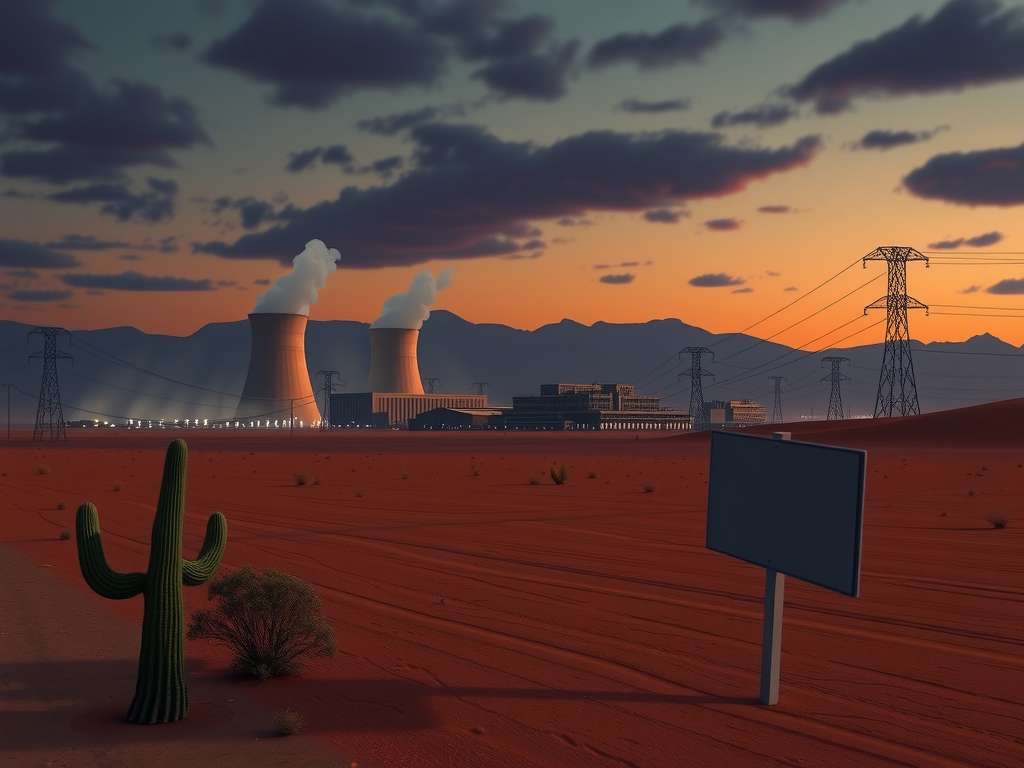
In the high desert of Millard County, Utah, a planned expansion of the Delta Gigasite could one day draw 9,700 megawatts of power—more than ten times the capacity of a typical nuclear reactor. That project, listed in a CleanView tracker of U.S. data centers, is just one of 1,764 planned facilities nationwide that would add 369,538 megawatts of new capacity, according to the same source. The American West, stretching from Washington through California to Phoenix, is ground zero for what industry promoters call "the most intense period of data center development in U.S. history" (advancing-data-center-construction-west.com). This is not your father's server farm.[11][1]
From ENIAC to AI: A Brief History of the Server Farm

The first data center was built in 1945 to house the ENIAC at the University of Pennsylvania—a 27-ton, 300-square-foot behemoth that already required careful attention to airflow and cooling, according to Enconnex. Additional early facilities rose at West Point, the Pentagon, and CIA headquarters in the 1950s. The transistor shrank the machines, and by the early 1990s, the client-server model gave birth to the first true data centers, where racks of PCs replaced mainframes. That evolution set the stage for today's hyperscale campuses, but the scale of change is dizzying: a single modern AI data center can consume as much electricity as 100,000 homes, according to the World Resources Institute.[2][14]
Land, Water, and Power: The Environmental Toll
The land requirements alone are staggering. Modern AI data centers need 500 to 800 acres each, and some require even more, according to a farmdoc daily analysis. That land is often covered with impermeable steel, concrete, and pavement, removing it from farming, nature, or housing, notes the Lincoln Institute of Land Policy. In the West, where water is already scarce, the thirst is equally alarming. Data centers consumed about 1.7 billion liters of water per day globally in 2021, with 57% drawn from potable supplies, according to a study in Npj Clean Water cited by Wikipedia. A mid-sized facility uses as much water as a small town, while larger ones can draw 5 million gallons a day—enough for a city of 50,000, per the Lincoln Institute.[5][15][10]
A single modern AI data center can use as much power as 100,000 homes—more than the entire city of New Orleans.
The energy appetite is equally voracious. The International Energy Agency estimated that data centers consumed about 415 terawatt-hours in 2024, about 1.5% of global electricity, and projects that could double to 945 TWh by 2030. In the U.S., data centers will account for "almost half of the growth in electricity demand between now and 2030," per the IEA, as cited by Wikipedia. A Cornell University study published in Nature Sustainability projects that by 2030, AI growth alone could emit 24 to 44 million metric tons of carbon dioxide annually and drain 731 to 1,125 million cubic meters of water each year—unless smart siting, grid decarbonization, and efficiency measures cut those impacts by up to 73% and 86%, respectively.[10][8][9]
Local Pushback: The $64 Billion Question
Not every community is rolling out the welcome mat. According to Data Center Watch, local opposition blocked or delayed $64 billion worth of data center projects between May 2024 and March 2025—six projects were blocked entirely, ten were delayed. Such movements have emerged across Europe, the U.S., and South America, notes Wikipedia. In the West, the Salt River Project, a utility serving the Phoenix area, is among the speakers at a 2026 industry conference focused on navigating "supply constraints, workforce challenges, and escalating power demands" (advancing-data-center-construction-west.com). The pushback is not just about aesthetics; it's about who bears the cost.[10][1]
The Economic Promise vs. The Real Costs
Proponents tout jobs and investment. A Georgia Tech analysis found that data center openings boost host county employment by about 3.5%, wages by 5%, business establishments by nearly 5%, and household income by about 2%. But those gains are concentrated in metropolitan areas; rural counties see no measurable employment or business growth, and facilities often employ fewer than 100 permanent workers, with many specialized services imported from outside. Meanwhile, electricity prices rise by about 5% after a data center enters an area, and a single large facility can use as much power as 80,000 homes. The Goldwater Institute, a free-market think tank, argues Arizona should embrace the "new digital future," but critics note that the jobs impact is often overstated.[6][5][3]
Data centers can also drive up housing costs. Research cited by farmdoc daily shows they raise house prices, which benefits property owners but hurts renters and prospective buyers. The Gardner Food and Agricultural Policy Survey found that U.S. consumers are concerned about land use, infrastructure, energy consumption, and water use related to data centers and AI. In rural areas, the economic benefits are even more elusive—Brookings notes that national policymakers view data centers as "strategic infrastructure," but local communities often see little return.[5][4]
Policy Responses: Catching Up to the Boom
Governments are scrambling to respond. At the federal level, the Department of Energy has funded studies like the one from Lawrence Berkeley National Laboratory that projects data centers could consume up to 12% of U.S. electricity by 2028. States are taking varied approaches—some, like Arizona, are courting the industry with free-market rhetoric, while others are imposing moratoriums or requiring environmental reviews. The industry itself is pushing for "localized collaboration" and "new delivery strategies" to speed up construction, per the conference marketing. But as the Cornell study warns, the AI industry's net-zero targets are "out of reach" without aggressive intervention.[14][3][1][9]
A Fork in the Desert
The AI-driven data center boom is different from anything that came before. It's bigger, faster, and hungrier. The first wave of purpose-built AI data centers is coming online in 2025, and the West is ground zero. The question is whether the region can harness this digital gold rush without draining itself dry. As the Cornell researchers note, "siting, grid decarbonization and efficient operations work together" to reduce impacts, but time is short. The land grab is real, and the stakes are nothing less than the future of the American West.[1][9]
Sources
- Advancing Data Center Construction West 2026 — advancing-data-center-construction-west.com
- Data Center History & Evolution | Enconnex — enconnex.com
- Data Centers - Goldwater Institute — goldwaterinstitute.org
- The local implications of data centers for rural communities in the US | Brookings — brookings.edu
- Rural Americans are Concerned About the Impact of Data Centers - farmdoc daily — farmdocdaily.illinois.edu
- Data Centers Are Booming. Who Benefits? — gatech.edu
- Environmental Cost of Artificial Intelligence: Carbon, Water ... — unu.edu
- Environmental impact and net-zero pathways for ... — nature.com
- 'Roadmap' shows the environmental impact of AI data center ... — news.cornell.edu
- Wikipedia: Data center — en.wikipedia.org
- US Data Center Map — Project List & Tracker — cleanview.co
- U.S. Data Center Tracker: Power, Facilities & Growth — electricchoice.com
- Top 10 U.S. Data Center Markets and Why They Are Hot — coresite.com
- 7 Ways Data Centers Affect US Communities — wri.org
- Data Drain: The Land and Water Impacts of the AI Boom — lincolninst.edu
- Understanding How Data Centers Impact Surface and Ground Waters — fieldreport.caes.uga.edu
Reported with AI assistance using internet sources.