Seeing Like a Cow: How Temple Grandin's Autism Revolutionized the Meat Industry
The scientist and designer, diagnosed with autism at three, used her visual thinking to create humane livestock handling systems now used for half of all cattle in the United States.

Half the cattle in the United States are handled in facilities designed by one woman: Temple Grandin. A professor of Animal Science at Colorado State University, she is also autistic. Her unique way of thinking—seeing the world in pictures, not words—allowed her to simulate the cow's perspective through the entire slaughter process, then redesign it to eliminate pain and fear.[5][11]
A Mind That Thinks in Pictures
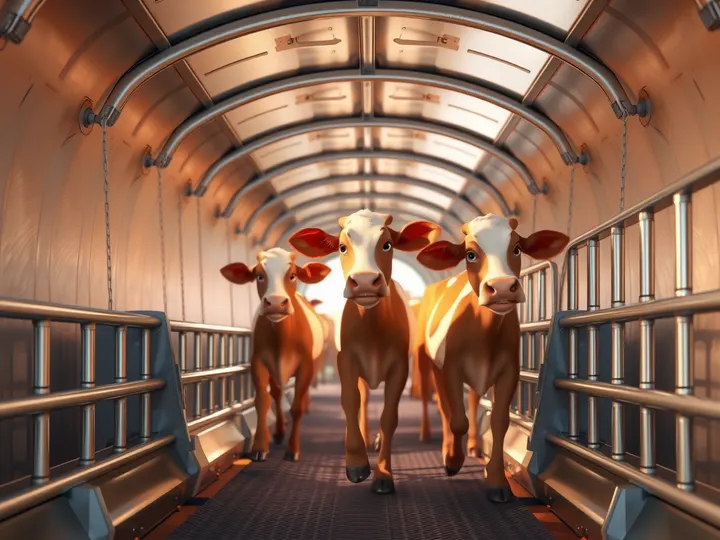
Grandin was diagnosed with autism at age three, according to Britannica. At the time, doctors recommended institutionalization; her mother refused. As a toddler, Grandin could not understand basic human emotions or interactions. She thought in pictures, not words. That visual, detail-oriented cognition turned out to be a professional asset. When she walked through a meat plant, she literally imagined being the animal: what does the cow see, what frightens it, where is its footing secure? By keeping frightening objects out of sight and ensuring stable footing, she reduced stress in cattle. Her empathy for animals, she later explained, came from her own sensory sensitivities.[3][4][11]
At age 18, she built a “squeeze machine”—a padded device that applies deep pressure—to calm her own anxiety during social overwhelm. The device, later used to comfort autistic children and adults, was inspired by the chutes that restrain cattle. That link between her own needs and animal welfare became the foundation of her career.[3][11]
The Blueprints That Quieted the Feedlot
Grandin’s first major invention was the center track restrainer system for meat plants, according to a libguide from Franklin Pierce University. In North America, almost half of the cattle are handled in these systems. The curved chute and race systems she designed are used worldwide—in the United States, Canada, Europe, Mexico, Australia, New Zealand, and beyond. The designs allow workers to move animals without frightening them: single-file races curved so the animal cannot see what waits ahead, solid sides to block distractions, non-slip flooring.[3][6]
“Today half the cattle in the United States are handled in facilities she has designed.”
She also developed an objective scoring system for assessing how cattle and pigs are handled at meat plants, a tool now used by large corporations such as Cargill to improve animal welfare. Cargill, the first company to implement her approach, saw immediate improvements in both process and product quality, according to a Forbes article. Her writings on flight zone and other principles of grazing animal behavior have helped reduce stress during handling across the industry.[6][13]
The Bullied Teen Who Never Stopped Drawing
Grandin’s path was not smooth. In high school, she was teased and bullied for being “super weird,” as she told Forbes. She was expelled at age 14 for throwing a book at a taunting classmate. Fellow students called her a “tape recorder” because she would repeat phrases. Entering the male-dominated livestock industry in the 1970s, she faced skepticism. But whenever she pulled out her drawings—detailed blueprints of handling systems—the doubters often fell silent.[4][5][13]
Grandin’s mother played a critical role, encouraging her fixated interests. When Grandin drew only horse heads, her mother said, “We need to draw the whole horse,” and kept expanding the focus. That structured guidance, Grandin later said, turned a repetitive behavior into a career. She advises parents today: “Build on the thing the kid is good at,” rather than obsessing over deficits.[12]
From U.S. Feedlots to Global Standards
Grandin’s influence now extends well beyond North America. Her designs have been applied to a broader range of livestock and poultry in facilities across the globe, according to Forbes. She has authored more than 60 scientific papers on animal behavior and become a leading advocate for humane slaughter. Her advocacy has pushed the industry toward transparency, including third-party remote video auditing (RVA) adopted by companies like Cargill. Today, many large meat processors voluntarily use her scoring system to monitor handling.[4][6][13]
“Grandin’s designs for humane livestock facilities aimed to eliminate pain and fear during slaughter.”
Despite her success, Grandin remains blunt about the industry’s shortcomings. She continues to consult, research, and push for reforms. “Parents get so worried about the deficits that they don't build up the strengths,” she told the University of Colorado. “But those skills could turn into a job.”[5]
What Neurodiversity Taught the Meatpacking World
Grandin’s career is a case study in the value of neurodiversity in innovation. Her focused, visual thinking—sometimes dismissed as a disability—enabled a revolution in animal welfare. She saw what neurotypical designers missed: the cow’s point of view. By building on her strengths, she turned a weakness—difficulty with verbal communication—into a superpower of spatial empathy.[11][12]
Her story challenges the perception that autism is only a deficit. Grandin herself is careful to credit the early intervention and the mother who refused to give up. But she also insists that the world needs more minds like hers—minds that can see the world from the inside of a chute. “The worst thing you can do with a child that’s not talking at age two and three is do nothing and let them zone out on electronics,” she warns. Instead, she says, find the picture they are drawing—and ask them to draw the whole horse.[12]
Sources
- Daybreak June 16 : Fertilizer prices drop on news of peace deal | Agri - Pulse Communications , Inc . — agri-pulse.com
- Community calendar from February 26 — saratogian.com
- Temple Grandin | Biography, Books, & Facts — britannica.com
- Temple Grandin - Wikipedia — en.wikipedia.org
- Dr. Temple Grandin biography — colorado.edu
- Temple Grandin: Livestock Behavior, Design of Facilities and Humane Slaughter Website - Temple Grandin - Library Guides at DiPietro Library, Franklin Pierce University — libguides.franklinpierce.edu
- Temple Grandin’s mind is a gift to livestock and humanity | College of Agricultural, Consumer & Environmental Sciences | Illinois — aces.illinois.edu
- Drawing inspiration: Temple Grandin’s unique perspectives and innovations in animal science | College of Agricultural, Consumer & Environmental Sciences | Illinois — aces.illinois.edu
- Current Studies – Access for Autism Research Program — accessforautism.uark.edu
- Frist Center for Autism and Innovation | Vanderbilt University — vanderbilt.edu
- Medium — medium.com
- Temple Grandin Shares Her Journey With Autism — greatergood.berkeley.edu
- How Temple Grandin Changed The Food Industry Forever — forbes.com
- Temple Grandin, a pioneer in the field of animal well-being — pmc.ncbi.nlm.nih.gov
Reported with AI assistance using internet sources.