The Woman Who Read the Ice
Ellen Mosley-Thompson spent four decades extracting frozen time from the world's most hostile places — and turned it into a warning system.
The Quelccaya ice cap sits at 5,500 meters in the Peruvian Andes, the largest tropical ice cap in the world at 44 square kilometers. On a good day, the team drilling there is racing to core a cylinder of 1,500-year-old ice before the surface melts. On a bad day, the weather simply wins. Ellen Mosley-Thompson, who co-leads the Ice Core Paleoclimatology group at Ohio State University with Lonnie Thompson, has spent her career on those bad days — and on the cores they produce. The group's records come from Antarctica, Bolivia, China, Greenland, Peru, Russia, and the United States, per Ohio State's foundation office. That geographic spread is not a bucket list. It is a deliberate strategy: ice archives are disappearing, and someone has to read them before they do.[4][15]
What a Core Actually Holds
An ice core is a cylinder pulled from an ice sheet or a high mountain glacier, and the deepest reach over two miles and contain ice up to 800,000 years old, according to Wikipedia's background entry on the subject. But the cylinder itself is only the container. The payload is the air. As each winter's snow accumulates and is compacted by newer layers into impermeable ice, it traps the original atmosphere in tiny bubbles — a direct sample of the air from the time the ice formed, as the American Meteorological Society's Project Ice explains. Carbon dioxide, methane, oxygen, nitrogen, and other greenhouse gases can be discerned from those bubbles.[10][5]
Then there are the proxies. The ratio of "light" oxygen-16 to "heavy" oxygen-18 in a sample reveals the global temperature when the ice formed, according to NOAA Climate.gov. Hydrogen isotopes do similar work. Mineral dust in the layers tracks droughts; black carbon and trace elements reveal whether fires are part of the historical record, per Ohio State. Pollen shows which plants were growing when a layer formed. Volcanic ash anchors a core in time by linking it to eruptions of known age. And because heat flow through a large ice sheet is very slow, the borehole temperature itself is another indicator of past temperature, according to Wikipedia's background entry.[3][4][11][10]
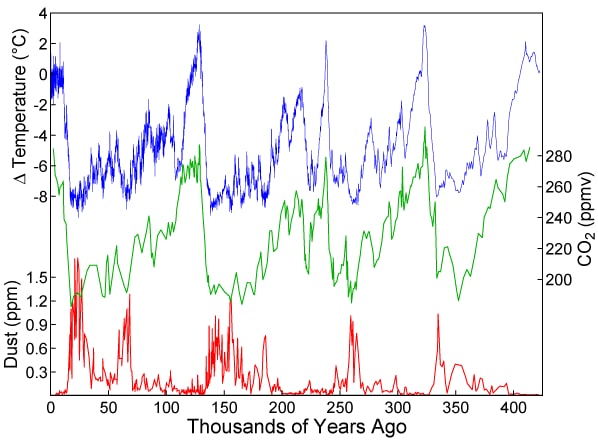
Ice cores provide direct measurements of Earth's CO2 levels for the past 800,000 years, establishing natural cycles from about 180 ppm to 280 ppm.
Why Nothing Else Substitutes
Paleoclimatology — the study of climates before meteorological instruments existed — draws on tree rings, corals, shells, sediments, boreholes, and microfossils, according to Wikipedia's overview. Each has limits. Tree rings give you growing seasons, not atmospheric chemistry. Corals give you ocean temperatures, not air. Sediments give you long timelines with fuzzy resolution. Only ice cores hand you the actual ancient atmosphere. Examining the gases trapped in ice cores is how scientists first learned that carbon dioxide and global temperature have been linked for at least the last million years of Earth's history, per NOAA Climate.gov. That is not a proxy for the atmosphere. It is the atmosphere.[11][3]
The timeline problem is real, though. Air bubbles are younger than the ice around them, sometimes by thousands of years, and nitrogen isotopes in the bubbles help reveal the depth at which air was finally cut off from the atmosphere, according to MIT's Climate Portal. Deeper layers thin as ice flows, eventually making annual layers imperceptible — "as layers thin and thin, you lose the ability to continue to layer-count," as one researcher told MIT. Volcanic ash provides hard anchors. Without them, the chronology drifts.[2]
The Field Season
Collecting the deepest cores, up to 3,000 meters, requires many scientists and technicians and usually a static field camp for a prolonged period, according to AntarcticGlaciers.org. The borehole must be filled with drill fluid — normally a petroleum-derived liquid like kerosene — to keep it open. Ice coring has been around since the 1950s; the International Geophysical Year of 1957–58 triggered several drilling projects, and Soviet teams worked Vostok Station for decades, reaching 3,769 meters.[1][10]
The logistics are brutal, but the scientific payoff is a continuous reconstruction of past climate going back at least 800,000 years, per AntarcticGlaciers.org. The EPICA project pushed past that 800,000-year mark, according to Wikipedia's background entry. The most recent Greenland effort, the East Greenland Ice-Core Project, was originally expected to complete a deep core in 2020 but has since been postponed.[1][11][10]
From the Drill Site to the Policy Table
The path from a frozen cylinder to an international assessment runs through archives. The World Data Service for Paleoclimatology maintains ice core data from polar and low-latitude mountain glaciers worldwide, and the U.S. National Ice Core Laboratory stores, curates, and studies cores recovered from all over the world, according to NOAA's National Centers for Environmental Information. The National Snow and Ice Data Center manages and distributes scientific data from all of Earth's frozen environments. Researchers can search ice core studies by investigator, title, location, parameters, and latitude/longitude bounds — a library of frozen time, open to anyone.[9]
That data does not stay in the lab. Mosley-Thompson and Thompson's research showed glaciers in the Andes and Tibetan Plateau are melting more rapidly than at any point in the past 6,000 years, with serious repercussions for water supply in parts of Peru, Pakistan, China, India, and Nepal, per Ohio State. That is the kind of finding that enters IPCC assessments and national adaptation plans. The Ice Memory Foundation, whose scientific lead is Margit Schwikowski of the Paul Scherrer Institut near Zurich, frames the stakes plainly: knowledge of past climate and environment history obtained through ice cores will continue to guide policy decisions that will ultimately contribute to the well-being of humanity, according to the foundation.[4][13][14]
The Race Against Melt
The archive is leaking. Warming has created meltwater that trickles down through glaciers, washing away trapped aerosols that researchers use as a historical record of forest fires and other environmental events, according to Yale Environment 360. The pace of glacial ice loss has accelerated from a few inches per year in the 1980s to nearly 3 feet per year in the 2010s. When Schwikowski's team attempted a core from Corbassière in the Alps, the core was a failure — the meltwater had already erased the signal.[13]
The Ice Memory Foundation aims to collect cores from 20 glaciers around the world in 20 years and, starting in 2025, store them in an Antarctic ice cave at close to minus 60 degrees Fahrenheit — a natural freezer that will hold them for decades or centuries. Since the program's start in 2015, cores have been taken from eight sites in France, Bolivia, Switzerland, Russia, Norway, and Italy. The foundation describes glaciers as climate and environmental archives jeopardized by ice melting and global warming, and its mission as long-term governance — passing on a heritage of ice cores to future generations.[13][14]
Mosley-Thompson's career spans the arc from first field season to international policy, but the through-line is simpler than that. Ice cores are the closest thing climate science has to a time machine, and the machine is melting. The work now is not just reading the ice. It is deciding what to save before the reading is done.[4][13][14]
Sources
- Ice core basics — antarcticglaciers.org
- When scientists reconstruct ancient climates from ice cores, how do they create an accurate timeline? | MIT Climate Portal — climate.mit.edu
- Climate at the core: how scientists study ice cores to reveal Earth's climate history | NOAA Climate.gov — climate.gov
- Ice Core Paleoclimatology | The Ohio State University — foundationengagement.osu.edu
- Project Ice - Ice Core Analysis and Paleoclimatology — ametsoc.org
- Paleoclimatology: The Ice Core Record — science.nasa.gov
- Intergovernmental Panel on Climate Change (IPCC) | Environmental Sciences | Research Starters | EBSCOhost — ebsco.com
- Evidence - NASA Science — science.nasa.gov
- Ice Core | National Centers for Environmental Information (NCEI) — ncei.noaa.gov
- Wikipedia: Ice core — en.wikipedia.org
- Wikipedia: Paleoclimatology — en.wikipedia.org
- For whom and by whom is glaciology? | Journal of Glaciology | Cambridge Core — cambridge.org
- The Race to Save Glacial Ice Records Before They Melt Away - Yale E360 — e360.yale.edu
- Ice Memory Foundation — ice-memory.org
- Analyzing Ice Cores: 150000 Years of Climate History — amnh.org
Reported with AI assistance using internet sources.