The Great Pacific Garbage Patch: A Floating Island of Plastic and the Race to Clean It Up
Twice the size of Texas, the Great Pacific Garbage Patch is growing faster than expected—and a Dutch nonprofit is racing to clean it up, one net at a time.
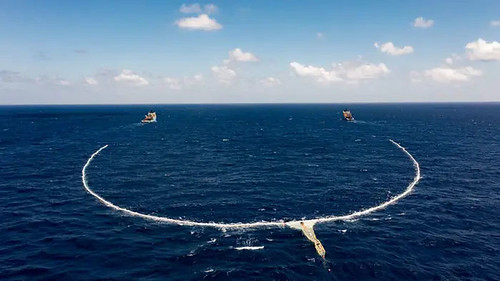
Somewhere between Hawaii and California, an estimated 1.6 million square kilometers of ocean holds a floating debris field that has grown to twice the size of Texas. The Great Pacific Garbage Patch is not a solid island; it's a diffuse soup of plastic—some pieces large enough to snag a fishing boat's propeller, most smaller than a grain of rice. As of 2018, researchers from The Ocean Cleanup project estimated the patch contains between 45,000 and 129,000 metric tons of plastic. [1][11][1][11]
The patch is not a single blob but two distinct zones: the Eastern Garbage Patch, between California and Hawaii, and the Western Garbage Patch, near Japan. Ocean currents—the North Pacific Gyre—trap debris in a slow whirlpool, where it can linger for decades. [3][12][3][12]
A Growing Problem: More Plastic, Faster Fragmentation
The patch is not just big; it's growing. A seven-year study published by The Ocean Cleanup's research team found that the concentration of plastic fragments (0.5–50 mm) in the patch increased from 2.9 kg per square kilometer in 2015 to 14.2 kg per square kilometer in 2022—a nearly fivefold jump. The rise in small fragments is outpacing the increase in larger items, suggesting that plastic is breaking down faster than previously thought. [7][8][7][8]
What's driving this? The study estimates that 74% to 96% of the small fragments are new to the region, not merely the result of larger items degrading in place. That means new plastic is pouring in from somewhere—and that somewhere is mostly rivers. Between 1.15 and 2.41 million tonnes of plastic waste enter the ocean from rivers each year, with the top 20 polluting rivers, mostly in Asia, accounting for 67% of the global total. [5][7][5][7]
The patch is believed to have increased '10-fold each decade' since 1945. [1]
The scale of the problem is staggering. An estimated 11 million metric tons of plastic waste enter the ocean annually; if significant measures aren't taken, that figure could nearly triple to 29 million metric tons per year by 2040. Only about 9% of all plastic ever produced has been recycled. [4][16][4][16]
The Cleanup Race: Systems, Interceptors, and AI
Leading the cleanup charge is The Ocean Cleanup, a Dutch nonprofit that has been developing technologies to tackle the patch since 2013. Their approach has two prongs: large offshore collection systems for the open ocean and river interceptors to stop plastic before it reaches the sea. [10][10]
The offshore systems have evolved through several iterations. System 001, deployed in 2018, failed to retain plastic due to speed issues. System 002, nicknamed "Jenny," gathered 28,000 kilograms of trash in October 2021. The current System 03, deployed in May 2023, is a 2,250-meter-long barrier with a retention zone and a mesh size of 15 mm, designed to allow marine life like fish and turtles to escape. [10][10]
By the end of 2024, The Ocean Cleanup had removed more than one million pounds (about 454,000 kilograms) of trash from the patch—just 0.5% of the total accumulated debris. As of 2026, the organization reports removing over 60 million kilograms across all its projects, including rivers. [1][10][1][10]
In 2025, the nonprofit partnered with Amazon Web Services to use artificial intelligence, machine learning, and cloud computing to detect, predict, and extract plastic at scale. Numerical modeling has long been essential for pinpointing accumulation hotspots. [8][8]
River interceptors have proven particularly effective. In Guatemala's Rio Las Vacas, the organization's Trashfence site removed 10,000,000 kilograms of trash in its first year. Other deployments include Indonesia, Malaysia, the Dominican Republic, and the United States. [10][10]
Does Cleanup Actually Help? The Science Says Yes—With Caveats
A 2024 study in Scientific Reports evaluated the environmental impact of cleaning the North Pacific Garbage Patch, using The Ocean Cleanup as a case study. The researchers found that marine life is more vulnerable to plastic pollution than to cleanup activities, with average vulnerability scores of 2.3 for macroplastics, 1.9 for microplastics, and 1.8 for cleanup (on a scale where 1 is low and 3 is high). They concluded that an 80% cleanup could reduce macroplastic concentrations to within safe levels for marine mammals and sea turtles. [9][9]
The study also estimated that cleanup-related carbon emissions (0.4–2.9 million metric tons total) are significantly lower than the potential long-term impact of microplastics on ocean carbon sequestration (15–30 million metric tons of carbon per year). However, the authors acknowledged uncertainties regarding effects on air-sea carbon exchange. [9][9]
An 80% cleanup could reduce macroplastic concentrations to within reported safe levels for marine mammals and sea turtles. [9]
But cleanup efforts have faced criticism. Some devices have been shown to harm marine organisms—including fish, crustaceans, and seaweeds—in quantities that can exceed the plastic captured, according to a Georgetown University analysis. The Ocean Cleanup's own systems have encountered mechanical failures, such as System 001 losing collected plastic and Interceptor 001 breaking due to flooding in Jakarta. [10][13][10][13]
The Root of the Problem: What You Can Do
While cleanup is necessary, experts emphasize that reducing plastic waste at its source is the most cost-effective and efficient solution. Roughly 80% of plastic in the ocean comes from land-based sources, with the remaining 20% from marine activities like fishing. Synthetic fishing nets alone make up nearly half the mass of the patch. [1][3][14][1][3][14]
For individuals, the simplest steps are familiar: opt for reusable water bottles and carrier bags, and be more mindful of recycling. A 2026 Marine Conservation Society report notes that most UK householders are uncertain about what can and cannot be recycled. But individual actions, while important, are dwarfed by the need for systemic change—especially in middle-income countries, where most plastic emissions originate. [14][16][14][16]
The Great Pacific Garbage Patch is a visible symptom of a global addiction to single-use plastic. Cleanup efforts like The Ocean Cleanup's are gaining momentum, but they can only do so much. As the patch continues to grow—and fragment into ever smaller, harder-to-catch pieces—the race to clean it up is also a race against time. The most effective cleanup may well be the one that never has to happen: stopping plastic from entering the ocean in the first place. [1][4][13][1][4][13]
Sources
- Great Pacific Garbage Patch - Wikipedia — en.wikipedia.org
- Great Pacific Garbage Patch - Wikipedia — en.wikipedia.org
- Great Pacific Garbage Patch | Environmental Sciences | Research Starters | EBSCO Research — ebsco.com
- Effective Plastic Waste Solutions: Strategies for Reducing Marine Pollution — tontoton.com
- Sources of Marine Plastic Pollution | CMEMS — marine.copernicus.eu
- Ocean pollution and marine debris | National Oceanic and Atmospheric Administration — noaa.gov
- Scientific Publications | The Ocean Cleanup — theoceancleanup.com
- Researching ocean plastic | The Ocean Cleanup — theoceancleanup.com
- Evaluating the environmental impact of cleaning the North Pacific Garbage Patch | Scientific Reports — nature.com
- Wikipedia: The Ocean Cleanup — en.wikipedia.org
- The Great Pacific Garbage Patch — theoceancleanup.com
- What is the Great Pacific Garbage Patch? - Plastic Collective — plasticcollective.co
- The Mega Impact of Microplastics: the Reality of the “Great” Pacific Garbage Patch | Common Home | Georgetown University — commonhome.georgetown.edu
- How to reduce ocean plastic pollution in 2026 | Marine Conservation Society — mcsuk.org
- Global marine plastic pollution: Sources, distribution, implications on human health and mitigation strategies — sciencedirect.com
- Ocean Plastic Pollution Explained - The Ocean Cleanup — theoceancleanup.com
Reported with AI assistance using internet sources.