The $200 Boot and the $40 Boot: A Decade-Long Math Problem
A good pair of boots is a lesson in materials science, labor economics, and the difference between repairable and disposable design.
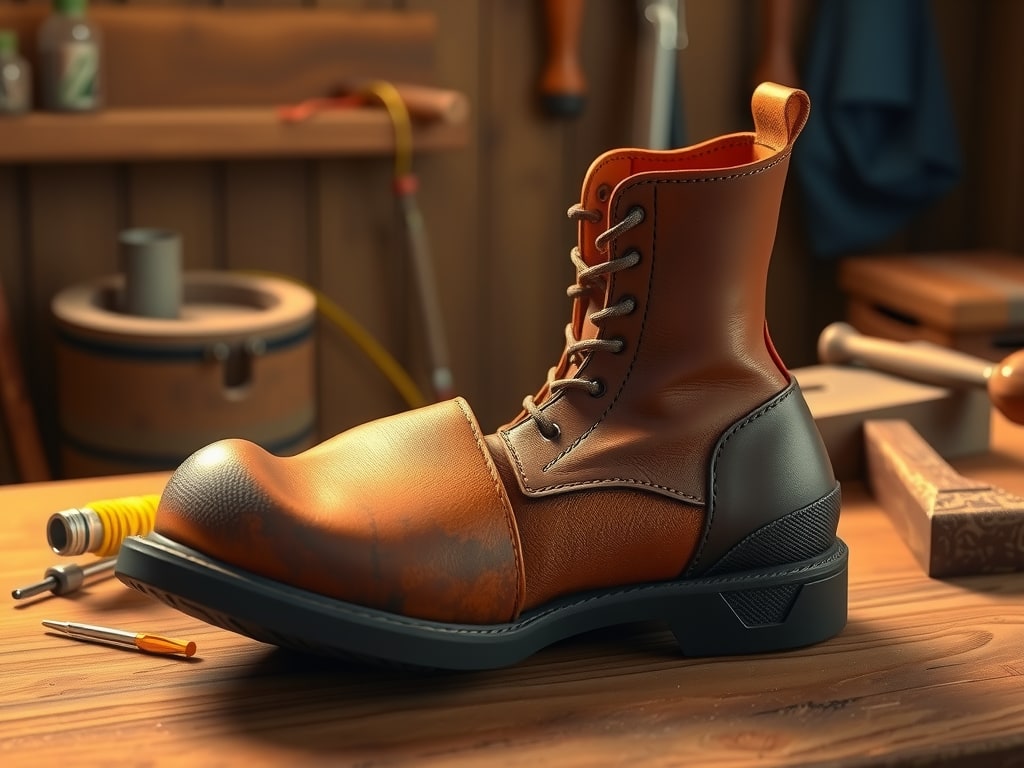
A cobbler can split the sole of a cheap cemented boot lengthwise, peel off the worn part, and glue on a new slab. According to Stridewise, it is imprecise, laborious work most cobblers will not take. That single sentence explains why the boot you bought for $40 is already landfill, and the boot you bought for $200 is still on its first outsole — and why the real price of anything durable is never the sticker.[9]
Stitches vs. Glue: The Line Between Repairable and Disposable
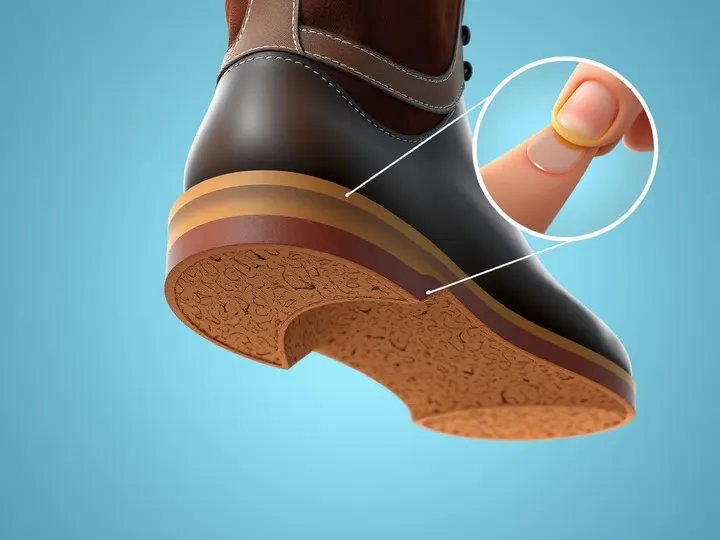
Almost every shoe on a discount rack is cemented: the upper is glued to the sole. Thursday Boot Company's blog calls cementing the most common footwear manufacturing method, and notes that once a cemented sole wears down, resoling is not a viable option — the boot is thrown out. Stridewise adds the tell: if a boot is labeled waterproof — distinct from water resistant — it is almost certainly cemented. Cemented boots are cheaper to make, flexible, and often more comfortable out of the box. They are also a one-way ticket.[2][9]
The alternative is stitching. Blake stitching sews the upper to the sole with stitches made inside the boot, directly under the footbed. That makes it technically resoleable, but harder to repair than a Goodyear welted shoe, and not waterproof. Goodyear welting uses two sets of stitches: the upper is stitched to a leather welt, and the outside of the welt is stitched to the outsole. The welt itself is a strip of leather, rubber, or plastic running along the perimeter of the outsole. In the classic construction, the welt connects to the upper and insole via a raised ridge around the bottom outside edge of the insole, usually reinforced with a canvas-like rib called gemming cemented to the back of the ridge. The cavity is filled with cork or foam or leather strips, and the outsole is stitched to the welt.[1][2]
That architecture is why a welted boot can be resoled repeatedly as long as the upper remains viable, and why it resists water penetration into the insole. It is also why it costs more. Wikipedia notes that welted shoes are more expensive to manufacture than mass-produced shoes with molded soles. The welt does not guarantee the grade of calfskin above it, the lining inside it, the finishing on it, or the elegance of the last beneath it, according to Cobbler Union. But it does guarantee the boot can be born again.[1][8]
“Any true Goodyear welted shoe — at any price — gives you a shoe that holds its shape, wears in rather than out, and accepts a new sole when needed.” — Cobbler Union
The Hide You Can’t See
Full-grain leather is the outermost layer of the hide — the strongest and most durable part of the skin. It is not sanded or buffed, so it keeps its original surface and develops a patina over time. Maverick Leather Company notes it may cost more because sorting hides for unaltered use is time-consuming. Corrected-grain leather takes the opposite route: the surface is heavily sanded to remove scars, then often embossed with a faux grain. BestLeather.org calls it cheaper than full-grain and almost as durable, but the processing makes it less breathable, less supple, prone to cracking, and incapable of developing a patina. Top grain and corrected grain are both thinner than full grain, and therefore lacking in strength. Genuine leather — the bottom of the barrel — is heavily processed from lower layers and will crack and wear out more quickly.[4][5]
Corrected leather is the most widely used leather in the world, because flawless hides are rare and expensive. That is the quiet trade-off in every sub-$100 shoe: you are buying a surface engineered to look like leather, not a material engineered to last like leather.[4]
The Machine That Made the Math Work
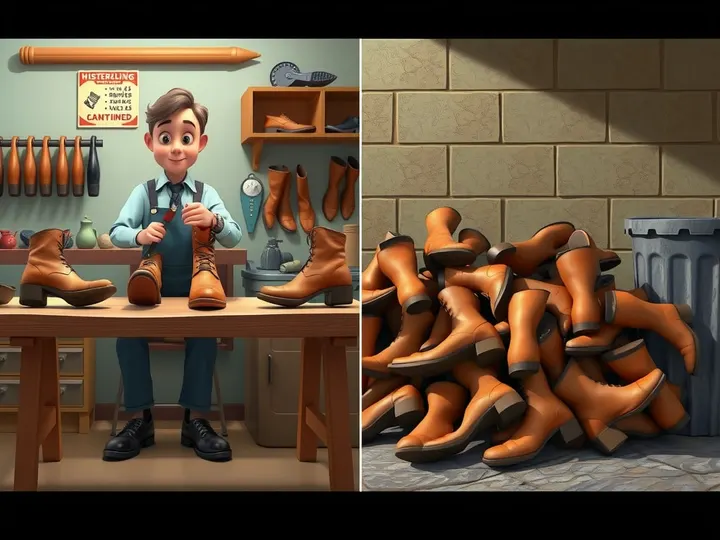
Goodyear welting is not a craft secret; it is a 19th-century industrial hack. August Destouy invented the first machine for sewing welted construction in 1862. James Hanan of Hanan & Son patented the method but his small company lacked the financial muscle to bring machine stitching to a broader market. Charles Goodyear Jr. streamlined and improved Destouy’s work, and the Goodyear machine appeared in 1876. It could also sew turnshoes, but it became a success mainly for welt stitching. By the end of the 19th century, shoemaking had been almost completely mechanized, with production in large factories. The welt survived because the machine made it cheap enough to keep.[3][7]
Today, a genuine Goodyear welted shoe can be bought for $200 — or $500, or $900. Cobbler Union’s value guide places Meermin from $225 and Berwick 1707 from $260 under $300, with real welt construction, leather soles and linings. In that band, the calfskin is a grade down, creases more visibly, and takes less depth of finish; factory finishing is simpler, with little to no hand-burnishing. At $400–$500, Cobbler Union loafers are $465 and oxfords and derbies $490, TLB Mallorca’s main collection starts at $445, and Allen Edmonds lists around $450. The welt is the floor, not the ceiling.[8]
The Labor Behind the Price Tag
Domestic production carries a premium of $300 to $3,000 per unit compared to international alternatives, according to Trisonwells. American factories operate under the Fair Labor Standards Act, guaranteeing minimum wage and overtime protections; small manufacturers face compliance costs of $50,100 per employee annually. Vietnam and Mexico deliver production at one-eighth U.S. rates, while Thailand drops to one-tenth. Container shipping handles 99% of goods entering the United States and takes two weeks to two months. Pivot International adds that U.S. manufacturers generally have higher and better-enforced labor standards, and that international manufacturers are equipped to produce high-volume orders in a single round while U.S. shops often are not.[11][12]
The macro picture is messier. A USITC report notes that in 1982 U.S. multinationals had 30% of their labor force in foreign affiliates, rising to 60% by 2014. U.S. manufacturing employment fell from almost 20 million in 1980 to a little over 12 million in 2017. The ratio of nonproduction to production workers rose from 35:100 in 1980 to almost 45:100 in 2011, and the wage premium for nonproduction workers grew from 50% to 85%. The literature has generally found the net effect of offshoring on domestic employment to be either zero or only mildly negative. That is the economics inside the boot: the stitching is cheap, the labor is not, and the difference shows up in whether the sole can be replaced.[6]
The Decade Math — and the Logic Beyond Boots
Run the numbers. A $40 cemented boot cannot be resoled once the sole is worn down, so it is thrown out. Over ten years, that is $200 to $400 — plus the quiet cost of replacing them, and the waste. A $250 Goodyear welted boot, resoled once or twice at $60 to $100 a pop, costs $370 to $450 over the same decade and ends the decade still a boot. The cheap version is not cheaper. It is just paid in installments.[9][8]
The same logic travels. A chair with a screwed-and-glued joint is a cemented sole; a chair with mortise-and-tenon joinery is a welt. A tool with a potted motor is disposable; a tool with replaceable brushes and a standard chuck is repairable. The test is always the same: can the wear part be separated from the structure without destroying the structure? If yes, you are buying years. If no, you are renting them. The bootmakers figured this out in 1862. The rest of us are still catching up.[1][3]
Sources
- Goodyear welt - Wikipedia — en.wikipedia.org
- What is Goodyear Welt Construction? – Thursday Boot Company — blog.thursdayboots.com
- History – The Goodyear welted shoe construction – Shoegazing.com — shoegazing.com
- What Is Corrected Grain Leather? - BestLeather.org — bestleather.org
- The Story of Leather Grains, Textures, and Finishes: A Comprehensive Guide - Maverick Leather Company — maverickleathercompany.com
- THE EFFECTS OF OFFSHORING ON DOMESTIC WORKERS: — usitc.gov
- Wikipedia: Shoemaking — en.wikipedia.org
- Best Goodyear Welted Shoes Under $500: An Honest Value Guide (2026) - Cobbler Union — cobbler-union.com
- Which Boots Can Be Resoled? Cemented, Blake Stitch, Goodyear Welted, & More | Stridewise — stridewise.com
- When To Replace, Repair or Resole Luxury Shoes – A Fine Pair of Shoes — afinepairofshoes.co.uk
- Domestic vs International Manufacturing: The Truth About Hidden Costs in 2025 — trisonwells.com
- International vs Domestic Manufacturing » Pivot International — pivotint.com
- Domestic Wages and Offshoring by US Firms (Avi, Ann, ... — nber.org
Reported with AI assistance using internet sources.