The Country That Runs on Corn
In Mexico, maize is a calendar, a deity and a currency — and a 9,000-year-old food culture now squared off against a trade panel in Washington.
MEXICO CITY — The oldest maize pollen ever found, roughly 8,700 years old, came out of the Balsas Valley in Mexico, the region scientists consider the cradle of maize domestication. Everything that followed — the tortilla, the tamale, the pozol, the trade dispute — grew from that dust. Maize was domesticated by Indigenous peoples in southern Mexico about 9,000 years ago from a wild grass called Balsas teosinte, according to the science-history resource Earth@Home. The grain that now feeds the world started as a project in one valley.[7][8]
For a long time, it was a side dish. Analysis of human remains from Mesoamerica indicates maize only became a significant part of some peoples' diets between about 4,700 and 4,000 years ago, shifting to a dietary staple after 4,000 years ago, per Earth@Home. Once it did, it built empires. Maize nourished the Olmec, Maya, Aztec and Inca civilizations, and because it was nutritious, easy to store and carry, and adaptable to diverse growing conditions, it became a staple food for cultures across the Americas.[7]
A Grain With a God and a Calendar
In pre-Columbian Mesoamerica, maize was deified as a maize god and depicted in sculptures, according to Wikipedia's overview. The Popol Vuh, the sacred Mayan text, says the gods tried mud, then wood, then got it right: they created the first human from a dough of yellow and white corn, as the travel publisher Royal Caribbean's heritage write-up recounts. The link between plant and people led Mesoamericans to consider themselves "the men of corn."[1][2][8]
Corn shaped more than theology. Mayan culture was heavily influenced by corn — religion, astrology, marriage ceremonies, burial ceremonies — and the Maya developed vast cornfields around their stone cities, hand-selecting the best seeds to begin the slow domestication process, per Royal Caribbean. In some ceremonies, women drank Saka, a non-alcoholic beverage made of cooked corn, according to the Mesoamerican research group FLAAR. From corn derived a large part of the economic, social and religious characteristics of the Mesoamerican peoples, FLAAR notes. The crop was cultivated in the milpa system alongside beans, squash, sweet potatoes, yuca and chili — a polyculture Native Americans also planted as the Three Sisters, with beans and squashes, per Wikipedia.[1][2][8]
Its dietary weight was such that it can be identified as one specific factor in the transition from nomadic hunter-gatherer societies to sedentary producers, FLAAR writes. Agriculture and a whole civilization were constructed around this crop, according to the Satoyama Initiative, which studies socio-ecological landscapes.[2][6]
The Chemistry That Made the Tortilla
Here is the part most of the world gets wrong about corn. Untreated ground maize cannot form a dough with water. Nixtamalized cornmeal can — it forms a dough called masa, according to Wikipedia's entry on nixtamalization. The process is exactly what it sounds like to a chemist and nothing like it to a cook: the grain is soaked and cooked in an alkaline solution, usually limewater, then washed and hulled. Nixtamalization was invented in ancient Mesoamerica over 3,500 years ago, and the alkali of choice in the region is calcium hydroxide, or slaked lime, per the food-science blog Cooking Issues.[5][9]
The word itself is Nahuatl, a compound of nextli ("ash") and tamalli ("unformed or cooked corn dough, tamal"), per Wikipedia. The earliest evidence of the practice turns up on Guatemala's southern coast, with equipment dating from 1200 to 1500 BCE. The Aztec and Maya developed it using slaked lime and lye to create alkaline solutions.[9]
Nixtamalized corn has an amazing aroma and flavor, which is why a tortilla doesn't taste like plain cornmeal.
The chemistry is also a public-health story. Mature corn is deficient in available niacin — it contains plenty of bound niacin, and alkali processing releases it, Cooking Issues explains. Nixtamalization makes the tryptophan in corn proteins more available for human absorption, helping prevent niacin deficiency, or pellagra, per Wikipedia. It also increases calcium availability, making tortillas a natural source of the mineral; if calcium hydroxide is used, the calcium content of the corn skyrockets, and nixtamalized corn becomes the primary source of calcium for many people who eat tortillas as a staple. The process reduces mycotoxins by up to 97 to 100 percent.[4][5][9]
Which is why the industrial shortcut matters. Many mass-produced tortillas skip traditional nixtamalization entirely, relying instead on refined corn flours, preservatives and additives to mimic texture and extend shelf life, according to the tortilla maker Mi Niña Tortilla. The flavor difference is not nostalgia. It is chemistry, skipped.[4]
Why Your Tortilla Tastes Like Where It Grew
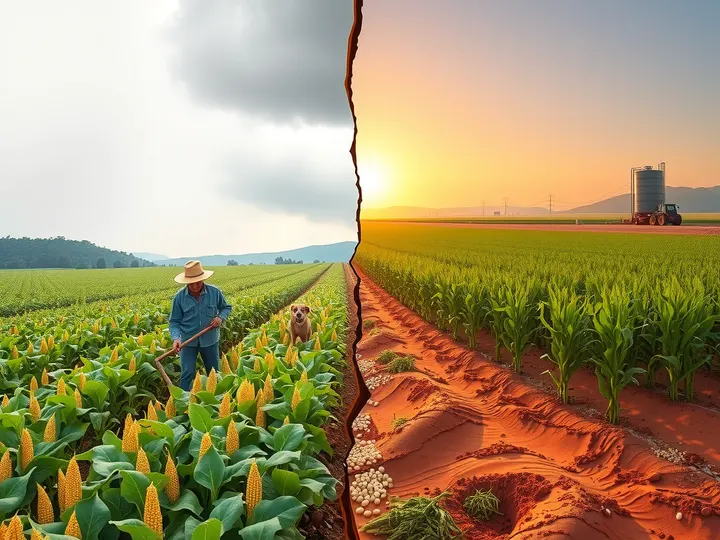
Mexico is the original source of maize and home to a wide biodiversity, and it boasts over 60 native varieties, known as landraces, many in a kaleidoscope of colors with distinct flavor profiles, Reuters reports. A project in the village of Soteapan, in the Santa Marta Mountains of Veracruz, run by the Foundation Semillas de Vida, found 15 variations of native maize, each showing important adaptation to specific climatic conditions, according to the Satoyama Initiative. That exceptional diversity is tied to the special slope agriculture practiced in those mountains and is associated with different food uses — especially the black and dark blue maize preferred for pozol, a traditional drink.[6][12][13]
Soil, altitude and variety are not marketing copy. In Mexico, knowledge about agriculture has been developed around maize, heightened by the crop's especially great capacity to adapt to different climates around the planet, the Satoyama Initiative notes. Maize's cultural importance is highly relevant to understanding Indigenous people's worldview and relationship with nature. A tortilla from Oaxaca and a tortilla from a supermarket freezer aisle are the same species and almost nothing else.[6]
The Trade War Over a Kernel
In February 2023, Mexican President Andrés Manuel López Obrador issued a presidential decree restricting the use of genetically modified corn in tortillas and other minimally processed corn products, to protect public health and the environment, according to the consumer-advocacy outlet U.S. Right to Know. The decree immediately banned GE corn in dough and tortillas and instructed government agencies to gradually eliminate it from other foods and animal feed, per the law firm Bergeson & Campbell. The U.S. government challenged the measures as unfair trade barriers under the U.S.-Mexico-Canada Agreement.[10][11]
The U.S. brought six legal claims under USMCA's Sanitary and Phytosanitary Measures chapter and one under its National Treatment and Market Access chapter. In December 2024, a panel of arbitrators ruled in favor of the United States on all seven claims, finding that Mexico's measures are not based on science and undermine the market access Mexico agreed to provide, per Bergeson & Campbell. Reuters reported the panel found the restrictions violate USMCA's chapters on sanitary and phytosanitary measures and on market access and national treatment, and recommended Mexico comply within 45 days; failure could bring punitive duties on some Mexican exports to the U.S.[11][12]
Mexico's defenders note what the panel did not address. According to U.S. Right to Know, the panel said Mexico did not conduct a "proper risk assessment" according to international scientific principles, and did not comment at all on the robust scientific analysis Mexico presented in defense of its position. On March 2, Mexico published a directive modifying the 2023 decree to comply, rescinding three articles relating to imports, including the restriction of GM corn in tortillas. Three restrictions survived: a ban on cultivating GM corn, a phase-out of glyphosate, and a mandate to trace GM corn entering the country.[10]
The contradiction underneath is stark. Mexico prohibits planting GM corn for fear it would contaminate native strains, yet it is the top foreign buyer of U.S.-grown yellow corn, nearly all of which is genetically modified, Reuters notes. Mexico imports one-third of its maize, per CIMMYT, the international maize and wheat research center. The country that gave the world maize now buys a third of what it eats.[3][12]
What NAFTA Did to the Milpa
The import habit has a start date. By the early 1970s, Mexico began importing corn, mainly from the United States, according to a United Nations analysis of the maize-tortilla chain. In the early 1990s, Mexico's opening economy was integrated with NAFTA and the country moved away from import substitution. Under the agreement, commercial farmers from the U.S. Midwest and Mexico supplied corn and met Mexico's food security — while small and medium Mexican farmers were deemed inefficient and uncompetitive in the world market.[13]
Maize has always been the main staple food of Mexicans and the principal crop cultivated by its farmers for millennia. The legacy can still be tasted in every home-cooked tortilla, per Royal Caribbean. The question the trade panel did not settle is whether a food culture can survive being efficient.[1][13]
Sources
- The Mayan Maize God and the Power of Corn | Royal Caribbean Cruises — royalcaribbean.com
- Maize: The most important crop for The Mayan Culture - FLAAR MESOAMERICA — flaar-mesoamerica.org
- Maize: From Mexico to the world – CIMMYT — cimmyt.org
- The Ancient Process Behind Nixtamalization – Mi Niña Tortilla — mininatortilla.com
- Mesoamerican Miracle Megapost: Tortillas and Nixtamalization — cookingissues.com
- Landrace maize diversity in milpa: a socio-ecological production landscape in Soteapan, Santa Marta Mountains, Veracruz, Mexico - The International Partnership for the Satoyama Initiative (IPSI) — satoyamainitiative.org
- Cultural history of maize - Evolution - Earth@Home — evolution.earthathome.org
- Wikipedia: Maize — en.wikipedia.org
- Wikipedia: Nixtamalization — en.wikipedia.org
- GM corn and glyphosate science: Documents from Mexico-US trade dispute — usrtk.org
- United States Prevails in USMCA Dispute on Genetically Engineered Corn - Bergeson & Campbell, P.C. — lawbc.com
- US wins Mexico GM corn dispute case as panel finds curbs not science-based | Reuters — reuters.com
- Tracing the Maize-Tortilla Chain | United Nations — un.org
Reported with AI assistance using internet sources.