The $460 Million Throwaway: Inside the Global Textile Waste Crisis
Fast fashion has made clothing cheaper than ever, but the true cost is piling up in landfills and washing onto shores across the globe.
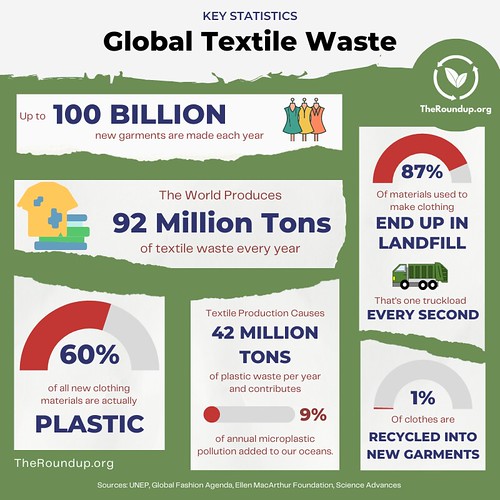
Every second, the equivalent of a rubbish truck full of clothes is dumped into a landfill or incinerator, according to Earth.Org. That's 92 million tonnes of textile waste a year, a figure projected to hit 134 million tonnes by 2030. The fashion industry, once the domain of seasonal collections and tailored fits, now churns out over 100 billion garments annually, most of which end up buried or burned within months of their last wear.[11][3][9]
The equivalent of a rubbish truck full of clothes ends up on landfill sites every second.

The Numbers Behind the Mountain
The scale is staggering. In the United States alone, 11.3 million tons of textile waste hit landfills each year, according to Earth.Org — that's 81.5 pounds per person. The Environmental Protection Agency found that in 2018, 66% of discarded textiles in the U.S. ended up in landfills, with only a fraction recycled. Globally, 85% of all textiles are landfilled or incinerated, per a report from Everywhere Apparel.[11][1][3]
Fast fashion is the engine driving this growth. Consumers now buy 60% more clothing than they did 15 years ago, but keep each piece only half as long. The number of times a garment is worn has dropped 36% in 15 years, with many items worn just seven to ten times before being tossed, Earth.Org reports. Clothing production has doubled since 2000, yet the infrastructure to handle the resulting waste hasn't kept pace.[6][15][11][5]
It's not just the volume that's the problem — it's the materials. Most fast fashion relies on synthetic fibers like polyester, derived from fossil fuels and non-biodegradable, according to Britannica. These plastics can persist in landfills for centuries, slowly breaking into microplastics. A 2024 federal report found that about 60% of textiles contain microplastics, which can leach into soil and groundwater as they decompose, the U.S. Government Accountability Office reported.[2][1]
The Global South: A Dumping Ground
When clothes are discarded in the West, many don't stay there. An estimated 15 times more second-hand clothing is imported into Africa than exported from it, according to a study in the Journal of Circular Economy. Countries like Ghana, Kenya, and Tanzania have become leading importers, receiving shipments from the U.S., Canada, Germany, and China. Much of this clothing ends up in massive markets like Accra's Kantamanto, but a significant portion is unsellable and ends up in open dumps or informal burning sites.[7]
The environmental toll is severe. Textile waste in landfills decomposes anaerobically, releasing methane, a potent greenhouse gas, according to the GAO. Some textiles are treated with PFAS, or 'forever chemicals,' which can leach into water sources as they break down. In developing countries with weak waste management systems, this can poison drinking water and soil, creating public health crises.[1]
The social impact is equally troubling. Fast fashion has long been criticized for exploiting workers in the Global South, where long hours, low pay, and unsafe conditions are common, according to Britannica. The 2013 Rana Plaza collapse in Bangladesh, which killed over 1,100 garment workers, remains a grim symbol of the industry's human cost. But the waste crisis adds another layer: local communities near dumpsites bear the brunt of pollution they had no hand in creating.[2]
Why Recycling Isn't the Answer (Yet)
You'd think all this waste would be a goldmine for recyclers. But the reality is that textile recycling is limited and labor-intensive. Sorting and fiber identification are still done primarily by hand, the GAO notes. In the U.S., the infrastructure to collect, process, and recycle garments at scale is practically non-existent, as Everywhere Apparel points out. And even when clothes are donated, many end up in landfills anyway — charities often can't sell low-quality fast fashion, and some have begun turning it away.[1][3][9]
Industry practices don't help. Pre-consumer waste — offcuts, defective pieces, overproduction — accounts for 10-15% of all fabric wasted in production, according to Everywhere Apparel. And nearly a third of all clothing produced is burnt or trashed before it ever reaches a customer. The business model depends on volume, not durability.[3][6]
What's Being Done — and What You Can Do
Some governments and brands are starting to act. Digital product passports — scannable QR codes that detail a garment's materials, production journey, and disposal instructions — have been proposed to encourage circularity, according to Business Waste. H&M has banned PFAS and invested in recycling programs, though critics accuse such efforts of greenwashing, Wikipedia notes.[12][8]
But systemic change is slow. Federal efforts in the U.S. are uncoordinated, with no national requirements to address textile waste, the GAO found. And while circular economy models show promise — one study in Brazil's energy industry cut textile waste by 2.7 tons through upcycling — they require investment and face quality variability, according to Springer.[1][13]
For consumers, the most effective lever is buying less. Purchasing fewer, higher-quality items that last longer can cut demand for disposable fashion, Britannica advises. Repairing, swapping, and buying second-hand also help. When you do discard, donate responsibly — but remember that even donated clothes often end up in landfills or shipped overseas, so the real fix is upstream.[2]
Consumers lose around $460 million per year simply by throwing away clothes.
The hidden cost of fast fashion isn't just in the price tag — it's in the methane bubbling from landfills, the microplastics in groundwater, and the mountains of second-hand clothes choking markets in Accra and Nairobi. As consumers, we hold the power to slow the conveyor belt. But without stronger policy and industry accountability, the rubbish truck will keep coming, every second, for decades to come.[1][7]
Sources
- Fast Fashion—Great for Your Wallet, Costly for the Planet | U.S. GAO — gao.gov
- Fast fashion | Brands, Environmental Impact, Definition, Companies, History, & Facts | Britannica — britannica.com
- Textile Waste 101: The Truth About Pre- and Post-Consumer Waste — everywhereapparel.com
- Environmental impact of fashion - Wikipedia — en.wikipedia.org
- Frontiers | An overview of the contribution of the textiles sector to climate change — frontiersin.org
- How the fashion industry pollutes our water | FairPlanet — fairplanet.org
- Two Sides of the Same Cloth: Exploring the Second-Hand Clothing Trade in Africa from a Circular Lens | Journal of Circular Economy — circulareconomyjournal.org
- Wikipedia: Fast fashion — en.wikipedia.org
- Wikipedia: Textile recycling — en.wikipedia.org
- Circular Economy and Sustainability of the Clothing ... - PMC — pmc.ncbi.nlm.nih.gov
- 10 Concerning Fast Fashion Waste Statistics | Earth.Org — earth.org
- Fashion Waste Statistics & Facts | Textile & Clothing Waste Facts — businesswaste.co.uk
- Invisible Textile Waste, Circular Solutions: An Action Research Experience in the Energy Industry | Systemic Practice and Action Research | Springer Nature Link — link.springer.com
- Unsustainable fashion and textiles in focus for International ... — unep.org
- How fast fashion is fuelling the fashion waste crisis in Africa - Greenpeace Africa — greenpeace.org
Reported with AI assistance using internet sources.