The Man Who Invented the Future: Nikola Tesla's Visionary Legacy
From AC power to wireless control, Tesla's ideas were dismissed in his time but now underpin modern tech—his story offers lessons in resilience and the cost of genius.
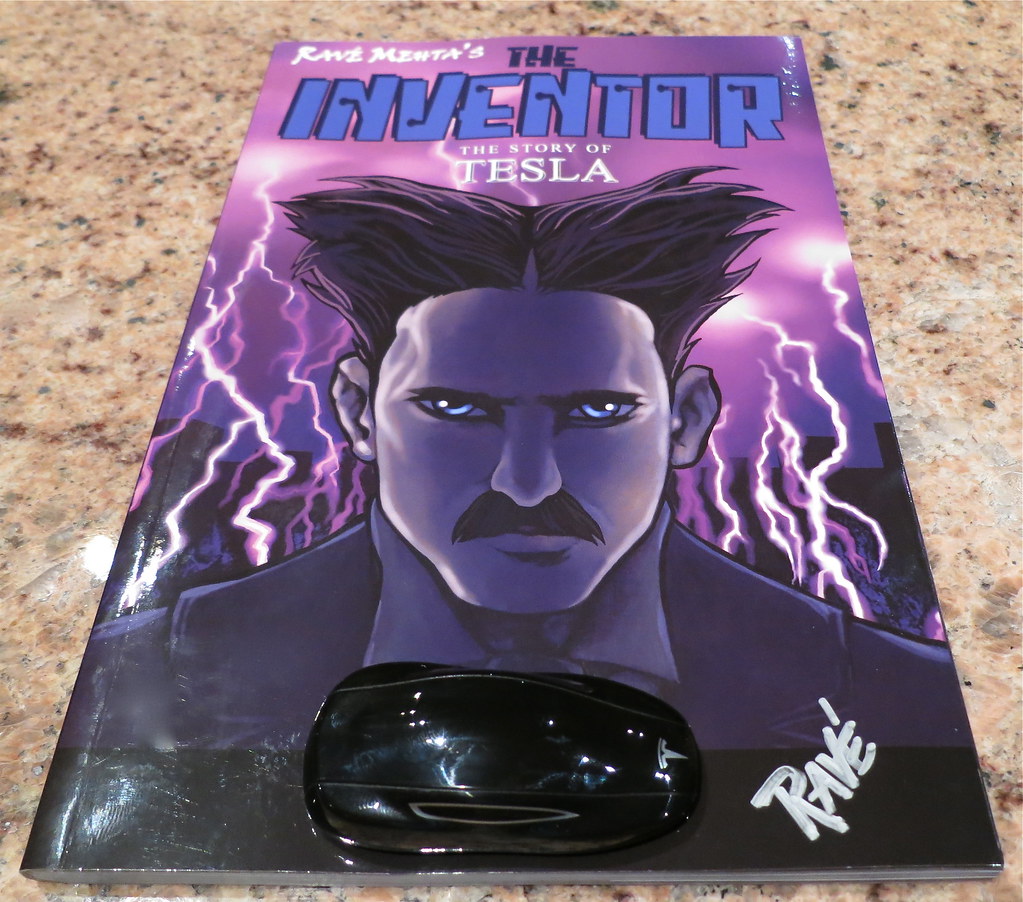
In 1898, at an electrical exhibition in Madison Square Garden, Nikola Tesla steered a small, unmanned boat across a pool of water with a handheld remote control. The crowd was baffled; some suspected a hidden swimmer or trained animal. Tesla corrected a reporter who called it a wireless torpedo: "You do not see there a wireless torpedo, you see there the first of a race of robots, mechanical men which will do the laborious work of the human race" [6]. The invention was so far ahead of its time that observers could not imagine its practical applications [6]. Today, that boat is recognized as the birth of robotics, though Tesla is seldom credited for it [6].[6]
The Mind That Built Worlds
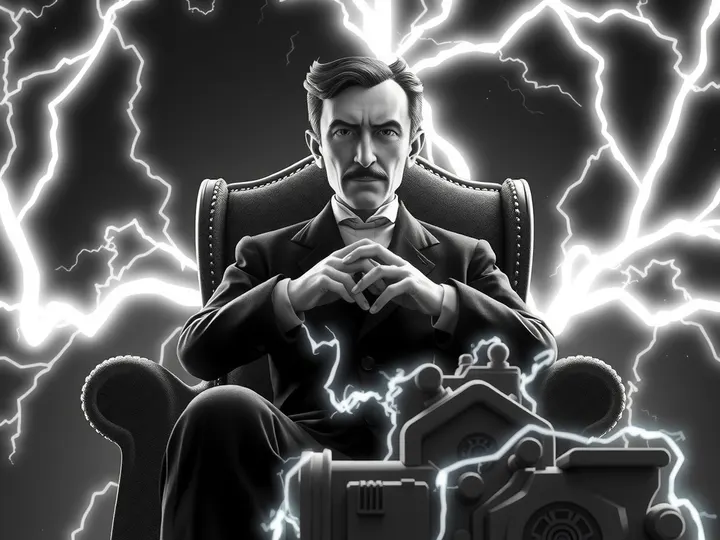
Tesla's method was as unusual as his results. In his autobiography, he described building inventions in his mind before committing them to hardware, a process he likened to high-fidelity simulation [1]. He would visualize the device, run it mentally, and only then build a physical prototype. This approach allowed him to design the alternating-current (AC) induction motor in 1888, a breakthrough that made long-distance power transmission practical [2][9]. His AC system, including the polyphase patents licensed by Westinghouse, became the cornerstone of modern electrification [9]. Today, AC is the standard for power generation and distribution worldwide, enabling the electrification of homes, industries, and cities [11].[1][2][9][11]
But Tesla's genius extended far beyond power. In 1891, he invented the Tesla coil, an induction coil still used in radio technology and education [2][11]. He pioneered radio communication, filing key patents as early as 1897—years before Guglielmo Marconi's work—and in 1943, the U.S. Supreme Court recognized Tesla's earlier patents, invalidating Marconi's [4][11]. His experiments with high-frequency electricity laid the foundation for wireless technologies, including WiFi and Bluetooth, through patents like "System of Transmission of Electrical Energy" and "Art of Transmitting Messages" [4]. He also developed early versions of fluorescent and neon lights, demonstrated at the 1893 World's Columbian Exposition [11].[2][4][11]
"You do not see there a wireless torpedo, you see there the first of a race of robots, mechanical men which will do the laborious work of the human race."
The War of the Currents
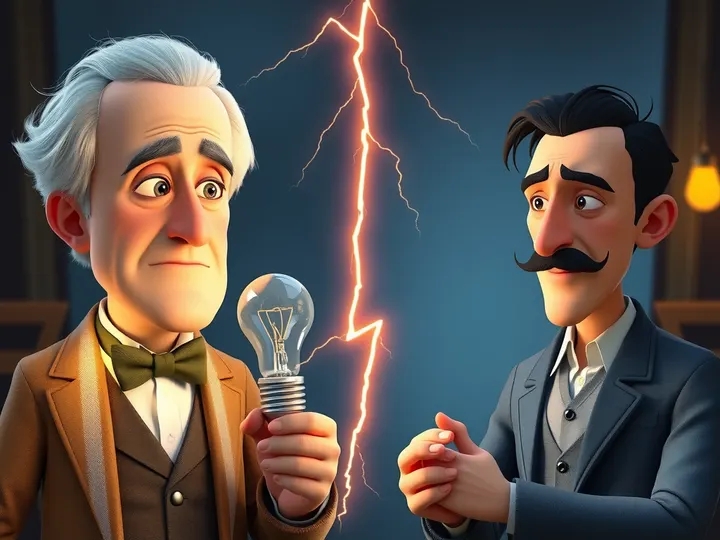
Tesla's rivalry with Thomas Edison defined his career and public perception. After immigrating to the U.S. in 1884, Tesla worked briefly for Edison, but their visions clashed: Edison championed direct current (DC), which was strong but couldn't travel far, requiring power plants every mile [13][14]. Tesla saw the potential of alternating current, which could be stepped up and down by transformers, allowing efficient long-distance transmission [7]. The conflict, dubbed the "War of the Currents" by newspapers, was a battle of ambitions, beliefs, and money [15].[13][14][7][15]
Edison, with a vested interest in DC, launched a smear campaign, publicly killing animals with AC to prove its danger and even helping design the first electric chair using AC [10][13]. Despite this, Tesla's AC system won key contracts: the 1893 World's Fair in Chicago and the Niagara Falls hydroelectric project, which sent electricity over 20 miles to Buffalo, New York [13][10]. The success of these projects established AC's superiority, and by 1892, Edison's company had merged with Thomson-Houston to form General Electric, effectively ending the war [10]. The last DC utility in New York City was shut down in 2007 [10].[10][13]
The Fall and the Mad Genius
Despite his technical victories, Tesla's financial downfall was as dramatic as his rise. He lacked entrepreneurial instinct, giving away patents to Westinghouse and handing J.P. Morgan 51% of his patents when only 50% was asked [8]. His grandest project, Wardenclyffe Tower, aimed to provide global wireless energy and communication, but Morgan refused additional funding after Tesla revealed his plans for wireless power delivery [4][12]. The project was abandoned in 1906, and Tesla, having spent most of his money, lived in a series of New York hotels, leaving unpaid bills [9][12].[8][4][12][9]
In his later years, Tesla's mental health struggles worsened, and he became a caricature of the mad scientist [8]. He proposed inventions that seemed impossible, like a particle beam weapon called "Teleforce" or "Death Ray," and a supersonic aircraft that would travel eight miles above Earth [11][12]. He even believed it was possible to photograph thoughts [12]. While many of these ideas were never built, some influenced later research, such as directed-energy weapons [11].[8][11][12]
Legacy Reassessed
Tesla's work fell into relative obscurity after his death in 1943, but his reputation has surged in recent decades. In 1960, the General Conference on Weights and Measures named the SI unit of magnetic flux density the tesla in his honor [9]. Today, his legacy is celebrated worldwide: the Nikola Tesla Museum in Belgrade, the Memorial Center in Smiljan, the Tesla Science Center at Wardenclyffe, and Nikola Tesla Corner in New York [5]. Exhibitions like "Nikola Tesla: Yours is the Future" have further cemented his posthumous recognition [8].[9][5][8]
The reassessment reflects a cultural shift: as we live in a world of wireless everything, Tesla's foresight seems prophetic. His remote-controlled boat, once dismissed, is now seen as the precursor to drones and robotics [6][11]. His AC system is the backbone of the grid [11]. His wireless power vision, though unrealized, underpins modern technologies like WiFi and Bluetooth [4]. Tesla's story is a reminder that breakthrough engineering is rarely a straight line; it is contested, negotiated, and often deeply personal [1].[6][11][4][1]
Lessons for Innovators
For contemporary innovators, Tesla's life offers both inspiration and caution. His method of mental prototyping shows the power of visualization, but his failure to commercialize his ideas highlights the need for advocacy, strategic partnerships, and practical deployment [1]. Tesla's experiences illustrate that a superior technical solution still requires business acumen—something he lacked [8]. Yet his resilience in the face of ridicule and financial ruin is a testament to his conviction.[1][8]
Sources
- [Review] My Inventions: The Autobiography of Nikola Tesla (Nikola Tesla) Summarized — youtube.com
- Nikola Tesla | Biography, Facts, & Inventions — britannica.com
- Medium — solitaryresearcher.medium.com
- Nikola Tesla And The Lost Technologies Of A Visionary — quantumzeitgeist.com
- Nikola Tesla - GNS Wireless — gnswireless.com
- PBS: Tesla - Master of Lightning: Race of Robots — pbs.org
- Not-So-Epic Battles of History: Nikola Tesla vs. Thomas Edison | Science Focus — sciencefocus.hkust.edu.hk
- Nikola Tesla, the genius inventor in the shadow of Thomas Edison - Rincón educativo — rinconeducativo.org
- Wikipedia: Nikola Tesla — en.wikipedia.org
- Wikipedia: War of the currents — en.wikipedia.org
- Nikola Tesla Inventions — teslasciencecenter.org
- 6 Brilliant Tesla Inventions That Never Got Built | HISTORY — history.com
- Tesla vs. Edison: Battle of the Currents | The Current Wars — youtube.com
- Tesla versus Edison: The electricity wars | Endesa — endesa.com
- The Current Wars — edison.rutgers.edu
Reported with AI assistance using internet sources.