The Grid That Talks Back: How Household Batteries Became a Power Plant
Millions of garages now hold batteries that utilities can summon like a peaker plant — here's how the money, the risk, and the blackout math actually work.
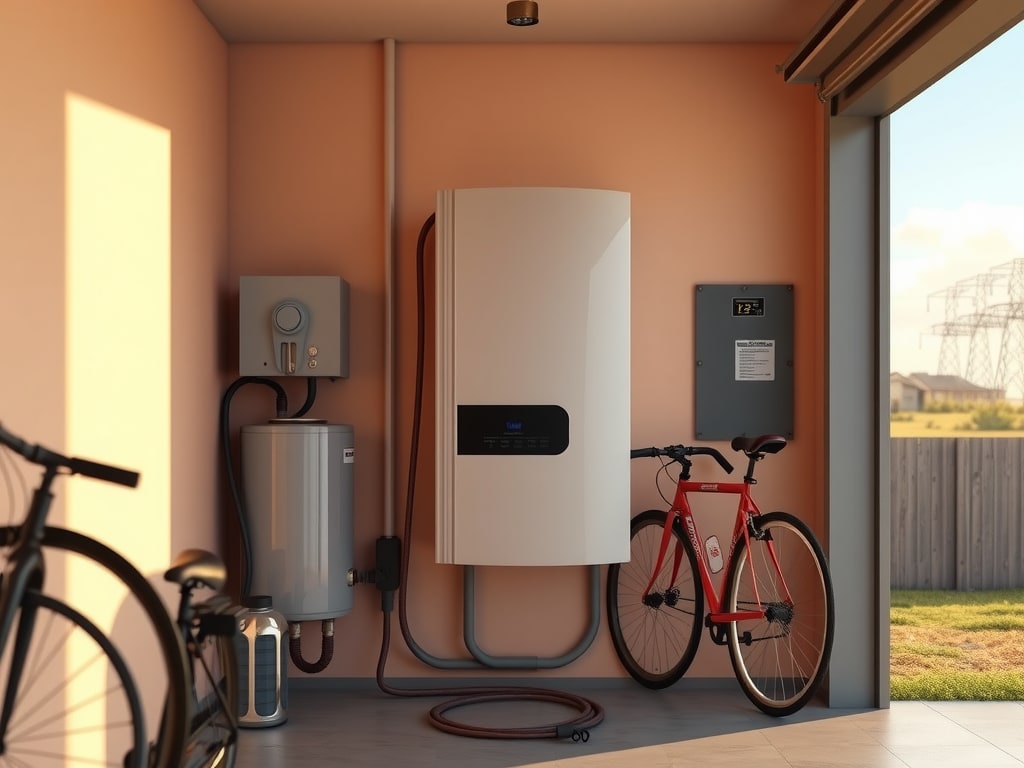
On the evening of June 24, 2025, a heat wave sat on New England like a wet blanket. Grid operators braced for the worst. Then something unusual happened: instead of firing up another gas plant, the regional grid got 5 gigawatts of support from thousands of home batteries and smart devices working in concert. Mark Christie, chair of the Federal Energy Regulatory Commission, later called that aggregated fleet — a virtual power plant — a critical resource in meeting demand, according to the Solar Energy Industries Association. No outage.[4]
What a VPP Actually Is (and Isn't)

A virtual power plant is a network of distributed energy resources — rooftop solar, home batteries, EV chargers, smart thermostats, water heaters — aggregated and coordinated by software to function like a single conventional power plant. The 'virtual' part is literal: there is no central physical facility, no turbine hall, no cooling tower. The units can be producers, storage, consumers, or power-to-X plants, linked and operated by one centralized control system. That control system uses an algorithm to respond to balancing-reserve commands from transmission operators and to grid conditions, just as a larger conventional plant does.[1][3][11]
The concept is not new. The first VPP ideas emerged in the late 1990s as power markets liberalized, but remained mostly theoretical for years. What changed is the hardware: millions of lithium-ion home batteries, controlled by intelligent software, now sit connected to the internet and can be ordered to provide short-term services — demand response during peak hours, frequency correction to keep mains within regulatory tolerances. Aggregated, those small units get access to lucrative markets like balancing reserve that were previously closed to households.[1][10]
A new 400-megawatt VPP would have a net cost of $43 per kilowatt-year. A gas peaker plant: $99 per kilowatt-year.
The Money: Who Pays Whom, and How Much
The pitch to homeowners is straightforward: you buy or lease a battery, and the utility or a third-party aggregator pays you for the right to dispatch some of its stored energy during peak events. Massachusetts runs the strongest residential program in the country through ConnectedSolutions, administered by Eversource, National Grid, and Unitil, paying $225 per kilowatt for summer dispatch and $50 per kilowatt for winter dispatch. In Vermont, Green Mountain Power offers customers up to $10,500 in assistance to lease a Tesla home battery at a discounted rate or buy their own, provided they agree to share stored energy with the utility as required. Tesla's VPP with Pacific Gas and Electric pays Powerwall owners an average of $350 per unit during summer season.[3][5][11]
The economics for utilities are just as compelling. The Department of Energy projected that a new 400-megawatt VPP would have a net cost of $43 per kilowatt-year, while a gas peaker plant would cost $99 per kilowatt-year. One study found that deploying 60 gigawatts of VPP capacity nationwide could directly save ratepayers between $15 billion and $35 billion in infrastructure costs over the next 10 years. The Brooklyn-Queens Demand Management program in New York invested $200 million in distributed energy solutions instead of $1 billion in traditional infrastructure — an 80 percent cost reduction for the same reliability outcomes, according to Avanza Energy. VPPs can be as dependable as conventional plants while costing 40 to 60 percent less, per Wikipedia's overview — though that figure should be treated as a broad industry claim rather than a single audited number.[4][9][13]
The Risks: Degradation, Defection, and Cyber
Every dispatch cycle puts wear on a battery. Home energy storage devices rely on lithium-ion cells that degrade with use, and while some manufacturers — Nissan, BMW, and Powervault among them — repurpose used EV batteries for home storage, lithium-ion packs remain difficult to recycle compared with lead-acid, of which 99 percent sold in the US get recycled. The cybersecurity surface is also real: these batteries are connected to servers via the internet, and a VPP is only as secure as its weakest communications link.[10]
There is a structural risk, too. As more consumers pair solar with home batteries and defect from the grid entirely, the cost of maintaining the grid gets spread across fewer customers, raising prices for those who remain — which in turn makes going off-grid more attractive.[10]
Who's Leading, and What's Gone Wrong
California is the undisputed leader, with 140 of the nation's more than 500 operational VPP projects. Sunrun's CalReady system connects more than 56,000 homes across the state, capable of delivering up to 375 megawatts to the grid. On July 29, 2025, PG&E ran a statewide test in which a VPP comprising Tesla and Sunrun batteries delivered 535 megawatts over a two-hour period. A recent analysis suggests California could deploy over 7,500 megawatts of VPP capacity within the next decade — more than the total peak demand of Los Angeles. In 2024 alone, 38 states plus Washington, DC took 105 VPP-related policy actions.[11][13]
Not every story is a win. The 2024–2025 bankruptcies of Sunnova, which carried $10.67 billion in debt, and Swell Energy, despite $120 million from SoftBank, were failures of specific business models rather than the VPP concept itself, according to Avanza Energy.[13]
What It Means for Your Bill and Your Blackout Risk
For ordinary consumers, VPPs cut both ways. If you own a battery and enroll, you can earn $80 to $225 per kilowatt of capacity per season, credited to your utility bill or paid directly — real money for hardware you already bought. If you do not own a battery, you still benefit from the grid-level savings: fewer peaker plants means lower infrastructure costs spread across all ratepayers. During a 2025 heat wave in Vermont, 275,000 customers collectively saved about $3 million thanks to Green Mountain Power's VPP. And blackout risk falls when thousands of batteries can shave peak demand — the June 24, 2025 event in New England is the proof of concept.[4][5]
But not everyone is covered. Pennsylvania, for instance, has no VPP program yet, so battery value there comes from time-of-use arbitrage and backup power alone. Participation is voluntary and events are usually short — often 30 to 90 minutes — with opt-in, pause, or opt-out controls directly from an app. That flexibility is the selling point, but it also means the grid cannot count on every battery every time. The reliability math works at scale, not at the level of any single home.[5][8]
The Regulatory Missing Piece
The single biggest unlock came in 2020, when FERC Order 2222 enabled distributed energy resources to bid directly into wholesale markets. But implementation has been uneven, and most households still cannot participate without an aggregator. The Department of Energy's 2025 VPP Liftoff Report Update notes that VPPs can be deployed in under six months to maximize existing grid infrastructure, and that scaling them to serve about 20 percent of peak demand would be the fastest, cheapest way to increase grid capacity — a number that matters because US peak demand is projected to reach roughly 900 gigawatts by 2030. The report showcases over 75 case studies of solutions in action. Only 19.5 percent of distributed energy resources are enrolled in VPP programs today, according to Avanza Energy, which means the quiet energy shift is still mostly potential.[9][13][15]
Sources
- How a Virtual Power Plant Works — next-kraftwerke.com
- Evaluation of economic benefits of virtual power plant between demand and plant sides based on cooperative game theory — sciencedirect.com
- How virtual power plants are shaping tomorrow's energy system — technologyreview.com
- How Virtual Power Plants Are Making the Grid More Affordable, Reliable, and Secure – SEIA — seia.org
- Virtual Power Plants 2026: Battery VPP Earnings | NuWatt — nuwattenergy.com
- 2026 Solar Power Aggregator Programs for Homeowners | News | Sol-Ark® — sol-ark.com
- Best Solar Battery Storage: Top 2026 Home Backup Options — solarinfopath.com
- Energy Aggregation Guide for Homeowners | Inowattio — inowattio.com
- Wikipedia: Virtual power plant — en.wikipedia.org
- Wikipedia: Home energy storage — en.wikipedia.org
- How Virtual Power Plants are Transforming Grid Reliability in California — Aspen Environmental Group — aspeneg.com
- The Role of Smart Grids in Supporting Virtual Power Plants — sunlithenergy.com
- Virtual Power Plants: The $10 Billion Opportunity Reshaping America's Grid — avanzaenergy.substack.com
- Q1 2025 VPP and Supporting DER Policy and Regulatory Updates — DSIRE Insight — dsireinsight.com
- Virtual Power Plants - Pathways to Commercial Liftoff | Jen Downing | 18 comments — linkedin.com
Reported with AI assistance using internet sources.