Why the Apron Never Left the Kitchen
From a 14,000-year-old figurine to Miu Miu's spring runway, a scrap of cloth has always told you who works and who is served.
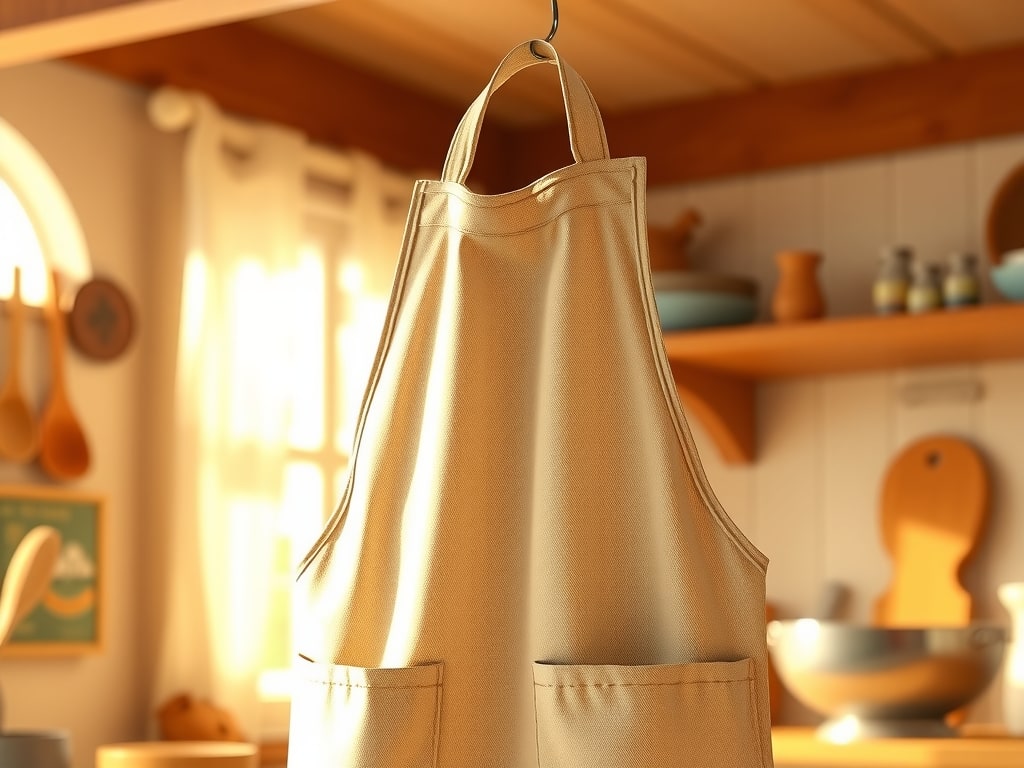
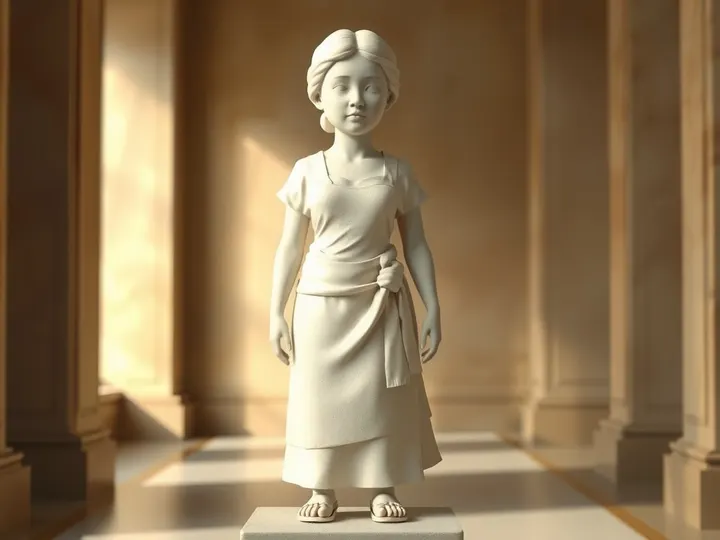
A Great Mother figurine carved around 14,000 B.C., known as the Venus of Lespugne, wears an apron slung beneath her buttocks. That is the earliest apron in the record, according to Bucknell University's Confluence journal, and it was already doing what aprons do: marking a body as belonging to a role. The garment has since passed through Pharaonic Egypt, medieval guilds, Victorian parlors, wartime kitchens and, this spring, the Miu Miu runway in Paris. It has been a badge, a shield, a uniform and a rebuke. It has never once been neutral.[6][8]
First, the Word Lost an N
The English word descends from the Old French naperon — a small tablecloth or napkin — by way of a linguistic accident called rebracketing: "a napron" slid into "an apron." By the 16th century the n was gone and the spelling settled, according to Qooqer's history of the garment. Evidence of apron use runs back to ancient Crete and Pharaonic Egypt, where it played a part in religious ceremonies, and Assyrian priests and Bronze Age Minoan figures are said to have worn versions of it.[8][10]
In medieval and Renaissance Europe, when fabric was precious, aprons were little more than scraps of material tied at the waist to protect the valuable clothes underneath, per Wikipedia's entry. Then the scraps started talking. English barbers were known as "checkered apron men." Cobblers wore black against shoe wax, butchers blue stripes, butlers green, stonemasons white. Blue marked weavers, spinners and gardeners. In the Middle Ages nearly everyone wore an apron, and some were distinctive enough to name a person's trade from across a square.[5][8][13]
The Duchess of Queensbury, a renowned fashionista in the late 1700s, was reported to wear an apron costing £210 — in an era when a middle-income family earned £100 a year.
Lace, Lawn and the Politics of Impracticality
Wealthy women learned early that the surest way to own a work garment is to ruin its usefulness. In Elizabethan England, titled women made what Confluence calls a frivolous parody of the working apron, stitched in white lawn and expensive French lace. By the end of the 1700s aprons were fashionable among upper-class women and decorated with embroidery and drawn work, according to the Scott County Historical Society, while cooks wore checked gingham. Victorian ladies sat at their needlework in dainty aprons, announcing their class through the apron's sheer impracticality.[6][11]
The same logic ran the other way down the social ladder. Women's eNews describes upper-class women accessorizing lace-trimmed aprons with pearls and cluster earrings while lower- and middle-class women wore simple aprons splattered with sauces and gravies. The cloth was similar; the stains were the tell.[4]
Aprons also carried civic and ceremonial weight. Swedish and Swiss aprons were gaily striped in patterns that identified the wearer's parish, per Confluence. In Polynesia, missionaries replaced natural apron materials with cheap cotton pinafores called the Pina Foa — a small episode in a much larger story about dress and colonial power.[6]
The Apron Gets Tied to the House
The 19th century produced the pinner, a small tea apron pinned on and often the badge of the parlor maid, according to the Scott County Historical Society. The idiom "tied to your mother's apron strings" dates from the early 1800s and probably alluded to Apron String Tenure, a 17th-century law that let a husband control his wife's and her family's property during her lifetime. Even the language of apron-wearing was, for a while, a property law.[11]
By the 1940s the apron had become almost mandatory in portrayals of the household woman at work, per TILIT, and in the late 1940s in the United States it came to symbolize the warmth of the home and family hospitality, mass-produced with kitchen-themed prints. During the Great Depression, women sewed them from flour sacks and clothing scraps rather than white cotton or linen. A 1944 US Department of Agriculture bulletin even proposed a dual-use apron whose side ties gathered into a basket for collecting produce from Victory Gardens.[8][10][11][13]

Then the knot slipped. In the late 1960s and '70s, women marching for equality untied their aprons and tossed them, banishing them to drawers and hooks on the back of a door, Women's eNews reports. The garment plummeted out of fashion as a housewifely accoutrement symbolizing a secondary role. Cheaper clothes and washing machines had already made it less necessary in countries such as the United States from the mid-1960s. The bib apron — long popular with tradesmen and lower-income wearers since the 1880s — became the most-used apron precisely when women stopped wanting the domestic symbol, according to Wikipedia.[4][5][11]
The emotional residue is real. Women's eNews notes that a woman in her fifties or sixties today may associate her mother's apron with suppression, unfulfilled dreams, longing, entrapment and emotional bondage. Curator Gail M. Brown built an exhibition, Domestic Matters: The Uncommon Apron, around that charge, commissioning forty-eight contemporary artists to make one-of-a-kind works treating the apron as a political and emotional symbol of traditional women's roles and domestic labor.[4]
Back on the Runway, Still Saying Something
Miu Miu's Spring/Summer 2026 show put apron dresses on the runway — some frilly and patterned, others structured and made of leather, all layered over bra tops, leather jackets and other apron dresses. Who What Wear called it Miu Miu's ode to the working woman, making her uniform high fashion, and reported that the dresses were not to be worn with shame but as a proud statement. The catch, per the same report: you can't just throw an apron dress on. You have to be strategic. Cool girls in New York were already trying the look as spring began.[7]
That is the class signal in its purest form. When the apron is worn by someone who doesn't have to wear it, the labor becomes costume, and the wearer's distance from the sink is the whole point. The Victorians knew this with their lace. So did the Elizabethans.[6]
How to Read One
Start with the fabric. Muslin, silk and serge appear in early aprons worn for both special occasions and everyday use, per the Scott County Historical Society; flour sack and scrap cloth mark the Depression; leather marks the blacksmith shielding himself from sparks. Then the cut: waist versus bib, a basic distinction, with the bib covering the upper body and the waist covering from the waist down. Then the details — embroidery and drawn work on an 18th-century fashionable apron, stripes that name a parish, a pinner that names a parlor maid.[5][6][11][13]
And then the stains, which are the most honest document of all. Most of the aprons in the Irving Archives and Museum's exhibition are homemade — evidence that for generations, making aprons was one imaginative outlet through which women expressed creativity inside tightly drawn artistic boundaries.[4][12]
The apron endures in professional kitchens for the reasons it always did: it protects against stains, acid, allergens and excessive heat, and it serves hygiene and identification when an employer supplies a domestic worker's uniform. Chefs, butchers, blacksmiths, waiters, bartenders and gardeners still wear them. The garment's persistence is not nostalgia. It is a record — of who cooked, who served, who was allowed to be impractical, and who was not. Hang one on the back of a door and you have hung up a small, stained autobiography.[4][5]
Sources
- History — en.wikipedia.org
- HISTORY | Topics, Shows and This Day in History | HISTORY — history.com
- HISTORY — youtube.com
- Aprons as Art: No Strings Attached – Women's eNews — womensenews.org
- Apron - Wikipedia — en.wikipedia.org
- The Apron... Status Symbol ... or Stitchery Sample? | CONFLUENCE — leaf.bucknell.edu
- Cool New Yorkers Love Miu Miu's Spring 2026 Apron Dress | Who What Wear — whowhatwear.com
- The history of the apron: Origins and evolution to the present day - Qooqer — qooqer.com
- The History of Linen Aprons: from Ancient Times to the Modern Revival | Thing Stories — thingstories.com
- Alluring Aprons: The Fashion of The Kitchen – TILIT — tilitnyc.com
- Aprons – Tie One On — Scott County Historical Society — scottcountyhistory.org
- Irving Archives & Museum — irvingarchivesandmuseum.com
- What's Out There: Apron Ties Past to Present - Columbia River Sewing - Portland, Oregon chapter of ASG — columbiariversewing.org
Reported with AI assistance using internet sources.