The Great Emu War: When Australia Lost a War Against Birds
In 1932, Australia deployed soldiers with machine guns to cull 20,000 emu “invaders”—and lost. The bizarre failed campaign offers lessons about ecology, wildlife management, and the folly of military solutions to environmental problems.
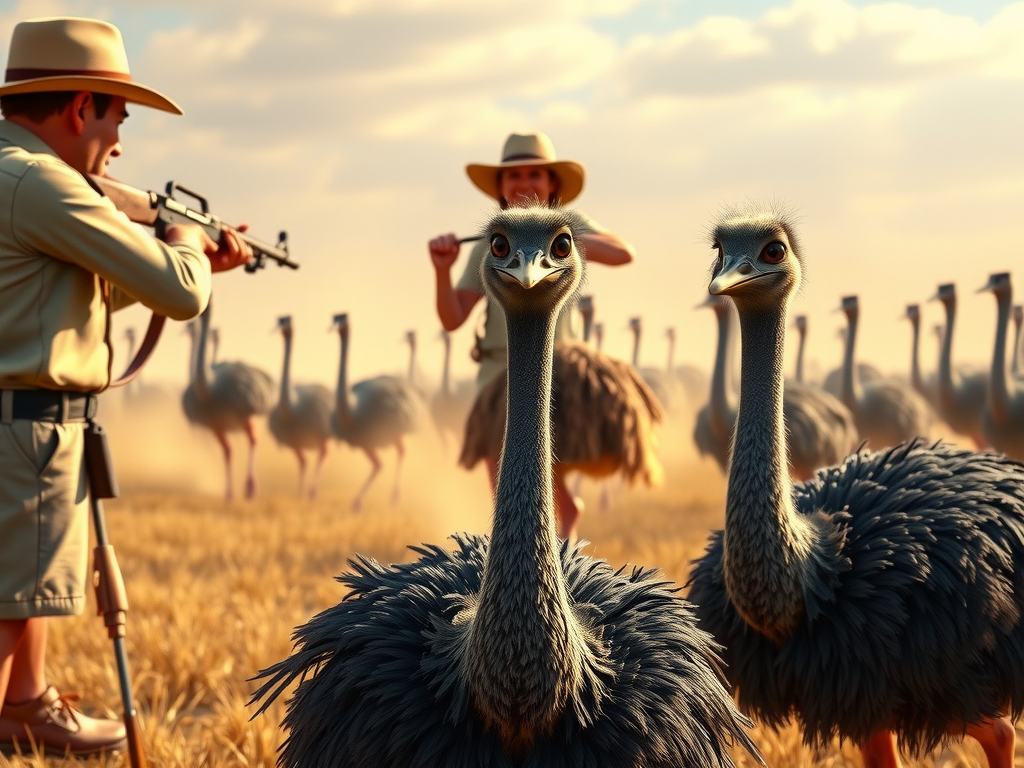
On November 2, 1932, a machine gunner from the Royal Australian Artillery squeezed the trigger on a Lewis gun aimed at a flock of emus near Campion, Western Australia. Within seconds, the gun jammed. The birds scattered. The Great Emu War, a quixotic military campaign against 20,000 flightless birds, was effectively over before it began—despite lasting another 45 days.[3][4]
The Invasion That Wasn’t

The emus were not invaders. They were native birds drawn by drought. After World War I, the Australian government settled more than 5,000 returning soldiers on farms in Western Australia’s wheat belt. When a severe drought hit in 1932, some 20,000 emus migrated inland from the desert, trampling fences, flattening crops, and—by breaking wire barriers—letting rabbits and kangaroos feast as well. Farmers, many of them ex-servicemen already struggling through the Great Depression, petitioned the government for help.[4][5][8][9]
Minister of Defence Sir George Pearce approved the use of military force. According to en.wikipedia.org, Pearce saw the deployment as “good target practice” for the troops and a way to be seen aiding farmers. The task fell to the Seventh Heavy Battery, armed with two Lewis machine guns—leftovers from World War I—and 10,000 rounds of ammunition. Major G.P.W. Meredith was put in command.[1][3][13]
The Campaign: Emu vs. Machine Gun
The soldiers expected a turkey shoot. Emus stand up to six feet tall, but they are not easy targets. They can sprint at 30 miles per hour (National Geographic says up to 55 mph) and walk 15 miles a day. Major Meredith later compared them to Zulu warriors, according to 2newthings.com.[3][4][13]
The first engagement, on November 2, ended with the Lewis gun jamming after the troops tried to ambush a flock. The emus split into small groups—what the Australian press later called “guerrilla tactics.” Over the next two weeks, soldiers attempted to herd emus into kill zones, but the birds outran them. A second attempt in December killed about 100 emus per week, according to the Wikipedia article on the Emu War. However, the overall toll remains disputed: after 45 days, an estimated 2,500 emus had been killed according to some accounts, while other reports suggest fewer than 1,000, at a cost of 10,000 rounds of ammunition. The government called off the operation.[1][4][6]
Aftermath and National Ridicule
The campaign became a laughingstock. Newspapers at home and abroad mocked the “Emu War.” The government quietly handed the problem over to civilians, offering a bounty on emu beaks. In 1934 alone, over 57,000 bounties were claimed, according to 2newthings.com. The emu species, however, survived and is now farmed for meat, oil, and leather. As National Geographic notes, emus play an essential ecological role by dispersing seeds over vast distances, helping regenerate vegetation.[4][6][13]
Lessons for a Modern Age
The Emu War is a classic case of a simplistic, short-term reaction to a complex ecological problem—and it echoes today. Australia has a notorious track record with wildlife management: in 1935, the country introduced cane toads from Hawaii to control beetles, and the toads became a massive invasive species, now numbering in the billions and poisoning native predators. Invasive species remain Australia’s number-one extinction threat.[5]
The lesson, according to analysts, is that environmental challenges demand “systems thinking, not quick fixes.” A LinkedIn analysis noted that wildlife conflicts require habitat management, data-driven prevention, and long-term planning—not machine guns. The Emu War also illustrates the importance of understanding animal behavior: emus are fast, coordinated, and resilient, and they adjusted their tactics to the threat.[4][8]
The Emu That Won
Today, the Great Emu War is a cautionary tale taught in ecology courses and retold with a grin. It underscores that nature often resists simplistic solutions. The emus, in the end, had the last laugh: they still roam the Australian outback, while the machine guns are museum pieces.[4][6][7]
Sources
- Emu War — en.wikipedia.org
- The Great Emu War of 1932 — themeateater.com
- The Great Emu War of 1932 | Forgotten History — youtube.com
- The bizarre story of when Australia went to war with emus ... — nationalgeographic.com
- The Great Emu War: How Flightless Birds Beat ... — historyhit.com
- Emu War | Australia, Casualties, History, Summary, & Facts — britannica.com
- The Emu War: A Military Operation to Manage Nuisance Wildlife - LearningMole — learningmole.com
- The Australian Emu War: Lessons in Biosecurity and Balance — linkedin.com
- Think Like an Emu? Lessons from the Great Emu War — elleruss.com
- Wikipedia: Emu — en.wikipedia.org
- Invasive species are Australia’s number-one extinction threat — theconversation.com
- The Great Emu War of 1932 | PDF — scribd.com
- Embarrassing attempt to eradicate emus: Australia's Great Emu War – A new ecology, history thing for curious kids – 2 New Things — 2newthings.com
Reported with AI assistance using internet sources.