The Umami Paradox: Why 'Savory' Is the Sixth Taste That Changed Cuisine
Discovered over a century ago, umami is now recognized as a fundamental taste, shaping global cuisine and modern food science.

In 1908, a Japanese chemist named Kikunae Ikeda sat down to a bowl of dashi, the kelp-based broth that underpins much of Japanese cooking, and sensed something that didn't fit the four accepted tastes of sweet, sour, salty, and bitter. Ikeda, a professor at Tokyo Imperial University, had spent years in Germany, where he'd been struck by the physical robustness of the locals and developed a drive to improve nutrition back home. That bowl of broth led him to identify a fifth basic taste, which he called umami—from umai, meaning delicious, and mi, meaning taste. It was a discovery that would eventually reshape how the world understands flavor, though it took decades for the rest of the scientific community to catch up.[1][3][12]
The Man Who Found the Fifth Taste

Ikeda was born in Kyoto in 1864 and educated at Tokyo Imperial University, where he later taught chemistry. His eureka moment came while studying the taste of dashi, a staple of Japanese cuisine made from kombu seaweed. He suspected that the savory quality he detected was not a combination of known tastes but something entirely distinct. Through meticulous research, he isolated glutamic acid—an amino acid—as the source of that savoriness. He named the taste umami and, in 1908, patented a method for producing monosodium glutamate (MSG), the sodium salt of glutamic acid. That invention led to the founding of Ajinomoto Co., Inc., which introduced MSG as the world's first umami seasoning.[2][3][6][9]
Ikeda was the first to identify glutamic acid as the source of savory taste. He named this 'umami' and designated it as the fifth of the five basic taste modalities.
But Ikeda's discovery did not immediately win over the world. For decades, many Western scientists dismissed umami as a mere flavor enhancer rather than a basic taste, sparking a long-running debate. It wasn't until the late 20th century that researchers found the biological machinery that proves umami is a distinct taste: specific receptors on the tongue that respond to glutamate and nucleotides. The recognition of umami as a fifth basic taste was a significant development in taste science, one that has since influenced everything from restaurant menus to processed food formulations.[1][4][6]
How Umami Works on the Tongue
The science of umami perception is a story of receptors and synergy. When you eat a tomato or a piece of aged cheese, glutamate molecules bind to taste receptor cells on your tongue. The primary receptor for umami is a protein dimer called T1R1/T1R3, which is found in the fungiform papillae at the tip and edges of the tongue and in taste buds on the roof of the mouth. This receptor responds most strongly to L-glutamate, an amino acid abundant in many foods. But here's the twist: the receptor's activity is dramatically enhanced by certain nucleotides—specifically inosine 5'-monophosphate (IMP) and guanosine 5'-monophosphate (GMP)—which are found in meats, fish, and dried mushrooms. This synergistic effect means that combining a glutamate-rich food with a nucleotide-rich food creates a umami blast far greater than either alone.[5][6][10]
Japanese cuisine has long exploited this synergy. The traditional combination of dashi—made from kombu, rich in glutamate—and bonito flakes, rich in inosinate, is a textbook example. Similarly, pork and chicken, which contain nucleotides, pair with tomatoes, celery, or mushrooms, which are high in glutamate, to produce an enhanced savory taste. This isn't just culinary folklore; it's a chemical reaction that your taste buds are wired to detect. And the signal doesn't stop at the tongue: sensing umami triggers the secretion of saliva and digestive juices, preparing the body to break down protein, which is why umami-rich foods often feel satisfying and complete.[5][8]
Umami Around the World
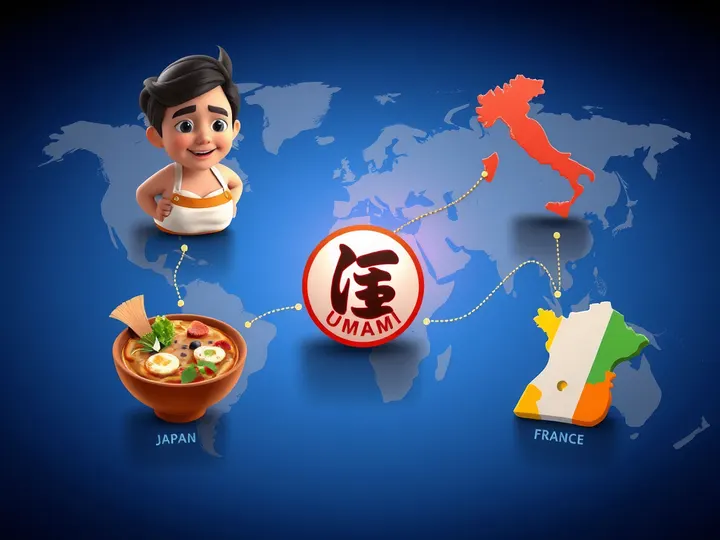
Though the word is Japanese, umami is a global phenomenon. Italian cuisine owes much of its appeal to tomatoes, parmesan cheese, anchovies, and mushrooms—all umami bombs. In Thailand and Vietnam, fish sauce is the backbone of countless dishes, delivering a concentrated hit of glutamate. Mexican and Peruvian cuisines rely on dried meat, a storehouse of the same compound. Worcestershire sauce and ketchup, staples of Western tables, are full of umami. Oyster sauce, used across Vietnamese, Thai, and Cantonese cooking, adds an extra layer of savoriness. Even green tea, seemingly delicate, contains umami compounds. The list goes on: beef, pork, chicken, mackerel, tuna, crab, squid, seaweed, soy sauce, miso, Marmite—all owe their depth to this fifth taste.[7][9]
The Modern Umami Revolution
Once the scientific community accepted umami as a basic taste, the culinary and food science worlds took notice. Chefs began deliberately pairing ingredients to maximize umami synergy, and food manufacturers started adding MSG and other umami compounds to enhance palatability. The recognition of umami has influenced modern culinary practices and food science, from the development of low-sodium products to the creation of umami-rich flavorings. One notable application: using fish sauce or other umami sources can reduce the need for salt while maintaining overall taste intensity, a boon for low-salt diets. This has health implications beyond simple flavor—umami can help people eat healthier without sacrificing satisfaction.[4][6]
Yet the story isn't just about MSG. The flavor-enhancing action of glutamate is more nuanced than simply adding a savory note. Research published in Nature suggests that when MSG is added to complex foods, it facilitates the binding of kokumi substances—compounds that don't have a taste of their own but enhance the intensity of other tastes—to their receptors. This can amplify umami, sweet, salty, and fatty tastes, resulting in increased palatability accompanied by a sensation of thickness, mouthfulness, and continuity. In other words, umami doesn't just taste good on its own; it makes everything else taste better.[13]
The Health and Dietary Implications
Umami itself is not harmful; it's a natural component of many nutritious foods. The concern that some people have about MSG is largely based on anecdotal reports rather than solid evidence, and the scientific consensus is that MSG is safe for the general population. In fact, umami may play a role in appetite regulation. Some evidence suggests that umami not only stimulates appetite but also contributes to satiety, helping people feel full sooner. This dual effect could be useful in managing weight and improving dietary quality. But there's a catch: the palatability boost from umami can also make unhealthy foods more appealing, so it's a tool that cuts both ways.[6][12]
For the home cook, the umami paradox is simple: the same taste that makes a bowl of ramen irresistible can also make a plate of steamed vegetables more appealing. Understanding umami gives us a new lens for cooking—pairing a splash of soy sauce with mushrooms, or a sprinkle of parmesan over tomatoes, is not just tradition but science. The next time you savor a rich broth or a ripe tomato, you'll know it's not just in your head; it's in your taste buds.[4][6]
A century after Ikeda's discovery, umami has earned its place alongside sweet, sour, salty, and bitter. It has changed how we cook, how we eat, and how we think about flavor. And it all started with a bowl of soup.[1][8]
Sources
- Umami and History of MSG — labxchange.org
- Kikunae Ikeda - Wikipedia — en.wikipedia.org
- Kikunae Ikeda | Umami Information Center — umamiinfo.com
- Molecular insights into human taste perception and umami tastants: A review — pmc.ncbi.nlm.nih.gov
- Umami - an overview | ScienceDirect Topics — sciencedirect.com
- Umami - Wikipedia — en.wikipedia.org
- Umami is Found in Every World Cuisine | Everything about umami | Umami | The Ajinomoto Group Global Website - Eat Well, Live Well. — ajinomoto.com
- What is Umami | Umami Information Center — umamiinfo.com
- That's umami | Kikkoman — kikkoman.eu
- Wikipedia: Taste receptor — en.wikipedia.org
- Taste Receptors — youtube.com
- Exploring Umami: Beyond the Quintessential Flavor Clash — lustau.es
- The flavor-enhancing action of glutamate and its ... — nature.com
- Umami and Food Palatability — sciencedirect.com
Reported with AI assistance using internet sources.