The Suitcase That Outlived the War: Irène Némirovsky’s Last Manuscript
How a celebrated novelist, writing in hiding, left a masterpiece that would wait sixty years to be read.

In the summer of 1942, in a small village in occupied France, Irène Némirovsky was writing a novel about the fall of France. She was one of the most widely read French authors of her generation, a Russian-born Jew who had converted to Catholicism, but none of that mattered to the French gendarmes who arrested her on July 13. She was deported to Auschwitz and died a month later, at thirty-nine, of typhus. Before she was taken, she handed her two daughters a suitcase containing clothes, photographs, and the handwritten manuscript of what would become Suite Française. The girls, aged five and thirteen, carried that suitcase into hiding and kept it unopened for fifty years.[1][3][14]
A Star of the Literary Scene

Némirovsky’s rise was swift. Born in Kiev in 1903 to a wealthy Jewish banking family, she fled Russia after the Bolshevik Revolution and settled in Paris in 1919. She learned French with such acuity that she published her first short novel before she was twenty-five. In 1929, David Golder, the story of a wealthy Jewish banker unable to please his troubled daughter, became an immediate success and was adapted into a film by Julien Duvivier. Her next novel, Le Bal, about a mistreated daughter’s revenge, became a play and a movie. By the 1930s, she was one of the most prolific and widely read French authors of her generation, a rare woman writer enjoying both commercial and critical success.[2][3][6][10]
But success did not translate into safety. Despite her fame, French nationality was denied to the Némirovskys in 1938. When Germany declared war on France in 1939, friends and acquaintances in the literary community began to shun her. By 1940, her books could no longer be published because of her Jewish ancestry. The life of entitlement she had known—the salons, the acclaim, the easy assumption of belonging—evaporated. She was, as one biographer put it, “accustomed to a life of entitlement” and suddenly persecuted herself, forced to wear the yellow Star of David and confined to the village of Issy-l’Évêque, about 300 kilometers southeast of Paris.[2][3][6]
Writing the Disaster as It Happened
It was in Issy-l’Évêque, during the first years of the German occupation, that Némirovsky wrote Suite Française. The novel was planned as a five-part epic, but she completed only two parts before her arrest. The first, “Storm in June,” opens in the chaos of the massive 1940 exodus from Paris on the eve of the Nazi invasion. The second, “Dolce,” enters the increasingly complex life of a German-occupied provincial village. What makes these pages remarkable, according to critics, is that they were written during the actual period they describe, yet they read as considered reflection, not a hasty journal. Némirovsky took solitary walks in the woods to compose, her daughters later recalled, and she wrote in a small notebook that she kept close.[2][3][6][14]
The novel is striking for what it omits. There is no mention of Jews or their trials, despite Némirovsky’s own endangered position as a Russian Jewish emigrant. As the Jewish Book Council noted, “any mention of Jews and their trials and tribulations of assimilation and acceptance into French society is strikingly absent.” Some scholars see this as a deliberate choice—a way to write a universal story of occupation, or perhaps a survival instinct to avoid drawing attention to her own identity. Others see it as a sign of her lifelong ambivalence about her Jewishness. Either way, the absence is a powerful reminder of the constraints under which she wrote.[4]
“For me, the greatest joy is knowing that the book is being read. It is an extraordinary feeling to have brought my mother back to life. It shows that the Nazis did not truly succeed in killing her. It is not vengeance, but it is a victory.” — Denise Epstein, Némirovsky’s daughter, in a 2006 BBC interview.
The Suitcase That Held a Masterpiece
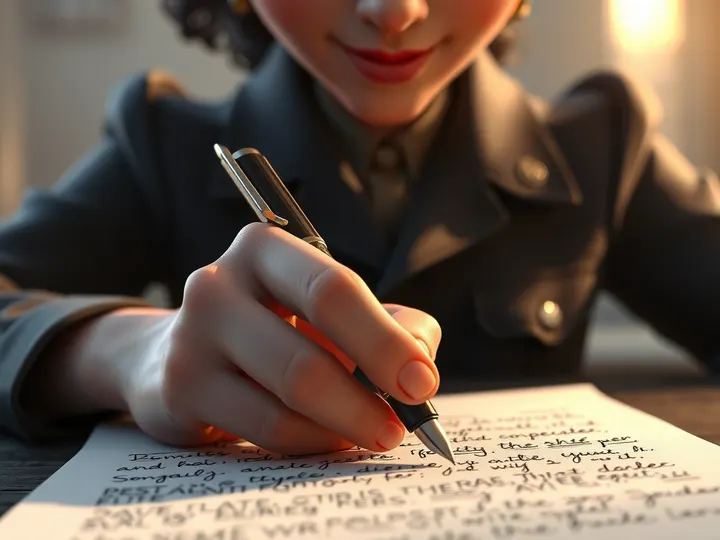
After Némirovsky’s arrest, her husband, Michel Epstein, tried to intercede, but he too was deported and died in Auschwitz. The two daughters, Denise and Élisabeth, were hidden by a family friend and survived the war. They kept the suitcase, but Denise did not open the notebook for fifty years. She assumed it was her mother’s diary, too painful to read. In the late 1990s, while making arrangements to donate her mother’s papers to a French archive, she finally examined the notebook. What she found was not a diary but a major literary work: the first two parts of Suite Française. She typed out the handwritten pages with the aid of a magnifying glass, and the novel was published in France in September 2004.[1][2][3][5]
The book became a sensation. It won the Prix Renaudot, the first time the prize had been awarded posthumously, and was translated into English in 2006, becoming a New York Times bestseller. Critics and writers chose it as the book of the year. The publisher included an appendix of excerpts from Némirovsky’s journal and correspondence, which added an extra dimension to the story—readers could see the author’s own fear and hope as she wrote. The manuscript itself was given to the Institut mémoires de l’édition contemporaine (IMEC) in Paris.[2][4][12][14]
What Her Story Tells Us
Némirovsky’s life is a lesson in the fragility of freedom. She did everything right: she achieved fame, converted to Catholicism, married a Frenchman, and raised her children in France. None of it saved her. Her story, as the Brooklyn Rail put it, shows how “harsh and dividing social and economic realities—easily ignored in times of peace—were magnified” under occupation. Her success did not protect her from being shunned by friends, denied citizenship, and eventually murdered. The freedom she thought she had earned was an illusion, and her fate is a reminder that rights can be revoked overnight.[3][10]
And yet, her art outlived the persecution. Suite Française is not a document of resistance in the conventional sense—it contains no heroic acts or political manifestos. But it is a testament to the power of observation, of bearing witness. As her daughter Denise said, publishing the book was a victory over the Nazis: “It shows that the Nazis did not truly succeed in killing her.” The novel is a reminder that art can preserve a voice that tyranny tried to silence.[2][12]
A Legacy Reclaimed
Today, Némirovsky is remembered not only through Suite Française but also through exhibitions and biographies. In 2010, the Museum of Jewish Heritage in New York mounted “Woman of Letters: Irène Némirovsky and Suite Française,” which illustrated her life and her literary gift. In 2010, a biography by Olivier Philipponnat and Patrick Lienhardt, The Life of Irène Némirovsky, was published in English, chronicling her rise, her arrest, and her death. The book’s final pages narrate her deportation and death, establishing a foundation for understanding her work.[1][5]
For contemporary readers, Némirovsky’s story resonates beyond the historical record. It is a story about the precarity of belonging, the danger of complacency, and the stubborn persistence of creative work. In an age of rising nationalism and ethnic scapegoating, her fate is a warning. Her novel, written in the shadow of death, is a reminder that even in the darkest times, the human impulse to tell stories—to make sense of chaos—remains unquenchable. As one scholar put it, her talent “was for storytelling; it was not for proselytising.” That storytelling, delayed by sixty years, finally found its audience.[11][12]
Sources
- The Life of Irene Nemirovsky « Three Percent — rochester.edu
- Irène Némirovsky - Wikipedia — en.wikipedia.org
- Writing in the Dark: The Story of Irene Nemirovsky - The Brooklyn Rail — brooklynrail.org
- The Absence of the “Jewish Question” in Irene Nemirovsky’s Suite Francaise | Jewish Book Council — jewishbookcouncil.org
- Woman of Letters: Irène Némirovsky and Suite Française — mjhnyc.org
- Nemirovsky, Irene. Suite Française | Book Review — yadvashem.org
- Irène (novel) - Wikipedia — en.wikipedia.org
- Irène Joliot-Curie - Wikipedia — en.wikipedia.org
- Irène (2002) | Rotten Tomatoes — rottentomatoes.com
- Irene Nemirovsky — jwa.org
- The “Ambiguities” of Irène Némirovsky - Books & ideas — laviedesidees.fr
- NemirovskyYFSpdf.pdf — dash.harvard.edu
- Amazon.com: Suite Française: 9782070336760: Irène Némirovsky: Books — amazon.com
- SUITE FRANCAISE — The French Publishers' Agency — frenchrights.com
- A Marvelous Writer in a Hopeless Situation | Anka Muhlstein — nybooks.com
Reported with AI assistance using internet sources.