The Peace That Was Signed by Two Men Who Never Met
The 1648 Peace of Westphalia took years of letters, two cities, and zero group photos. As modern ceasefires are shuttled through third capitals, its mechanics read like a user's manual.
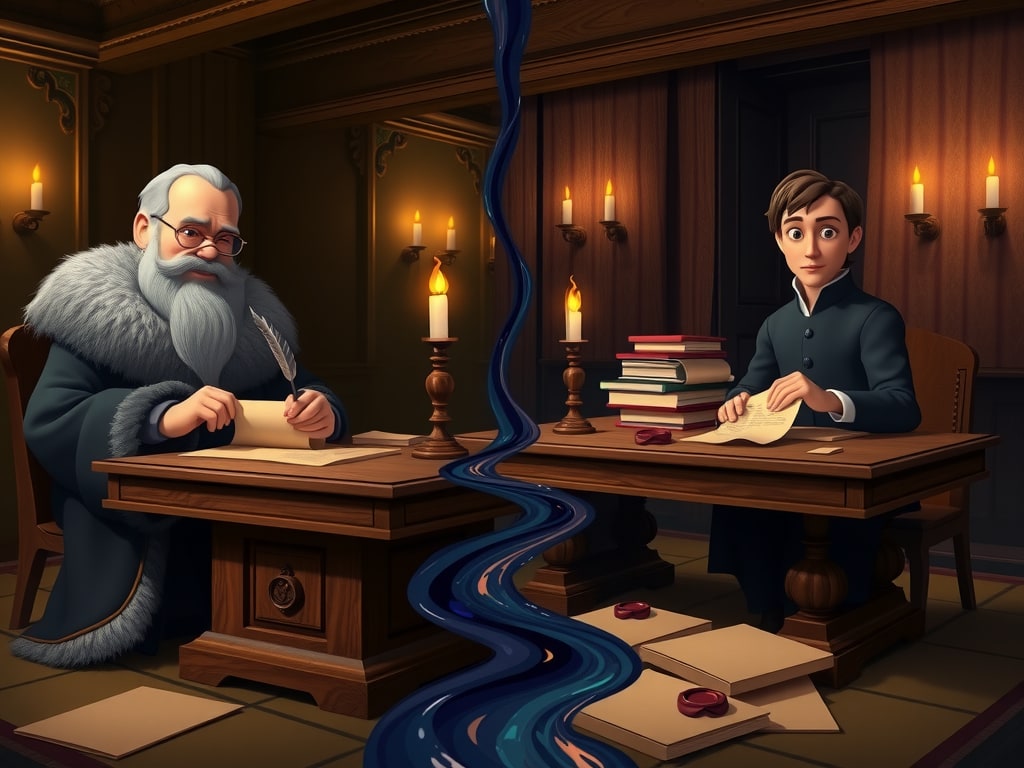
The Peace of Westphalia was signed on 24 October 1648, but no one at the signing table could claim to have met everyone whose name was on the parchment. The 109 delegations that arrived to represent the belligerent states never once met in a plenary session, according to Wikipedia's summary of the congress. There was no single hall, no opening ceremony, no final group portrait. There were two cities, a lot of couriers, and roughly five years of letters.[1][10]
Two Cities, One War, No Shared Room

The split was physical and confessional. Osnabrück hosted the Swedes, the emperor's envoys, and the Protestant imperial estates; Münster hosted France, the emperor, and the Catholic estates, according to the city of Osnabrück's peace portal. Both Protestant Sweden and Catholic France had demanded a venue where their envoys could practice their faith. The two cities sat close enough to ensure a rapid exchange of information, but far enough to keep rival delegations from sharing a dinner table. Both were maintained as neutral and demilitarized zones for the negotiations, per Wikipedia.[6][1]
The arrangement was agreed in Hamburg on 25 December 1641 between Sweden, France, and the Emperor, according to a study published by the University of Wrocław. From 1643 onward, the Westphalian cities began receiving messages from all over Europe. The emperor's deputation arrived in Münster at the end of July 1643, but Count Maximilian von Trauttmansdorff, the Habsburgs' most skilled negotiator, did not show up until November 1645. The congress, by one count, drew 194 official political entities, 178 of them from the German Reich.[5]
"There was never a plenary session among the participants." — a study of the Holy See and the treaties of Westphalia, hosted by UNAM's law archive
The Men in the Middle
Two mediators carried the traffic. Fabio Chigi, the papal nuncio in Cologne, and Alvise Contarini, the Venetian envoy, acted as go-betweens, according to Wikipedia. Chigi served as Mediator Pacis in Münster from 1644 to 1649 and wrote roughly 400 letters in Italian from Münster to friends and the Curia in Rome, according to a study published by the LWL, a German regional authority. Those letters were long accessible only to scholars working in Roman archives; a printed edition appeared in Rome in 1943 and 1946, with a third volume still unpublished.[1][8]
Contarini was no neutral bystander. A Venetian patrician, he had already served as ambassador to England, France, and the papal court, and in 1630 he persuaded Cardinal Richelieu that France should back Sweden's intervention in the Thirty Years' War, according to Wikipedia. From 1643 he mediated at Münster. One contemporary description, cited by the FernUniversität in Hagen, called him a man of penetrating understanding who "masterfully possessed the art of dissimulation" and knew how to win and captivate others. The ratifications of both parties were eventually deposited with the Venetian co-mediator.[13][14]
The Venetian ambassador sent dispatches methodically to the Senate to keep it informed and receive instructions, according to a study published in Diritto e Storia. The congress ran on paper: proposals were presented, answered, and amended through intermediaries because the principals could not sit in the same room. The city halls of Münster and Osnabrück now carry the European Heritage Label for symbolizing those negotiations between 1643 and 1648.[12][9]

What the Slowness Bought — and Cost
The congress had no formal beginning and no formal ending, though it certainly had a long middle, according to the UNAM-hosted study. It was, by that study's description, "probably the longest continuous peace conference in modern history," with eight or nine years of preliminary negotiations that cannot properly be separated from the four years at the congress itself. Delegations arrived between 1643 and 1646 and left between 1647 and 1649, with the largest number of diplomats present between January 1646 and July 1647, according to Wikipedia.[7][1]
That slowness shaped substance. The settlement addressed military peace, territorial claims, amnesty, restitution, religion, imperial institutions, the rights of the Imperial Estates, and the position of foreign powers, according to diplomacyandlaw.com. The Osnabrück treaty was expressly incorporated into the constitutional settlement of the Empire rather than operating simply as a military truce. Duchhardt, cited by the same source, describes the Peace of Westphalia as the most important legal text governing interstate relations in Central Europe through much of the ancien régime. The guarantees of the great European powers allowed for stable development, and the peace was referenced in subsequent treaty negotiations up to the end of the 18th century, according to the European Heritage Label bureau.[3][9]
The cost was incompleteness. There was no single treaty called the Treaty of Westphalia: the settlement comprised the Franco-Imperial Treaty of Münster and the Swedish-Imperial Treaty of Osnabrück, both signed on 24 October 1648, plus the Spanish-Dutch Treaty of Münster signed on 30 January 1648, according to diplomacyandlaw.com. The Franco-Spanish War continued after 1648 and was settled only by the Treaty of the Pyrenees in 1659. The peace did not restore peace throughout Europe, though it created a basis for national self-determination, per Lumen Learning.[3][2]
The Ceasefire You're Reading About Is Probably a Letter
Modern mediated ceasefires — Gaza, Sudan, Ukraine — are often announced as single events, but the Westphalia record suggests the real work happens in the gaps between capitals. The congress had no plenary session; neither do many current talks, where mediators shuttle between hotel suites and third countries. The mechanics that built trust in 1645 were repetitive and unglamorous: written proposals, courier relays, a mediator who kept his own counsel. That is not a template for speed. It is a template for durability when the parties cannot bear to be in the same room.[7][1]
The historical record offers a caution as well as a model. Westphalia produced a settlement that outlasted its signatories because it was embedded in law and guaranteed by powers, not because it was signed quickly. But the same record shows that a pause in one war can coexist with continued fighting elsewhere — the Franco-Spanish conflict ran for another eleven years. Readers scanning today's ceasefire headlines might ask not only who signed, but who mediated, what was written down, and whether the document is a truce or a constitution. At Westphalia, the difference took years to become clear.[3][9]
Sources
- Peace of Westphalia - Wikipedia — en.wikipedia.org
- The Peace of Westphalia and Sovereignty | Western Civilization — courses.lumenlearning.com
- Treaty of Westphalia (1648): Meaning, Sovereignty, and International Law — diplomacyandlaw.com
- 1648: Peace of Westphalia sets inter-state rules for >370 years. (Etc.) | Just World News — justworldnews.org
- Congress of Westphalia. Participants in the negotiations, ... — wnus.usz.edu.pl
- Peace of Westphalia – Stadt Osnabrück — friedensstadt.osnabrueck.de
- the holy see and the treaties of westphalia — archivos.juridicas.unam.mx
- Der Nuntius Fabio Chigi (Papst Alexander VII) in Münster ... — lwl.org
- Münster and Osnabrück – Sites of the Peace of Westphalia - EHL BUREAU — ehl-bureau.eu
- The Peace of Westphalia: Five Years of Meetings, No Zoom, and a Diplomatic Miracle — medium.com
- Peace of Westphalia: The Swearing of the Oath of Ratification of the Treaty of Münster (1648) | German History in Documents and Images — germanhistorydocs.org
- Bussi-Mediazione-Repubblica-Venezia-pace-Westfalia — dirittoestoria.it
- Alvise Contarini (diplomat) - Wikipedia — en.wikipedia.org
- Wer war Alvise Contarini? - FernUniversität in Hagen — fernuni-hagen.de
Reported with AI assistance using internet sources.