The Science of a Good Night's Sleep: Why Your Bedtime Routine Matters More Than You Think
From memory consolidation to circadian rhythms, the latest sleep science reveals why your nightly habits are a biological necessity, not a luxury.
At 3 a.m., the world is quiet, but your brain is busy. It’s replaying the day’s events, sorting through conversations, and deciding what to keep and what to discard. This is not poetic metaphor; it’s the biological reality of sleep, a state in which the brain replays, organizes, and stores experiences, turning short-term impressions into more stable memories [1]. Yet, according to the CDC, more than one-third of adults in the U.S. don’t get enough sleep [12]. The cost is not just grogginess—it’s a profound impact on memory, mood, and long-term health.[1][12]
What Happens When You Sleep

Sleep is not a passive shutdown. It’s an active, anabolic state where the body restores the immune, nervous, skeletal, and muscular systems—vital processes that maintain mood, memory, and cognitive function [10]. The brain cycles through NREM and REM sleep in roughly 90-minute intervals, repeating four to six times a night [10]. During slow-wave sleep, the body secretes bursts of growth hormone [10], while the brain trims weaker connections, strengthens important ones, and supports the structure needed for clear thinking and a stable mood [1].[1][10]
These stages work together to protect neurons, balance brain chemicals, and maintain healthy brain networks [1]. When you skimp on sleep, you disrupt this intricate choreography. Restricted sleep makes it more difficult to move information from short-term to long-term storage [1]. It’s like trying to save files on a computer that keeps shutting down before the backup completes.[1]
Sleeping 4 hours per night has the same impact on cognitive performance as a blood-alcohol level of 0.1%—well over the legal driving limit.
The Body’s Internal Clock: Circadian Rhythms and Blue Light
Your body runs on a 24-hour cycle called the circadian rhythm, which governs not just sleep but also core body temperature, hormone release, metabolism, and even the body’s reaction to stress [8]. This internal clock is primarily synchronized by light—the strongest cue for resetting the circadian rhythm in humans [7]. When light hits your eyes, signals travel to the suprachiasmatic nucleus in the brain, which then coordinates the rest of the body [9].[7][8][9]
But artificial light—especially the blue light from smartphones and televisions—mimics daylight and tells your brain it’s time to be awake. This disrupts the release of melatonin, the hormone that regulates sleep [10]. Many people regularly watch TV or scroll through phones before bed, exacerbating the problem [10]. The result? Your internal clock gets confused, and falling asleep becomes harder.[10]
The High Cost of Sleep Deprivation
The effects of sleep deprivation are more serious than feeling tired. Even losing just one hour of sleep per night for several days can impair daytime performance, concentration, and mood [7]. Sleeping only four hours a night has the same impact on cognitive tasks as a blood-alcohol level of 0.1%—well over the legal driving limit [7]. Sleep deprivation slows reflexes, sabotages decision-making, and saps creativity [4].[4][7]
Chronic insufficient sleep is linked to a higher risk of anxiety, depression, and burnout, as the brain struggles to balance stress and mood [1]. It also takes a physical toll: high blood pressure, heart disease, stroke, diabetes, and weight changes are all associated with long-term sleep deprivation [5]. A recent study even found that sleep deprivation makes it harder to divert attention away from negative thoughts, putting us at greater risk for depression [4].[1][4][5]
The Bedtime Routine That Works
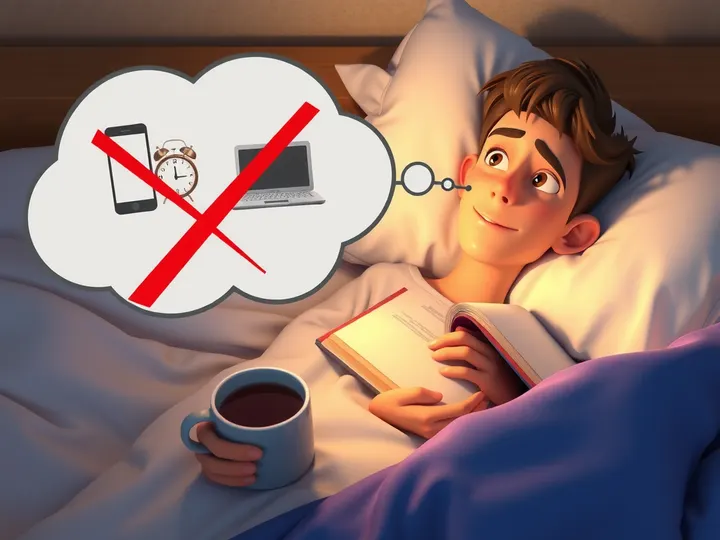
Given the stakes, what can you do? The answer lies in sleep hygiene—a set of evidence-based practices that create ideal conditions for healthy sleep [4]. It’s not about one magic trick; it’s about building habits that signal to your body it’s time to wind down.[4]
Start with consistency: go to bed and wake up at the same time every day, even on weekends [6]. This trains your circadian rhythm, making it easier to fall asleep and wake naturally [13]. Keep your bedroom dark, cool, and quiet [6]. And avoid screens for at least an hour before bed—the blue light suppresses melatonin [16].[6][13][16]
Your daytime habits matter too. Get outside in direct sunlight early in the day to reinforce your internal clock [6]. Exercise is great, but try to finish at least four hours before bedtime [6]. And be mindful of caffeine: it can stay in your system longer than you think, so stop consuming all caffeine by mid-afternoon [5].[5][6]
Debunking Common Sleep Myths
Many popular beliefs about sleep are wrong. For instance, hitting the snooze button doesn’t give you extra rest; it actually throws your brain back into a REM cycle, only to be jarred awake mid-cycle, leaving you groggier [17]. Similarly, being able to fall asleep anywhere at any time is not a superpower—it’s a sign of sleep deprivation [17].[17]
Alcohol is another culprit. While it may help you doze off, it disrupts sleep quality by interfering with REM cycles, often causing you to wake up in the middle of the night [16, 17]. And don’t think you can “catch up” on sleep over the weekend—it doesn’t fully counteract a week’s worth of sleep debt [16].[16][17]
Start Tonight
The good news is that you can improve your sleep starting tonight. If you can’t fall asleep within 20 minutes, get up and do a relaxing activity until you feel sleepy again [16]. Establish a bedtime routine that is realistic, relaxing, and ritualistic—adults need routines as much as children, given the heavier mental and emotional loads we carry [14].[14][16]
Sleep is not a luxury; it’s a biological necessity. Over time, healthy sleep habits are linked with a lower risk of cognitive decline and neurodegenerative conditions [1]. So tonight, put down the phone, dim the lights, and give your brain the rest it deserves. Your memory, mood, and health will thank you.[1]
Sources
- Sleep and Brain Health: How Sleep Memory Science… — inkl.com
- Sleep and Brain Health: How Sleep Memory Science Powers Better Focus and Stronger Memory — sciencetimes.com
- Sleep and Brain Health: How Sleep Memory Science Powers Better Focus and Stronger Memory — medicaldaily.com
- Sleep Hygiene Tips - Headspace — headspace.com
- Expert tips to improve your sleep hygiene | University Health Center | Nebraska — health.unl.edu
- 17 Sleep Hygiene Tips for Improved Rest and Overall Health — goodrx.com
- Sleep Waking Cycle - an overview | ScienceDirect Topics — sciencedirect.com
- What Is Circadian Rhythm? — sleepfoundation.org
- How Sleep Works - Your Sleep/Wake Cycle | NHLBI, NIH — nhlbi.nih.gov
- Wikipedia: Sleep — en.wikipedia.org
- Wikipedia: Circadian rhythm — en.wikipedia.org
- Sleep hygiene: Simple practices for better rest - Harvard Health — health.harvard.edu
- Rest Easy: 8 Ways To Improve Your Sleep Hygiene — health.clevelandclinic.org
- Improve Your Sleep Quality With a Bedtime Routine | Canyon View Ear, Nose & Throat — canyonviewent.com
- Debunking Sleep Myths With Facts About Sleep — sleepfoundation.org
- Debunking 10 Sleep Myths | VitalCare Family Practice — vitalcarefp.com
- Sleep Smarter: Debunking Common Myths About Sleep | Center for Teaching and Learning — ctl.stanford.edu
Reported with AI assistance using internet sources.