The Great Data Center Land Grab: How AI Is Reshaping the American West
As AI demand explodes, data centers are consuming land, water, and power at unprecedented rates—and local communities are starting to push back.
In Morrow County, Oregon, a rural expanse of wheat fields and high desert, local officials awarded Amazon nearly $1 billion in tax breaks for five new data centers two years ago, according to Stanford's & the West. The deal was typical of a regional pattern: In Oregon, companies like Meta, Apple, Twitter, and Google's parent have received hundreds of millions in incentives to build the warehouses that power the cloud. But the trade-offs are becoming harder to ignore. Data centers in Arizona now use 7.4 percent of the state's power; in Oregon, 11.4 percent, per Stanford's & the West. They need significant amounts of water to keep cool, and new ones will need more. Nearly 60 centers in Phoenix alone demand about 177 million gallons a day. All told, these facilities are reshaping local grids, plumbing, and politics.[1]
Thirsty Machines in a Dry Land
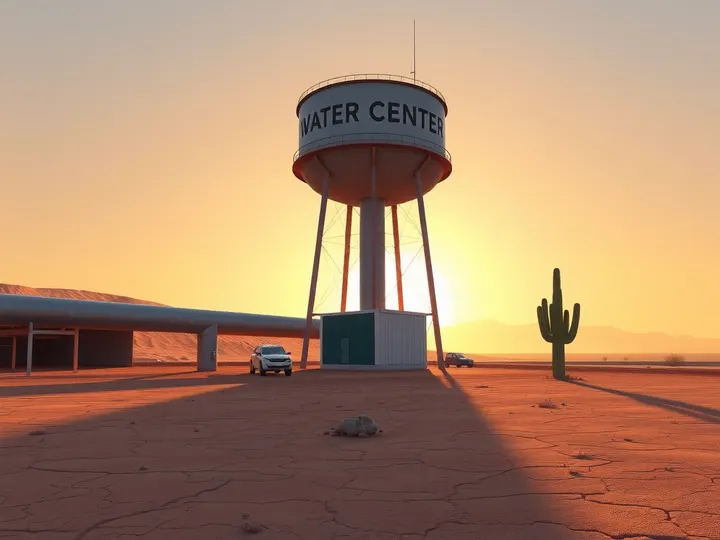
The American West, already parched by drought and over-allocation, is now hosting the engines of the digital economy. Data centers consume water directly for cooling and indirectly through electricity generation; in 2022, coal and gas power plants accounted for 40 percent of all U.S. annual water withdrawals—about 48.5 trillion gallons, according to Nature Forward. A single enterprise data center uses 300,000 to 500,000 gallons per day; hyperscale centers can gulp one to five million gallons daily, the equivalent of a town of 10,000 to 50,000 residents. Most of that water comes from potable supplies: one analysis estimated 57 percent of direct water use is drawn from drinking-water systems, and another industry assessment put the figure at 80–90 percent from 'blue' sources like lakes, rivers, and aquifers—often the same sources serving communities.[6][4]
Large hyperscale centers generally consume one to five million gallons per day. For context, five million gallons per day is equivalent to the water use of a town of 10,000 to 50,000 residents.
The scale is staggering. In Northern Virginia, the world's largest data center hub, over 300 operational centers across four counties consumed close to 2 billion gallons of water, according to Nature Forward. In Phoenix, the water demand of nearly 60 centers is about 177 million gallons a day, per Stanford. And the growth isn't slowing: U.S. data centers number 3,069 in operation, with another 1,489 planned or under construction, according to Consumer Reports. Hyperscale sites can sprawl across thousands of acres and use as much electricity as a mid-sized city; the biggest can draw 5 gigawatts or more.[6][1][5][16]
Power Hungry: The Grid Strain
Energy demand is the other half of the equation. The International Energy Agency estimated that data centers consumed around 415 terawatt-hours in 2024—about 1.5 percent of global electricity—and projects that could double to 945 TWh by 2030, according to Wikipedia. In the U.S., data center power consumption will account for 'almost half of the growth in electricity demand between now and 2030,' the IEA said. A January 2026 report by Bloom Energy predicts U.S. data centers' total energy demand will nearly double between 2025 and 2028, jumping from 80 to 150 gigawatts, per Consumer Reports. That load is already stressing grids: data centers require massive, continuous electricity, often exceeding local capacity, and they rely on backup generators that can affect air quality, according to the Arizona Corporation Commission.[10][5][8]
Utilities and ratepayers are feeling the pinch. In Illinois, data centers consume enough electricity to power more than a million homes, according to the Illinois State Association of Counties. Residents fear their bills will rise as utilities build new infrastructure for these facilities. A dominant theme in state policy debates is that data centers drive up electricity costs for residential and small business customers, notes TechPolicy.Press. In Virginia, utilities are now directed to determine cost recovery rates for high-demand customers (over 25 MW) after January 1, 2027, to prevent cost-shifting to households.[15][12]
The Pushback: From Tax Breaks to Moratoriums
For years, states competed to attract data centers with generous incentives. Between 2021 and 2024, over half of U.S. states offered tax breaks, according to Enkiai. But the tide is turning. In 2025, Illinois proposed a two-year suspension of its data center tax incentive program to control soaring power bills, and Governor Pritzker announced a pause effective July 1, 2026, until a regulatory framework is adopted, per the Illinois State Association of Counties. At least 20 moratoria on new data centers have been proposed since 2025, according to TechPolicy.Press. States like Washington and Oregon are advancing legislation that requires data centers to pay for grid upgrades, and Texas now requires large-load customers to bear upfront costs for transmission lines, notes Connect Humanity.[11][15][12][16]
Local communities are organizing. Data Center Watch identified 142 activist groups across 24 states actively opposing projects, according to Data Center Frontier. From May 2024 to March 2025, local opposition blocked or delayed up to $64 billion in U.S. data center projects—six blocked entirely, ten delayed, per Wikipedia and ThinkBRG. Common concerns include resource consumption, noise, aesthetic disruption, and limited local economic benefits, notes Data Center Frontier. Many deals are brokered behind closed doors under NDAs, and data centers generate relatively few permanent jobs, fueling resentment.[7][10][9]
“People are starting to be really, really aware that these projects tend to be very extractive and bring very little to local communities,” says Kasia Tarczynska, senior research analyst for Good Jobs First.
Who Pays for the Cloud?
The hidden costs are mounting. Data centers can introduce pollutants into water systems—biocides, corrosion inhibitors, heavy metals—and evaporative cooling towers can emit fine salt dust that harms vegetation and increases salinity in aquatic systems, according to Nature Forward. Their water use is often treated as proprietary or trade secret, limiting transparency, notes the Arizona Corporation Commission. Meanwhile, the Western Resource Advocates warns that unaddressed data center loads threaten air quality, climate, and water supplies, and risk utilities' ability to meet emissions reduction goals. But with the right policies, they argue, data centers can catalyze investments in clean energy and drive broader system transformation.[6][8][2]
Some companies are starting to adapt. Google uses reclaimed or non-potable water at over 25% of its data center campuses, and Amazon Web Services announced in 2023 that 20 of its data centers are cooling with purified wastewater, according to the Florida Water and Pollution Control Operators Association. But most data centers worldwide still use fresh water, and the pace of change is slow.[4]
The regulatory landscape is shifting from incentives to accountability. Virginia now ties tax exemptions to renewable energy commitments, and Minnesota established a separate water permitting requirement for data centers in 2025, notes Multistate. South Carolina and Maryland enacted rate negotiation laws in 2025, and dozens of municipalities have moved data centers from 'by-right' uses to 'special use permits' requiring site assessments and public hearings, per TechPolicy.Press. Still, there is no centralized registry of data centers, and much information remains estimates, according to the Arizona Corporation Commission.[11][13][12][8]
The question is who ultimately bears the cost of the digital boom. Tech companies tout economic growth and jobs, and some executives signed a White House-sponsored pledge to limit effects on residential electric bills, per Consumer Reports. But for many Western communities, the trade-off is stark: a few construction jobs and tax revenue versus strained water supplies, higher power bills, and a transformed landscape. As one analyst put it, these projects are 'very extractive.' The cloud, it turns out, has a heavy footprint—and it's landing on the American West.[5]
Sources
- Thirsty for power and water, AI-crunching data centers sprout across the West – & the West — andthewest.stanford.edu
- Data Center Impacts in the West: WRA's Policy Solutions — westernresourceadvocates.org
- The environmental footprint of data centers in the United States - IOPscience — iopscience.iop.org
- Myths vs. Reality: Data Centers And Water Usage - Florida Water and Pollution Control Operators Association — fwpcoa.org
- AI Data Centers Impact on Electric Bills, Water, and More — consumerreports.org
- Data Centers and Water Use - Nature Forward — natureforward.org
- When Communities Push Back: Navigating Data Center Opposition | Data Center Frontier — datacenterfrontier.com
- Data Center Siting Disputes: Navigating a Fragmented ... — azcc.gov
- NIMBY Opposition to Data Center Siting: Managing Local Environmental Impacts and Litigation Risk | ThinkSet | BRG — thinkbrg.com
- Wikipedia: Data center — en.wikipedia.org
- Data Center Regulation 2026: Why States Demand ... — enkiai.com
- The State of Data Center Policy in the United States | TechPolicy.Press — techpolicy.press
- State Data Center Policy 101: 2026 Legislative Guide — multistate.us
- Key Considerations for Data Center Development — bipartisanpolicy.org
- Data Center Resource Page — isacoil.org
- Data centers are coming. Here’s how communities can negotiate for local benefit. - Connect Humanity — connecthumanity.fund
Reported with AI assistance using internet sources.