The Faroe Islands: A Traveler's Guide to the World's Most Dramatic Archipelago
Beyond the Instagram shots, a practical guide to seasons, hidden trails, and responsible travel in the North Atlantic's sheep-filled archipelago.
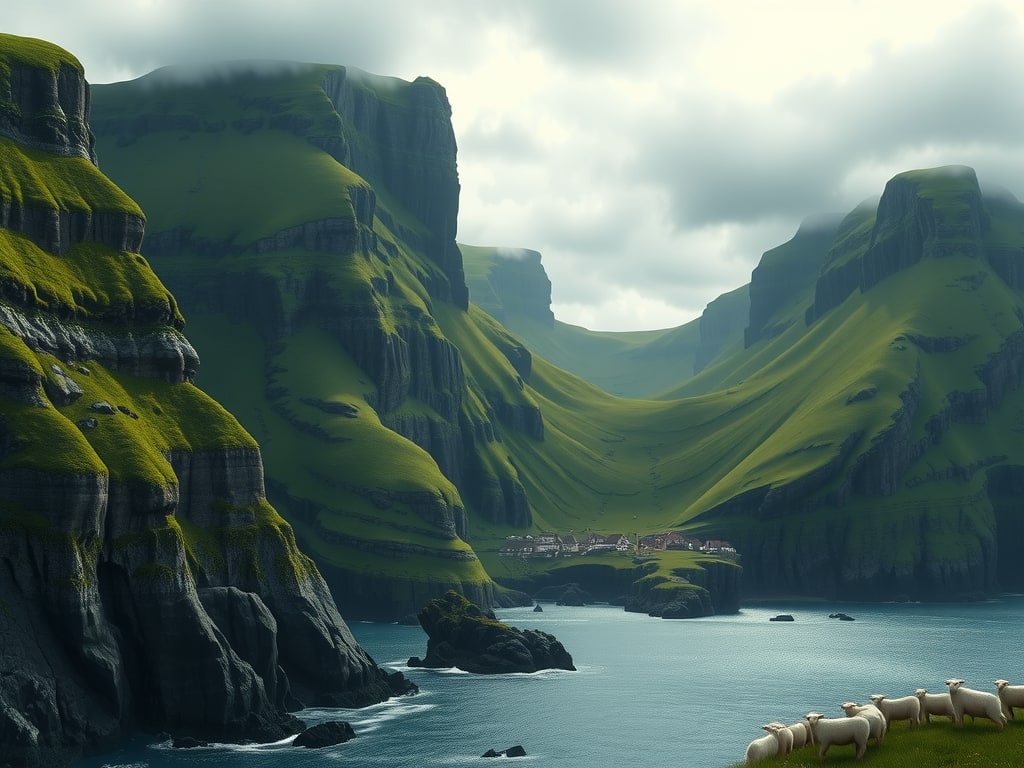
The Faroe Islands don't ease you in. Eighteen volcanic lumps of basalt and grass rise from the North Atlantic halfway between Scotland and Iceland, their cliffs dropping hundreds of feet into churning sea, their villages huddled in fjords with roofs of turf and walls of corrugated iron. The population is 54,870 as of November 2025, according to Wikipedia, but the sheep outnumber the people — the name itself means "Sheep Islands." And for a place that, per National Geographic Traveler in 2007, ranked first out of 111 island communities worldwide, it remains gloriously hard to reach and harder to leave.[9][2][10]
Seasons: When to Go for What
Summer is the obvious choice: daylight stretches to 22 hours in June and July, temperatures hover around 13–15°C, and the weather is at its most cooperative, according to Guide to Faroe Islands. Summer is also busy — not in a crowded-streets sense, but in a limited-capacity sense. Hotels and rental cars are in short supply between May and September, and day tours to Mykines, the puffin island reachable only by boat or helicopter, can be fully booked well in advance, per the same source. Booking early is essential.[1][2][7]
Autumn, from September to November, is the sweet spot for photographers and crowd-avoiders. The light turns golden and moody, the summer hordes have thinned, and October, according to Town and Tourist, is the best month for hiking. September is best for sightseeing. Winter, December to February, is the real test: only five hours of daylight at the solstice, snow, and the chance of northern lights. But the low sun creates a soft, minimalist beauty that photographers crave, and the islanders themselves live with this weather most of the year, as Guide to Faroe Islands notes. Spring, March to May, brings waterfalls at their most powerful and tourists still thin on the ground, per photographer Danny CPH's account.[11][12][13][1]
The capital, Tórshavn, receives the fewest recorded hours of sunshine of any city in the world — just 840 per year.
Beyond the Iconic Shots
Yes, you'll want the Mulafossur waterfall at Gásadalur, the village that was only reachable by a strenuous mountain route until a tunnel was blasted through in 2004, according to Hecktic Travels. And Lake Sørvágsvatn, the optical illusion that floats above the ocean, is worth the hype. But the Faroe Islands reward those who wander. The archipelago stretches 70 kilometers east to west and 120 kilometers north to south — compact enough that even after a week, you can still find a new trail, per 57hours.[7][2]
Northtrotter, a blog that has visited 14 times, recommends easy offbeat hikes under five kilometers. One is a four-kilometer cairn trail from Miðvágur to Vatnsoyrar, a gentle hour-long ramble. Another leads to Trøllkonufingur, the witch's finger sea stack — but most visitors miss Klovningur, a dramatic sea stack just beneath it. The walk is easy, though a guide can enrich it with folklore. For a bit more challenge, Gjógv's gorge path offers spectacular views over the village, and while a gate marks private property, locals ignore it and continue up the cliff, as Hecktic Travels discovered. The trail to Eiðiskollur, mentioned by Danny CPH, is another quiet favorite.[15][13][7]
For the truly committed, Mykines Island offers what Hecktic Travels calls "the most stunning hiking we've ever done." Access is only by boat or helicopter, and the island is a puffin sanctuary from May through August. But beware: the trails are not for the faint of heart. Hiking routes in the Faroes tend to suit more advanced outdoor lovers, with elevation gain and steep descents, per the same source. Yet most trails are hills rather than mountains, manageable for anyone with reasonable fitness and proper footwear, according to Penguin Trampoline.[7][12][3]
Treading Lightly on Sheep Land
The Faroe Islands have become trendy — tourist arrivals have risen rapidly in recent years, according to a research paper in the Journal of Responsible Tourism Management. But the land is fragile, and much of the hiking terrain is private grazing land. In response, the islands introduced paid access to several popular trails, with fees typically 150–200 DKK per person, per Penguin Trampoline. The fees are a direct result of tourism outpacing what the land could handle, causing real damage.[4][3]
Visit Faroe Islands, the official tourist board, has a strategy called "Preservolution" aimed at preserving natural and cultural heritage without harm. One initiative, "Closed for Maintenance, Open for Voluntourism," closes popular sites to regular visitors and invites volunteers to help maintain trails and infrastructure. In 2021, 100 tourists from 30 countries participated, according to REMÓT Travel, a 100% Faroese-owned company that supports the initiative. Travelers can also minimize impact by sticking to marked paths, avoiding drone use in sensitive areas, and respecting the sheep — they're not just scenery, they're the landscape's custodians.[5][10][6][11]
Practicalities: Getting Around and Staying Dry
A car is essential. Islands are connected by tunnels and bridges, but buses are very limited, according to Penguin Trampoline. The capital, Tórshavn, is on Streymoy, the most populated island. The other main islands are linked by underwater tunnels, while the least inhabited ones are only reachable by ferry. Atlantic Airways, the national carrier, announced in late 2019 that it was preparing to launch non-stop flights from New York's JFK, and Hilton opened the first global hotel chain property in 2020, per Wikipedia's tourism page. But don't expect a seamless digital experience: Google Translate doesn't support Faroese, so learn a few phrases — or rely on the locals' excellent English.[3][4][10][8]
Weather is the great equalizer. The subpolar oceanic climate, warmed by the Gulf Stream, means mild temperatures year-round, but fog, wind, and rain can arrive at any moment, regardless of season. Tórshavn receives the fewest recorded sunshine hours of any city in the world — just 840 per year, per Wikipedia. Trails along cliff edges become dangerous in thick fog or high wind, as you lose visual cues and the wind can push you. Waterproof boots with real grip are not optional, as Penguin Trampoline bluntly puts it. Check forecasts on YR.no or Windy, and pack layers.[9][3][11]
Accommodation ranges from guesthouses to the Hilton in Tórshavn, but book early for summer. Everything is expensive — a fact any traveler discovers quickly, as Danny CPH notes. But the cost is a filter: it keeps the crowds manageable and the experience raw. The Faroe Islands are not a place for a casual stopover; they demand intention. And that's exactly why they reward so richly.[13][10][1]
The So What
The Faroe Islands are a lesson in how to do tourism right — or at least try. They've seen the damage that unbridled visitation can do to fragile landscapes, and they've responded with fees, voluntourism, and a strategy that puts preservation first. For the traveler, that means a chance to experience one of the world's most dramatic archipelagos without contributing to its undoing. Go in October, when the light is golden and the trails are quiet. Walk the cairn path from Miðvágur, tip your hat to the sheep, and leave nothing but footprints — and maybe a little cash for the trail fee.[5][3][15][12]
Sources
- What is the best time to visit Faroe Islands? | Guide to Faroe Islands — guidetofaroeislands.fo
- Hiking in the Faroe Islands is Your Next Must-Do Adventure — 57hours.com
- Hiking in the Faroe Islands: Best Trails & Things to Know — penguintrampoline.com
- Research Project in The Faroe Islands — jrtm.org
- Sustainable Tourism in the Faroe Islands: Travel Responsibly — remottravel.com
- Responsible travel — visitfaroeislands.com
- The Best Hiking in the Faroe Islands - Hecktic Travels — hecktictravels.com
- Faroe Islands Travel – Things to Do, Trails & Hotels — penguintrampoline.com
- Wikipedia: Faroe Islands — en.wikipedia.org
- Wikipedia: Tourism in the Faroe Islands — en.wikipedia.org
- Best Time to Visit the Faroe Islands for Photography | Bogi Olsen Photography — bogiolsen.fo
- Best Time to Visit the Faroe Islands — townandtourist.com
- Visiting the Faroe Islands in March: A Photographer's Guide — danny-cph.com
- THE 5 BEST Faroe Islands Hiking Trails (2026) - Tripadvisor — tripadvisor.com
- 10 easy offbeat hikes under 5 km in the Faroe Islands – Northtrotter — northtrotter.com
Reported with AI assistance using internet sources.