The Forgotten Peace of Westphalia: How a 1648 Treaty Still Shapes Modern Borders
A 375-year-old peace treaty continues to define the rules of international relations—and its principles are under strain from Ukraine to the South China Sea.
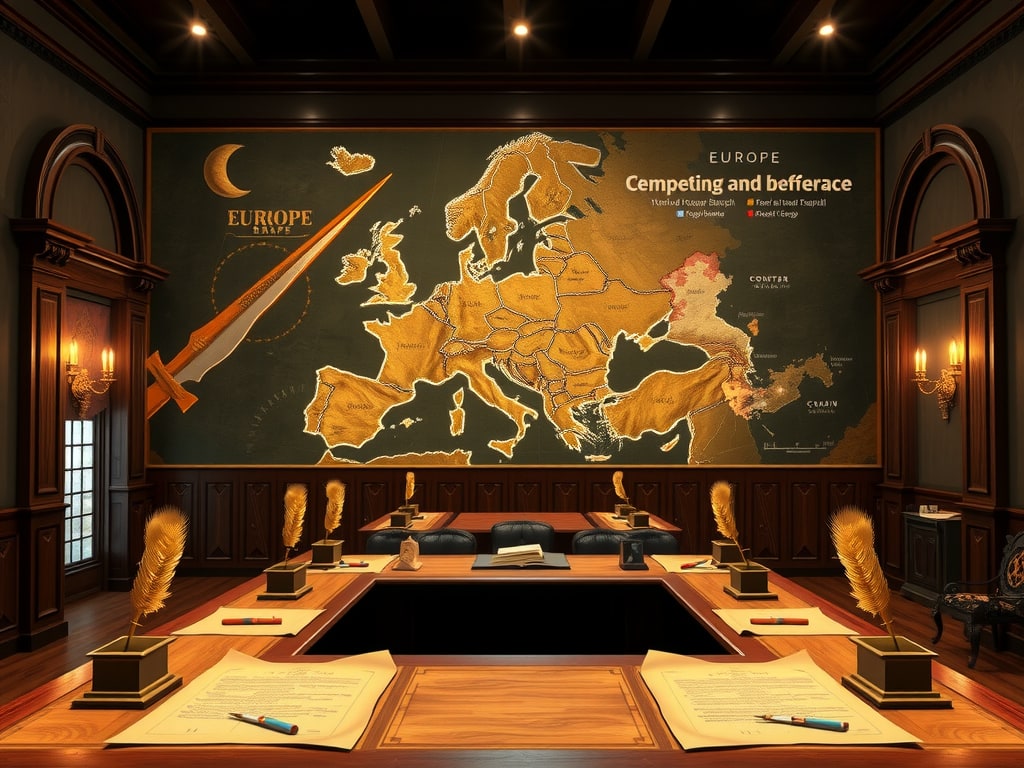
In October 1648, after five years of negotiations involving 109 delegations, two treaties were signed in the Westphalian towns of Münster and Osnabrück, ending the Thirty Years' War. The Peace of Westphalia, as it came to be known, did more than silence the guns. It laid down a set of principles—state sovereignty, territorial integrity, non-interference—that still underpin the modern international order. Today, as Russia's war in Ukraine and the South China Sea disputes test those principles, the 1648 settlement is worth a second look.[3]
What Westphalia Actually Did
The treaties were not a radical break. According to diplomacyandlaw.com, they 'transformed existing practices into mutually accepted legal commitments and embedded them in treaty form.' Before 1648, Europe was a patchwork of overlapping authorities—emperors, kings, princes, and ecclesiastical institutions—with no clear hierarchy to impose lasting order, the same source notes. The Thirty Years' War exposed the fragility of that arrangement, combining religious disputes, dynastic ambitions, and foreign meddling into a prolonged catastrophe.[1]
The settlement confirmed the authority of rulers within defined territories, formalized limits on external interference in domestic religious and political affairs, and recognized the coexistence of multiple autonomous actors within a shared legal framework, according to diplomacyandlaw.com. It also extended religious tolerance to Lutherans and the Reformed (Calvinist) church, per Britannica. The treaty recognized the sovereignty of the empire's member states, empowering them to form treaties, which weakened the Holy Roman Emperor and the Diet, Britannica adds.[1][2]
The treaties confirmed the authority of rulers and political entities within defined territories, formalised limits on external interference in domestic religious and political affairs, and recognised the coexistence of multiple autonomous actors within a shared legal framework.
The Myth and the Reality
Scholars have long debated what Westphalia really created. The term 'Westphalian system' is a shorthand for a fundamental transformation of international relations, replacing the idea of a Christian commonwealth governed by the Pope and Emperor with an order of independent sovereign states, according to the Oxford Public International Law. That concept is often traced to a 1948 article by Leo Gross in the American Journal of International Law, which interpreted the peace as the starting point of modern international law, the same source notes. But some historians argue that the sovereign-state system emerged later, and that the 1648 treaties had little to do with the principles later attributed to them, according to Wikipedia and the Boston Review.[5][3][8]
Regardless of its historical accuracy, the narrative has shaped international legal and political thought for centuries, as Wikipedia notes. The Westphalian system reached its zenith in 1945, when national governments exerted maximum power in global affairs, according to the Pari Center. It is enshrined in the United Nations Charter, which states that 'nothing ... shall authorize the United Nations to intervene in matters which are essentially within the domestic jurisdiction of any state,' as the Westphalian system Wikipedia page points out.[3][9][4]
Ukraine and the South China Sea: Westphalia in the Crosshairs
Current conflicts invoke Westphalian principles even as they challenge them. In Ukraine, Russia's annexation of Crimea and its support for separatists in the Donbas are direct assaults on the territorial integrity and sovereignty of a neighboring state—core Westphalian norms, as the World Governance Institute notes. At the same time, Russia invokes those same principles to justify its actions, claiming to protect ethnic Russians and Russian speakers, a move that echoes Westphalia's religious protections but twists them for modern geopolitics.[11]
In the South China Sea, the dispute involves competing visions of international order, according to the International Crisis Group. China's nine-dash line claim and its construction of artificial islands challenge the Westphalian principle of clear territorial borders, while other claimants and the international community appeal to the United Nations Convention on the Law of the Sea (UNCLOS) to adjudicate, a framework that both upholds and complicates state sovereignty. The Crisis Group notes that the dispute is not just about rocks and reefs but about the very rules that govern international relations.[12]
The System Under Strain
The Westphalian system faces challenges from multiple directions. Globalization has weakened the authority of national governments, according to the Pari Center, which argues that the acceleration of globalisation in the late twentieth century has 'severely destabilised the Westphalian Order.' Power has been redistributed to non-state actors—international organizations like the UN and EU, violent groups like ISIS and Boko Haram, and corporations like Facebook and Google, as the Boston Review notes.[9][8]
International organizations and international law both uphold and undermine Westphalian sovereignty. The UN Charter enshrines non-intervention, but humanitarian intervention—such as NATO's 1999 bombing of Yugoslavia to stop ethnic cleansing in Kosovo—challenges that principle, as the Westphalian system Wikipedia page notes. The International Criminal Court, the World Trade Organization, and regional bodies like the EU all limit state autonomy in various ways, according to the World Governance Institute.[4][11]
Is Westphalia Still Relevant?
Arguments for the continued relevance of the Westphalian system are straightforward: it provides a framework for international order, preventing interference in domestic affairs and maintaining stability, according to the World Governance Institute. The principle of state sovereignty—that every state, no matter how large or small, has an equal right to sovereignty—is a cornerstone of international law, as the Westphalian system Wikipedia page notes. Adherence to these principles has contributed to the decline of interstate war, according to the American Academy of Arts and Sciences.[11][4][10]
Against this, critics argue that the system is outdated and even harmful. Applying Westphalian principles to states that gained independence after 1945 has contributed to civil conflicts, because the norms of self-determination, uti possidetis, and noninterference are 'opaque, lock in an unstable status quo, or are inconsistently applied,' according to the American Academy of Arts and Sciences. The Pari Center proposes a 'Westphalia II'—a fundamental restructuring of global governance to eliminate anachronisms while retaining strong points. The Boston Review notes that the historical story of Westphalia is largely a myth, yet it continues to shape our thinking.[10][9][8]
The So What
The Peace of Westphalia may be 375 years old, but its principles are not relics. They are the operating system of international relations—however buggy that system may be. From the battlefields of Ukraine to the disputed reefs of the South China Sea, leaders invoke sovereignty and territorial integrity to justify their actions, even as they bend those principles to their will. The system is under strain, but it is not dead. As the World Governance Institute puts it, the challenges to state sovereignty in the post-Westphalian world are real, but the Westphalian framework remains the lens through which we understand them. Whether it survives the 21st century depends on whether the world's powers can agree on what it means—or whether they will rewrite it, as they did in 1648.[11]
Sources
- Treaty of Westphalia 1648 — diplomacyandlaw.com
- Peace of Westphalia | Definition, Map, Results, & Significance | Britannica — britannica.com
- Peace of Westphalia - Wikipedia — en.wikipedia.org
- Westphalian system - Wikipedia — en.wikipedia.org
- Oxford Public International Law: Westphalian System — opil.ouplaw.com
- Westphalian Vs. Indigenous Sovereignty: Challenging Colonial Territorial Governance — tandfonline.com
- The Emergence of the Westphalian System — nerd.wwnorton.com
- Beyond the Nation-State - Boston Review — bostonreview.net
- Westphalia II: The Real Millennium Challenge – The Pari Center — paricenter.com
- Civil Wars as Challenges to the Modern International System | American Academy of Arts and Sciences — amacad.org
- The Challenges to State Sovereignty in the Post-Westphalian World — wgi.world
- Competing Visions of International Order in the South China Sea | International Crisis Group — crisisgroup.org
Reported with AI assistance using internet sources.