The City That Removed Its Highway: What Happens When a Metropolis Deletes a Road
Seoul, Milwaukee and San Francisco tore out urban freeways and got parks, land value spikes and — sometimes — exactly the traffic jams they were promised. Here's the honest ledger before your city picks up a wrecking ball.
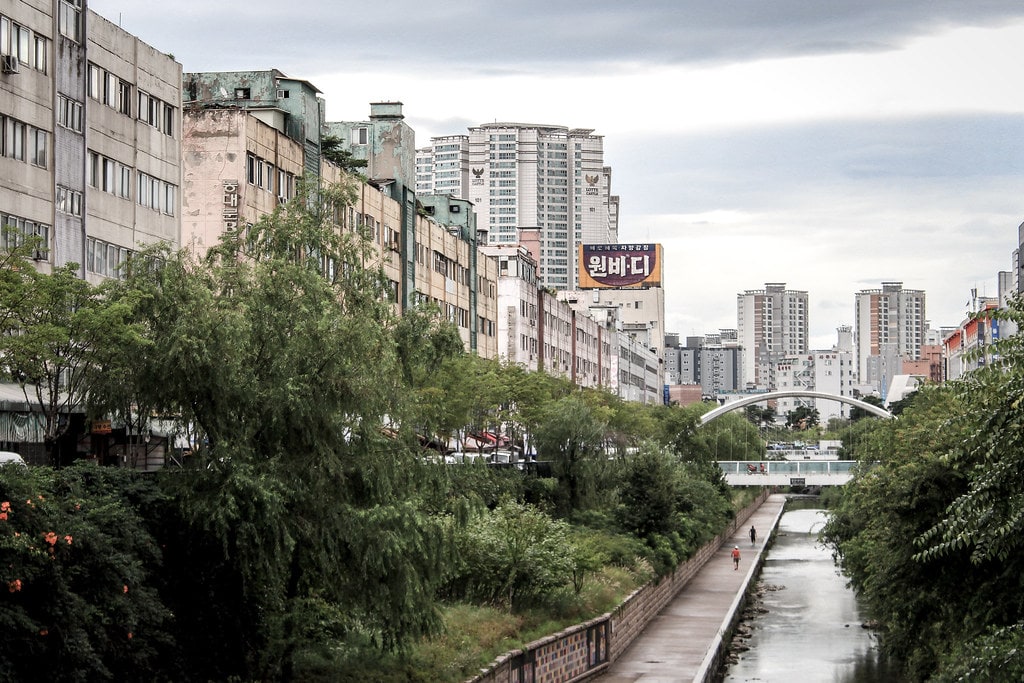
In 2003, Milwaukee finished demolishing a one-mile freeway stub called the Park East and replaced it with an at-grade, six-lane boulevard. The bill came to $25 million, with Washington covering 80 percent — against the $100 million it would have cost to rebuild the 30-year-old spur, according to the Federal Highway Administration. The land next to the new McKinley Boulevard was redeveloped as a mix of commercial, retail, townhouse and apartment uses.[8]
Seoul's $281 Million Stream — and the 0.75 Nobody Mentions
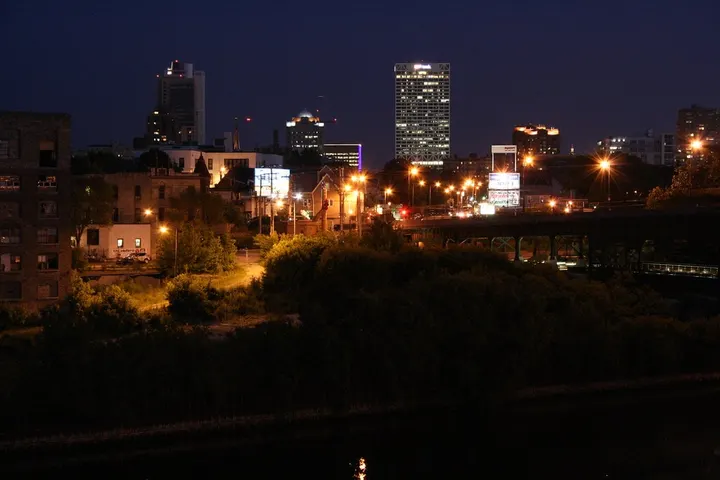
The Cheonggyecheon Expressway was a 5.6-kilometer elevated highway, 16 meters wide, completed in 1976 after the stream beneath it had been covered with concrete over two decades. In July 2003, Seoul mayor Lee Myung-bak launched a project to tear the road down and restore the water. It opened to the public in September 2005 at a final cost above ₩386 billion, roughly US$281 million.[9]
The ex-ante benefit-cost ratio was 1.89. At completion, researchers calculated it at 0.75 — the project cost more than promised and delivered less. Two reasons, per a cost-benefit analysis published in ScienceDirect: traffic congestion caused by the removal had been underestimated, and the restored stream was not identical to the original, which is what citizens had based their willingness to pay on. The study's advice to other cities is bracing: plan traffic impacts more accurately, and restore streams to as natural a state as possible.[5]
And yet. Traffic on roads adjacent to Cheonggyecheon slowed for a short period, then recovered its original speeds, according to Chung, Hwang and Bae (2012) and Hwang and Sohn (2004) — with pedestrians bearing the cost. The number of vehicles entering downtown Seoul fell 2.3 percent, while bus use rose 1.4 percent and subway ridership 4.3 percent, a daily average of 430,000 people. The project has been cited as a real-life example of Braess's paradox: remove a road, and the network can move faster.[6][9]
The ex-ante benefit-cost ratio for Seoul's Cheonggyecheon restoration was 1.89. At completion, it was 0.75.
Milwaukee: A Stub Nobody Used, a Land Boom Nobody Predicted
The Park East spur was underused and inhibited nearby development, per the Federal Highway Administration. Its removal opened 26 acres for redevelopment, and average land values per acre inside the parkway footprint grew by more than 180 percent between 2001 and 2006. The local street network absorbed the traffic, even with limited transit options. Not everyone was thrilled — opposition was spearheaded by Milwaukee resident George Watts, who argued the freeway mattered for local shopowners' revenue, and some business owners warned removal would congest streets.[7][8]
The deeper history is uglier. The freeway system disconnected African American, German, Jewish and white residents who lived along I-43, affecting 17,300 homes and as many as 1,000 businesses. In 1999, state, county and city officials approved the removal; work began in 2002 using federal ISTEA money and local tax increment financing.[8]
The Equity Question Cities Keep Skipping
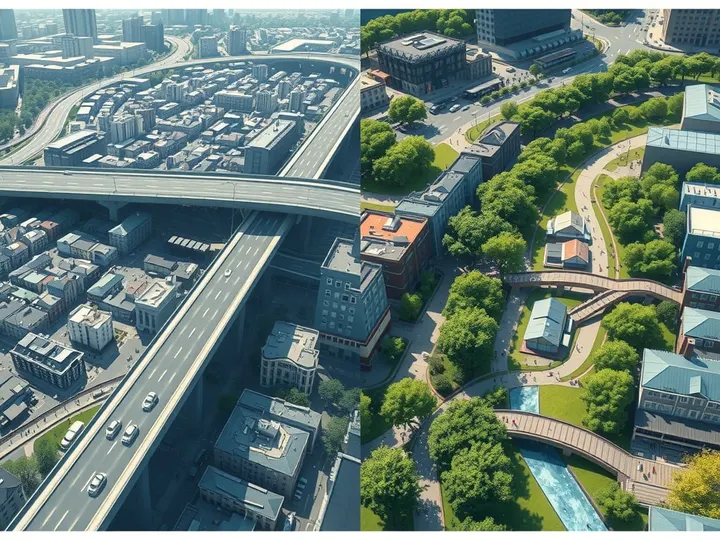
The automobile-dominated transportation system has historically and disproportionately harmed low-income communities and communities of color, dividing neighborhoods and increasing exposure to traffic and noise pollution while contributing to long-term health and economic disparities. That's the framing behind a symposium on freeway removal that pairs a panel on the impacts and inequities of freeway construction with a second on solutions — work that builds on decades of environmental justice scholarship, including Dr. Robert Bullard's writing on transportation racism.[2]
The catch: gentrification and displacement are only sometimes accounted for in transportation project planning, and rarely during implementation, according to the Urban Institute. Agencies tend to avoid displacement mitigation strategies, which they see as outside their responsibility, and it remains unclear whether transportation investments actually cause gentrification — practitioners believe they can, but context matters. In Seoul, land within 50 meters of the restored stream rose 30–50 percent, double the rate elsewhere in the city. The previous mayoral administration of Goh Kun had opposed the project precisely out of fear of gentrifying the adjacent machine-trade shops and small businesses.[9][12]
The economic upside is real, though. Between 2002 and 2003, the Cheonggyecheon area saw a 3.5 percent increase in businesses — double downtown Seoul's growth rate — and working people there increased 0.8 percent while downtown's fell 2.6 percent, per Wikipedia's summary of the project record. Jang (2009) argues the car-free streets boosted the local economy, drew visitors and built a positive city image.[6][9]
What's Coming Next — and What It'll Cost
Detroit's I-375, a one-mile stretch whose 1960s construction paved over Black neighborhoods in the city's core, is slated for conversion to a surface street by the Michigan Department of Transportation. The Texas DOT is exploring removal or footprint reduction for I-345 and I-30 in Dallas. In early 2021, U.S. Senator Chuck Schumer proposed a pilot program with $10 billion to cover infrastructure inspection and possibly removal and redevelopment planning. Not everyone is digging: Orlando is upgrading a 21-mile stretch of interstate carrying 200,000 vehicles a day in the $2.3 billion I-4 Ultimate project.[1][10]
The movement's engine is local, not federal. Ben Crowther, manager of the Highways to Boulevards program, describes it as built "from a grassroots base, by people in the neighborhood who have a vision for what it could be without the highway." San Francisco's Octavia Boulevard, completed in 2003, replaced the Central Freeway after the 1989 Loma Prieta earthquake damaged it; Boston's $15 billion Big Dig buried the Central Artery and produced the Rose Kennedy Greenway. Portland swapped Harbor Drive for Tom McCall Waterfront Park; Toronto demolished the Gardiner's easternmost stretch in 2000 for a boulevard with bike trail.[1][10]
The lesson from the completed projects is not that removal always works. Seoul's ratio fell from 1.89 to 0.75. Milwaukee's land values rose 180 percent. Both are true. The cities now holding the wrecking-ball plans get to decide which number they're planning for.[5][7][9]
Sources
- How Urban Highway Removal Is Changing Our Cities — lincolninst.edu
- The Road to Repair: Transforming Infrastructure to Advance Environmental Justice — youtube.com
- Freeways Without Futures 2025 | CNU — cnu.org
- Master Document Template — repositories.lib.utexas.edu
- Assessment of an urban stream restoration project by cost-benefit analysis: The case of Cheonggyecheon stream in Seoul, South Korea — sciencedirect.com
- The loss of road capacity and self-compliance: Lessons from the Cheonggyecheon stream restoration - ScienceDirect — sciencedirect.com
- CASE STUDY: PARK EAST FREEWAY - CNU.org — cnu.org
- Park East Freeway Removal Project, Milwaukee, Wisconsin | FHWA - Center for Innovative Finance Support - Project Profiles — fhwa.dot.gov
- Wikipedia: Cheonggyecheon — en.wikipedia.org
- Wikipedia: Freeway removal — en.wikipedia.org
- From elevated freeways to surface boulevards: neighborhood and housing price impacts in San Francisco — tandfonline.com
- Gentrification Guide — urban.org
- Analyzing the Impacts on Displacement and Environmental ... — shapessf.com
- Implementing an Equitable Inclusive Development Strategy ... — lisc.org
Reported with AI assistance using internet sources.