Permafrost Thaw: The Climate Time Bomb You’ve Never Heard Of
Beneath the Arctic lies frozen soil holding billions of tons of carbon. As it thaws, it releases greenhouse gases that could accelerate warming beyond control.
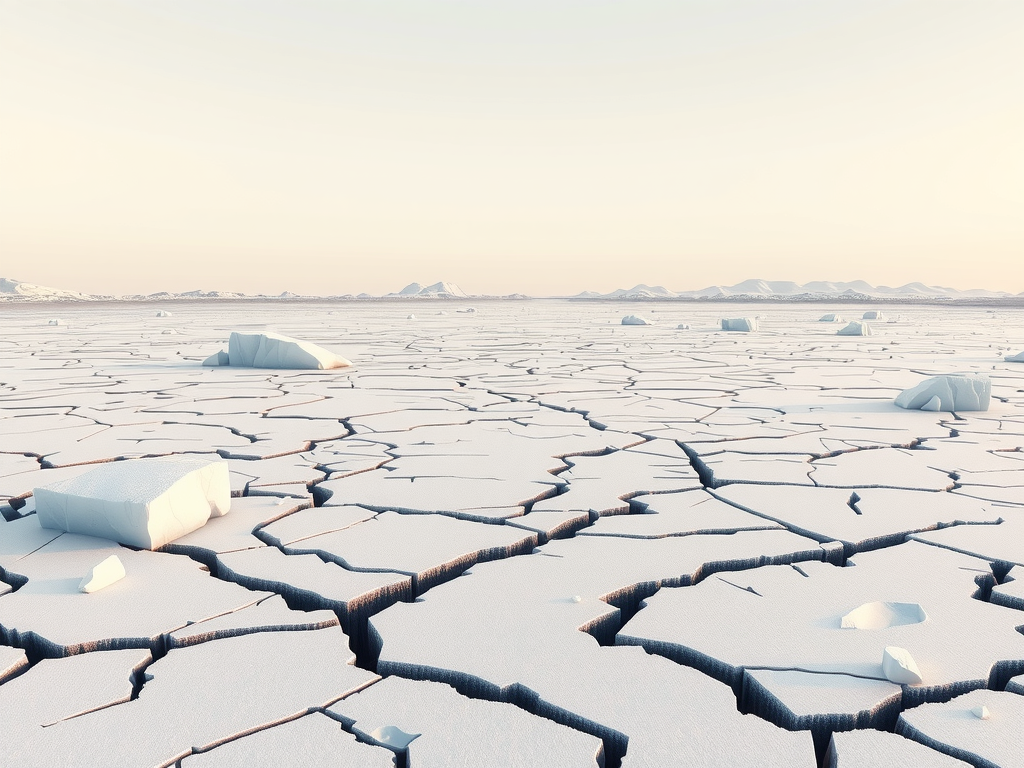
That heat is now penetrating the soil, awakening a carbon reservoir that has slept for millennia. Scientists are racing to understand a feedback loop that could rewrite the climate calculus.[4][6]
What Is Permafrost and Where Is It Found?

Permafrost is ground that stays frozen for at least two consecutive years, according to MIT’s Climate Portal. It underlies 15 percent of land in the Northern Hemisphere — from Siberia to Alaska, the Canadian Arctic to Greenland, and the high Tibetan Plateau.[4][10]
That frozen ground includes vast river deltas. The University of Alaska Fairbanks reports that Arctic river deltas cover about 1 percent of the world’s permafrost surface area, yet they hold roughly 5 percent of all permafrost-stored carbon.[1]
How Much Carbon Is Trapped?
The numbers are staggering. The NOAA Arctic Report Card estimates that northern permafrost soils contain 1,460 to 1,600 billion metric tons of organic carbon — roughly twice the amount currently in the atmosphere. Other sources put the figure even higher: the National Snow and Ice Data Center says up to 2.5 times the global atmospheric carbon pool.[6][7]
An estimated 1,500 gigatons of carbon is stored in permafrost — twice as much as the atmosphere contains.
What Happens When Permafrost Thaws?
When the ground warms, microbes spring to life. They feast on the dead organic matter — ancient plants and animals — and their metabolic activity releases carbon dioxide and methane.[1][4][6][7][11]
Not all permafrost thaws evenly. Saline permafrost, common in coastal areas, melts below 0°C, potentially accelerating carbon release. Researchers from UAF’s Thaw Below Zero project are studying these hidden processes.[1]
The Feedback Loop That Accelerates Warming
The released greenhouse gases warm the planet further, thawing more permafrost. This positive feedback loop is the core of the climate time bomb. A 2022 study led by France’s Laboratory of Climate and Environmental Sciences, with Chinese and Swedish partners, found that deep permafrost thaw could turn the Arctic from a carbon sink into a net source as early as 2055, releasing about 32 petagrams of carbon by that date.[2][3][6][9]
The same study warns that under high-emission scenarios, the Arctic’s impact on global warming could be “much more immediate and severe than previously expected.” Once thaw begins, the carbon release is largely irreversible — even if global temperatures stabilize, decomposition continues.[2][9]
Global Consequences: Not Just an Arctic Problem
Thawing permafrost shrinks the world’s remaining carbon budget — the total emissions allowed to keep warming below 1.5°C or 2°C. The additional greenhouse gases from permafrost mean humanity has less room for fossil fuel emissions. Climate models suggest that beyond regional warming and ice loss, changes in Arctic hydrology could disrupt weather patterns as far away as the Amazon and the Sahel.[4][9][10]
The damage is not only climatic. As the ground loses its frozen support, it collapses. The University of Alaska Fairbanks notes that nearly 70 percent of Arctic infrastructure — roads, pipelines, buildings — could be at risk by 2050. The ground also holds toxic waste and mercury deposits that may leak into waterways.[10]
Monitoring the Invisible Thaw
Scientists are deploying satellite instruments to measure ground subsidence and water level changes. Researchers at the Max Planck Institute for Meteorology are developing early-warning signals for abrupt thaw. The NSF-funded Thaw Below Zero project is examining saline permafrost, one of the biggest unknowns in Arctic climate science.[1][9]
Better prediction tools are critical. Scientific efforts aim to improve prediction tools to accurately reflect both the quantity and quality of frozen carbon, according to [3].[3]
The Bottom Line
Permafrost thaw will not trigger runaway warming on its own — human emissions remain the dominant driver. But it adds a persistent, self-reinforcing push that makes every fraction of a degree harder to avoid. It is now beginning to speak.[10][11]
Sources
- Arctic river deltas store 5 % of world frozen carbon | UAF news and information — uaf.edu
- PERMAFROST EMISOR CO2 | El permafrost dejará de capturar CO2 y empezará a emitirlo a partir de 2050 , alerta un estudio — laopiniondezamora.es
- PERMAFROST EMISOR CO2 | El permafrost dejará de capturar CO2 y empezará a emitirlo a partir de 2050 , alerta un estudio — diariodemallorca.es
- Permafrost — climate.mit.edu
- Permafrost carbon cycle - Wikipedia — en.wikipedia.org
- Permafrost and the Global Carbon Cycle — arctic.noaa.gov
- Why Frozen Ground Matters — nsidc.org
- Guest post: The irreversible emissions of a permafrost ' ... — carbonbrief.org
- Permafrost Thaw: Gradual Change or Climate Tipping Point? — mpimet.mpg.de
- Wikipedia: Permafrost — en.wikipedia.org
- Wikipedia: Climate change feedbacks — en.wikipedia.org
Reported with AI assistance using internet sources.