Life Under Pressure: How Deep-Sea Creatures Thrive in the Abyss
In the deepest ocean, where pressure exceeds 1,000 times sea level and sunlight never reaches, life has evolved remarkable adaptations—from flexible membranes that don't crush to bioluminescent lights that fake-out predators.

The Crush Zone
At the bottom of the Mariana Trench, 11 kilometers down, the pressure hits 1.1 kbar—eight tons per square inch. That’s a 1,100-fold increase over sea level [8]. You’d be crushed instantly. Yet here live fish, shrimp, and microbes, each with a suite of adaptations that turn a death sentence into a routine commute.[8]
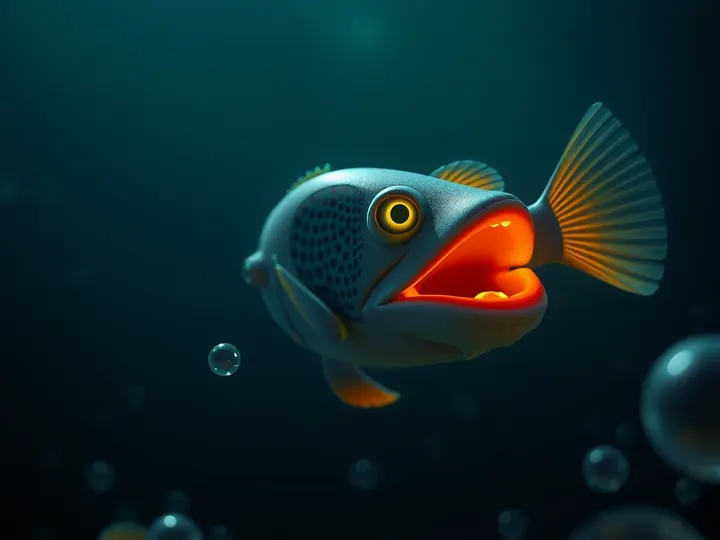
The key weapon is a molecule called trimethylamine N-oxide, or TMAO. It accumulates in cells and stabilizes proteins and membranes against the distorting force of pressure. Studies show that the deeper an organism lives, the more TMAO it carries [8]. Creatures such as the Mariana snailfish and giant amphipods pack high concentrations of these piezolytes, which literally prop open protein structures so they don’t collapse [9].[8][9]
Cell membranes also get a makeover. At depth, organisms increase the proportion of unsaturated fatty acids in their lipid bilayers, keeping membranes fluid instead of rigid [15]. Deep-sea comb jellies, for instance, rely on curved lipids called plasmalogens to maintain the perfect liquid-crystal state under pressure [13]. And because the pressure inside their bodies matches the outside, deep-sea fish never feel crushed—though they generally lack gas-filled swim bladders, which would collapse under pressure [15].[13][15]
At one of the deepest points in the Pacific, pressure is 1.1 kbar – eight tons per square inch.
Light in the Dark
Sunlight never reaches the midnight zone, from 1,000 to 4,000 meters down [4]. Yet the deep sea is not dark—it sparkles. An estimated 76% of creatures in the water column and 45% on the seafloor can produce their own light [4]. This bioluminescence comes from a chemical reaction: the enzyme luciferase catalyzes the oxidation of a substrate called luciferin, releasing blue-green photons [11, 12].[4][11][12]
Why glow? The uses are as varied as the species. Some fish use counterillumination—matching the faint downwelling light to erase their silhouette. Others flash to startle a predator, lure prey, or signal a mate [4, 16]. The deep-sea jellyfish Atolla wyvillei deploys a pinwheel of light as a “burglar alarm,” hoping to attract something bigger to eat its attacker [11].[4][11][16]
More than 75% of animals in the open ocean water column are bioluminescent.
Ecosystem Without Sunlight
Even without photosynthesis, life thrives. At hydrothermal vents, microbes use chemical energy from hydrogen sulfide and other compounds to build organic matter—a process called chemosynthesis. These microbes form the base of a food web that includes giant tubeworms, crabs, and fish [4].[4]
In other parts of the abyss, food falls from above. “Marine snow”—a rain of dead plankton, fecal pellets, and organic debris—drifts down from sunlit waters, feeding filter feeders and scavengers [15]. On rare occasions, a whale carcass sinks to the floor, creating a feast that can sustain whole communities for years or even decades [4].[4][15]
Life in the hadal zone—the deepest ocean trenches—is a masterclass in adaptation. From pressure-proof membranes to living flashlights, these creatures have turned the most hostile environment on Earth into a home. The next time you look at the ocean, remember: under that calm surface, a world of invisible engineering churns on.[9]
Sources
- 深海 SpaceX 崛起 : 世航智能破局 , 开启海洋资源开发新纪元 - 消费零售 - 贝尔财经 — finance.itbear.com.cn
- 创新团队丨深海 悟空 背后有群 自讨苦吃 的科研人 — stdaily.com
- 全国政协委员胡震 : 半生沉潜不负深蓝 — baijiahao.baidu.com
- 15 things you probably didnt know about the deep ocean — scienceblog.com
- 破解深海鱼发光之谜 : 独特晶体堪比天然光学棱镜 — finance.sina.com.cn
- 淡美岭海滩惊现 蓝眼泪 吸引大批游客一睹奇观 | 东海岸 | 地方 — orientaldaily.com.my
- 4 reasons why deep-sea fish can survive the pressure — youtube.com
- How fish survive extreme pressures of ocean life | University of Leeds — leeds.ac.uk
- How do fish survive in the deep ocean? — bbc.com
- Bioluminescence: An Adaptation for Deep-sea Survival - Deep Ocean Education Project — deep-ocean-education-project.mystagingwebsite.com
- Bioluminescence - An Adaptation for Deep-sea Survival — oceanexplorer.noaa.gov
- Student Investigation: Bioluminescence - An Adaptation for Deep-sea Survival - NOAA Ocean Exploration — oceanexplorer.noaa.gov
- The Cellular Secret to Resisting the Pressure of the Deep Sea | Quanta Magazine — quantamagazine.org
- Deep-sea discovery opens up ocean of potential | NSF - U.S. National Science Foundation — nsf.gov
- Wikipedia: Deep-sea fish — en.wikipedia.org
- Wikipedia: Bioluminescence — en.wikipedia.org
- Seeing in the deep-sea: visual adaptations in lanternfishes — pmc.ncbi.nlm.nih.gov
Reported with AI assistance using internet sources.