The Last Guardians of the Seed Vaults
Deep in the Arctic permafrost and the mountains of Lebanon, scientists race to preserve the genetic keys to the world’s food supply—against war, floods, and thawing ice.
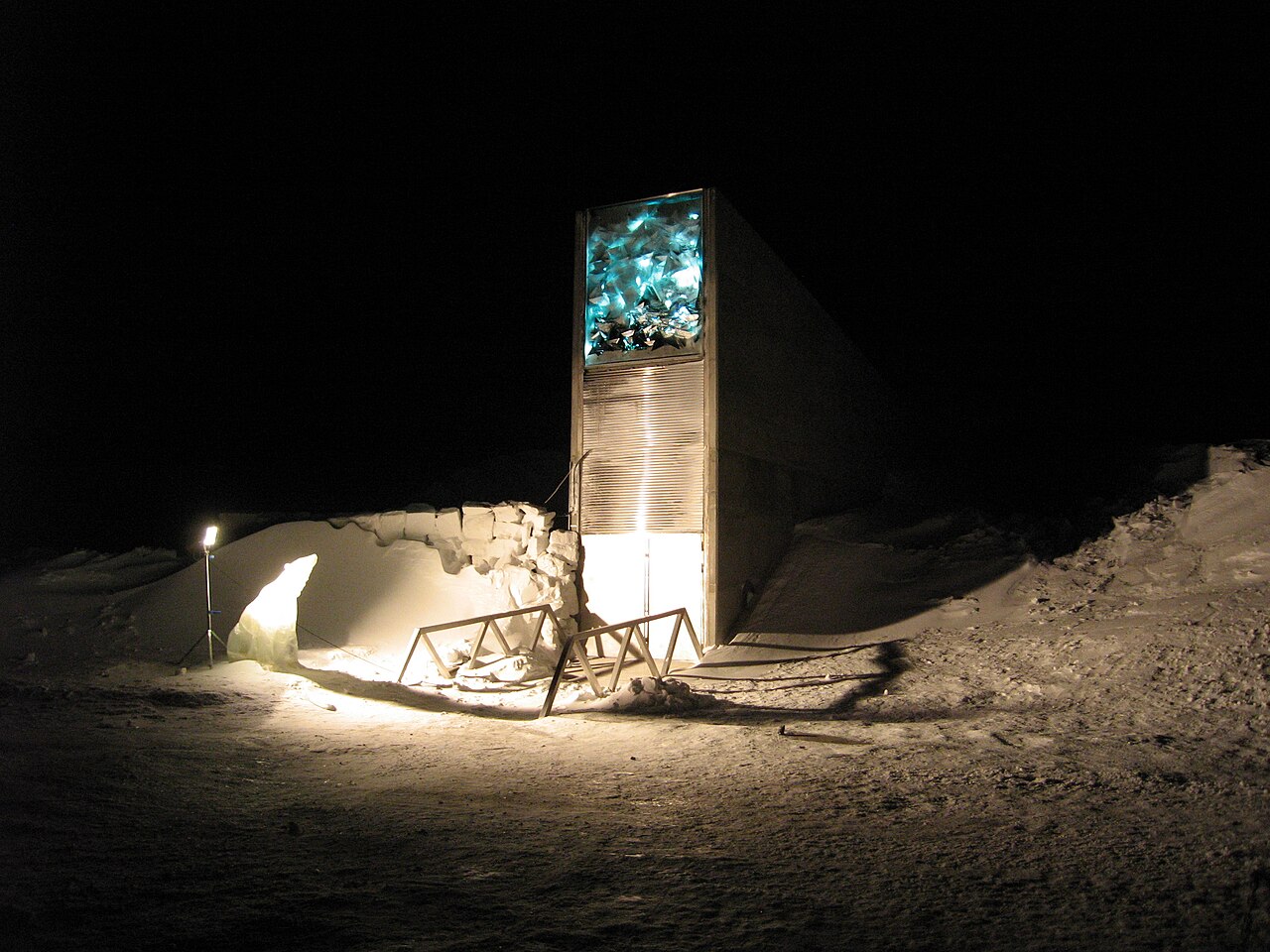
In October 2016, water poured into the Svalbard Global Seed Vault. But higher-than-average temperatures and heavy rainfall that season melted permafrost and seeped through the rock—a warning that even the world’s most secure seed bank is not immune to the climate it was built to outlast.[8]
A Coal Mine, a Flood, and a War
Svalbard is the backup for the planet’s gene banks, but that role was born from earlier failures. Norway’s original seed collection was stored in a coal mine periodically choked with hydrocarbon gases—deemed unsafe, according to the official history. The permafrost temperature there, around -3.5°C, was also too warm for long-term security. So in 2008, the Norwegian government opened the Svalbard Global Seed Vault, carving new chambers into solid rock.[1]
Since then, the vault has amassed about 1.3 million samples from nearly every country, representing more than 13,000 years of agricultural history. But vulnerabilities persist. The 2016 water intrusion was a shock, and by 2019 the Norwegian public works agency had waterproofed the tunnel, and dug exterior drainage ditches. The vault’s expansion, designed by Snøhetta, now sits on steel poles to withstand the forces of melting permafrost each spring.[8][6][12]
This diversity is the raw material that plants and agriculture need to adapt to future demands, to population increases – and to climate change.
Meanwhile, war has ravaged gene banks elsewhere. The national genebanks of Afghanistan and Iraq have been lost completely, and one in the Philippines was destroyed by Typhoon Xangsane. In Syria, the International Center for Agricultural Research in the Dry Areas (ICARDA) was forced to relocate from Tel Hadya to Beirut, Lebanon, in 2012 after the civil war made its headquarters untenable. Two seed banks in Afghanistan were looted for the plastic containers that held the seeds, per a 2015 report.[8][3]
The Scientists Who Carry the Seeds
Cary Fowler, an American agriculturalist, conceptualized the Svalbard vault and chaired the committee that made it a reality. Today, Norwegian biologist Åsmund Asdal coordinates the vault’s operations and management. But the people on the front lines are often those working in conflict zones. Safaa Kumari, ICARDA’s plant virologist, was recognized by the BBC in 2020 for developing virus-resistant crops—work that relies on the genetic diversity stored in the vault. Her colleague, Nora Castañeda-Álvarez, leads the Crop Trust’s Seeds for Resilience project, which supports five national seedbanks in Africa. The risk is personal: ICARDA itself was uprooted by war, and its scientists continue their research from decentralized platforms in North Africa, Sub-Saharan Africa, and South Asia.[7][9][2]
Seeds as a Weapon Against Extinction
The genetic material stored in these vaults is not a museum piece—it is a toolbox. In China, farmers have long grown traditional varieties of rice and maize alongside modern high-yield crops as insurance against drought. When droughts wiped out the modern plants, the traditional varieties survived. Those farmer-saved seeds were later used in cross-breeding programs that produced six new maize lines. Similarly, a gene for resistance to late blight—the fungal infection behind the Irish Potato Famine—was found in a wild potato from Argentina and used to make commercial Desiree potatoes resistant to the disease.[3]
Modern agriculture’s homogenization has narrowed the genetic base of crops, heightening vulnerability to pests and climate shocks. Seed vaults offer a buffer. As of June 2025, Svalbard held 1,355,591 accessions—including 4,000 plant species—some of which could remain viable for thousands of years. The vault has room for millions more. Every sample is a duplicate of another gene bank’s collection, ensuring that if a local facility fails, the world doesn’t lose the trait.[8][12][5]
The Long Game: Expansion and Resilience
The vault’s mission is permanent. Its tripartite management—by the Norwegian government, the Crop Trust, and the Nordic Genetic Resource Center—ensures continuity. The newly opened service building, with its black steel exterior designed to rust red over time, signals that the project is adapting to the thawing Arctic. Meanwhile, the Seeds for Resilience project is strengthening African seed banks, and ICARDA continues to develop new crop varieties for dry areas. The goal: to secure the foundation of the human food supply against whatever comes next—whether a war, a flood, or a warming planet.[8][7][12][9]
They’re there to back up the planet’s other genebank collections, and in so doing, secure the foundation of our future food supply.
Sources
- The History – Svalbard Global Seed Vault — seedvault.no
- The Svalbard Seed Vault: Saving our Global Food Security, History, and Quality — blog.smartsense.co
- After Svalbard: why safety of world seed vaults is crucial to future food security — theconversation.com
- Role of Genetic Diversity in Crop Improvement | IntechOpen — intechopen.com
- Crop Diversity: A Review of its Importance, Conservation, and Cha — interesjournals.org
- Keeping Seeds Alive If the World as We Know It Ends | The Brink | Boston University — bu.edu
- How the Svalbard Global Seed Vault could help us survive climate change — thinklandscape.globallandscapesforum.org
- Wikipedia: Svalbard Global Seed Vault — en.wikipedia.org
- Wikipedia: International Center for Agricultural Research in the Dry Areas — en.wikipedia.org
- HN: undefined — news.ycombinator.com
- HN: undefined — news.ycombinator.com
- Svalbard Global Seed Vault – Snøhetta — snohetta.com
Reported with AI assistance using internet sources.