The King Who Chose to Be Human: How Harald V's Quiet Reign Redefined Monarchy
From wartime exile to tram rides and Olympic sailing, Norway's Harald V turned royal duty into an act of profound humility.
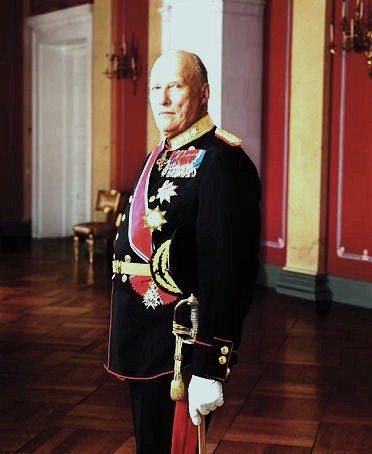
At 6:35 a.m. on Friday, August 28, King Harald V of Norway died peacefully in his sleep at Oslo University Hospital Rikshospitalet. He was 88, Europe's oldest reigning monarch, and had served his country for 35 years [3][4][9]. The news broke a nation that had long taken his presence for granted—a king who rode the tram, sailed in the Olympics, and once declared that Norwegians were, at heart, a people of immigrants. His death marks the end of a reign that redefined what a modern monarchy could be.[3][4][9]
A Childhood in Exile
Harald was born on February 21, 1937, at Skaugum, the royal estate near Oslo, into a country on the brink of war [10]. When Nazi Germany invaded Norway in 1940, his mother, Crown Princess Märtha, fled with her children across the border to Sweden, and from there to the United States at the invitation of President Franklin D. Roosevelt [4]. The family settled in Maryland, where young Harald spent the war years—a childhood shaped by displacement and the quiet dignity of a royal family in exile [1][10]. He returned to Norway on June 7, 1945, a boy of eight, to a country rebuilding itself [10].[1][4][10]
That experience left a mark. Harald would later speak of the gratitude Norwegians felt for those who sheltered them, and it instilled in him a deep sense of duty to a people who had suffered so much [1]. It also gave him an outsider's perspective—a king who had known what it was to be a refugee, and who never forgot it.[1]
A Sailor on the Throne
He was the flag bearer of Norway at the opening parade of the 1964 Summer Olympics.
Harald's humility was not a calculated PR move; it was simply who he was. As a young crown prince, he competed in sailing at three Olympic Games—Tokyo in 1964, Mexico City in 1968, and Munich in 1972—and even carried the Norwegian flag at the 1964 opening ceremony [9][10]. He kept racing after he became king in 1991, winning a world championship in 1987 and a European championship in 2005 [9][10]. When he finally declared his competitive sailing days over in 2022, citing health and mobility issues, it was with the same matter-of-factness he brought to everything else [9].[9][10]
But it was his everyday choices that endeared him to Norwegians. He was known for riding the tram in Oslo, unbothered and unguarded, a sight that became a symbol of his accessibility [1]. He married a commoner, Sonja Haraldsen, in 1968, after a nine-year struggle to win his father's permission—a break with royal convention that shocked the establishment but delighted the public [1][3][4]. The marriage, initially controversial, became the cornerstone of a modern, relatable royal family [1].[1][3][4]
A Constitutional Monarch, A Unifying Force
Norway's monarchy is largely symbolic; legislative power rests with an elected parliament, and the king's duties are mainly representative and ceremonial [3][7]. Harald performed those duties with a light touch, formally opening parliament each year and undertaking visits across the country [7]. But he understood that his real role was to be a non-political, unifying force [7]. In a widely noted 2016 speech in the Palace garden, he defined Norwegianness as encompassing immigrants, people of different religions, and LGBTQ people—a statement that resonated far beyond Norway's borders [3].[3][7]
His reign evolved with the times. He worked with Queen Sonja and Crown Prince Haakon to open the royal household to the public and the media, a deliberate move toward transparency [1]. He accepted commoners into the royal family—including Crown Princess Mette-Marit, a single mother—and was credited with modernising the monarchy [1][4]. Through it all, he balanced the ceremonial demands of his role with the realities of a democratic society, never overstepping, yet never disappearing.[1][4]
A Nation Mourns
The public's affection for Harald was immense. Norway's parliament, the Stortinget, said his reign was marked by "closeness to the people" thanks to "the unifying way in which he has exercised his royal duties" [3]. Prime Minister Jonas Gahr Støre said that for more than three decades, Harald "demonstrated an unwavering faith in the Norwegian people" and "helped us to see the best in ourselves—and in one another" [3]. His death was not just a royal event; it was a national moment of collective grief.[3]
Even Britain's King Charles III, who shares close family ties with Norway, paid tribute, noting Harald's "kindness, compassion and deep sense of duty" [5]. The two countries' bonds were forged in the Second World War, when Norway's royal family found refuge in Britain [5]. Harald's passing, Charles said, was a loss felt "across the sea and across the decades" [5].[5]
The Lesson of Authenticity
Harald V's reign offers a masterclass in leadership for an age of spectacle. He never sought the spotlight; he simply lived his life with integrity, whether that meant racing yachts or taking the tram. He showed that a monarch—or any public figure—can be both ceremonial and relatable, traditional and progressive. His authenticity was not a brand; it was a way of being. And in a world hungry for genuine connection, that may be his most enduring legacy.[1][3][4]
As Norway now turns to its new king, Haakon VIII, it does so with a model of kingship that will be hard to match [4]. Harald V proved that the crown's true power lies not in authority, but in humility. He was, in the truest sense, a king who chose to be human—and in doing so, he became something far greater.[4]
Sources
- Harald V — en.wikipedia.org
- Harald V of Norway - Simple English Wikipedia, the free encyclopedia — simple.wikipedia.org
- Meet King Harald V of Norway's Successor Haakon Amid Family Controversy — time.com
- King Haakon VIII takes the throne in Norway following ... — bbc.com
- A message from The King following the demise of King Harald V of Norway | The Royal Family — royal.uk
- Harald V, King of Norway — monarchies.fandom.com
- The Monarchy — royalcourt.no
- Monarchy of Norway — en.wikipedia.org
- His Majesty King Harald V of Norway and... - Royal World News — facebook.com
- King Harald V. of Norway — goldeneradler.com
Reported with AI assistance using internet sources.