Why Your Brain Loves a Good Story: The Neuroscience of Narrative
From campfire tales to Netflix binges, stories captivate us. This explainer dives into the neuroscience behind narrative: how our brains release oxytocin, mirror neurons fire, and memory consolidates when we hear a compelling story.
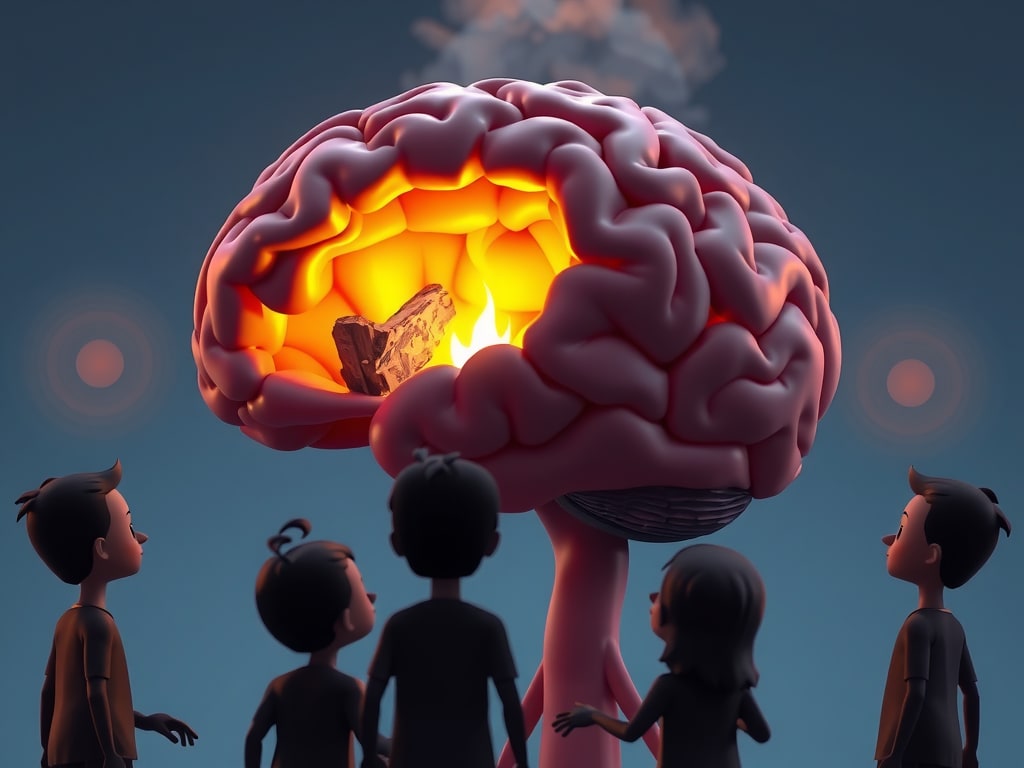
In 2014, scientists at the University of California published compelling evidence in Nature supporting a theory proposed in 1949 by Canadian psychologist Donald Hebb: that memories are created from the simultaneous firing of cells between neurons. That finding helps explain a phenomenon many of us have felt but few can articulate—why a well-told story can lodge itself in our minds far more stubbornly than a spreadsheet of facts.[11]
The Chemical Cocktail of a Good Story

When you hear a compelling story, your brain doesn't just process words—it releases a cocktail of neurochemicals that shape how you feel and remember. According to a blog post on BrandMultiplier.ai, storytelling triggers chemicals like oxytocin (trust), dopamine (focus), and cortisol (attention), making narratives far more engaging than plain facts. The ABT framework—short for "And, But, Therefore"—illustrates this: the "But" phase introduces a challenge that triggers cortisol, sharpening focus, while the "Therefore" phase provides resolution, releasing dopamine, which enhances memory and leaves a lasting impression, per the same source.[1]
The Hero's Journey, a classic narrative structure, exploits this chemistry. When the hero faces the "Call to Adventure," cortisol and ACTH levels increase, sharpening our focus, according to BrandMultiplier.ai. As we empathize with the hero, oxytocin floods our brains, pulling us deeper into the story—a phenomenon called narrative transportation. In one study cited by the blog, a Hero's Journey narrative about a father and his terminally ill son predicted donation behavior with 82% accuracy; when ACTH and oxytocin levels spiked, donations increased by 261%.[1]
In one study, a Hero's Journey narrative about a father and his terminally ill son was used. Neurological responses predicted donation behavior with 82% accuracy. When ACTH and oxytocin levels spiked, donations increased by an astonishing 261%.
Dr. Paul Zak, a neuroeconomist, has found that emotionally engaging stories can boost oxytocin levels by up to 47%, according to a blog post on Ingenius Prep. Zak, who has built his career on studying oxytocin—a neuropeptide produced in the hypothalamus and released by the posterior pituitary, per Wikipedia—calls it "the moral molecule." He argues that oxytocin is responsible for trust, empathy, and other feelings that help build a stable society, as stated in his TED talk. However, his claims have been challenged by other scientists, and a note on his TED talk page flags that research and statements in the talk have been questioned. Zak himself acknowledges that infusing oxytocin into participants and observing behavior changes doesn't prove the brain works that way naturally; his studies aim to "complete the causal circle" by measuring natural brain activity and then intervening pharmacologically, as he wrote in a PMC article.[3][6][9][2]
Mirror Neurons: Feeling the Story in Your Bones
Beyond chemicals, stories activate mirror neurons—brain cells that fire both when you perform an action and when you observe someone else performing it, according to Wikipedia. In humans, brain activity consistent with mirror neurons has been found in the premotor cortex, supplementary motor area, primary somatosensory cortex, and inferior parietal cortex. Some researchers, like Marco Iacoboni, argue that mirror neurons are the neural basis of empathy, the capacity to feel another's emotions. When you watch a character wince in pain or beam with joy, your mirror neurons simulate that experience, making the story feel real.[8]
How Stories Shape Memory
Stories don't just feel good—they stick. Research from Western Australia shows that when a good story is told but then revealed as misinformation, it's hard for our memories to let it go. Providing a retraction by just detailing the facts has little effect, and even telling a better, more plausible story doesn't eliminate the original information, according to Anecdote.com. This "continued influence effect" is why rumors and urban legends persist despite debunking.[11]
Neuroscientists are also uncovering how the way a story is told affects memory storage. A study reported by Scientific American found that telling the same story in different ways—conceptual versus perceptual—activates different memory mechanisms in the listener's brain. Memories aren't stored in one place; they're distributed throughout networks in the brain's outer layers, which connect to the hippocampus, a deep-brain structure that helps form, index, and retrieve memories. The hippocampus tends to engage with some networks more than others, and different storytelling techniques can change how information is stored and retrieved. Interestingly, participants recalled stories told in both ways roughly equally—so neither style is inherently more memorable, but each may favor different types of information.[4]
Story processing also enhances recall compared to other encoding strategies. In a study published in PMC, participants processed unrelated common nouns under pleasantness, survival, or story processing instructions; story processing improved recall performance across four experiments. This suggests that weaving information into a narrative gives it a cognitive boost.[10]
The Persuasive Power—and Ethical Peril—of Narrative
Because stories engage our emotions and memories so deeply, they are powerful tools of persuasion. According to a chapter on ethical considerations of narrative in science communication, narrative communication often improves comprehension, generates more interest, increases self-efficacy through modeling, influences real-world beliefs, and can persuade otherwise resistant audiences. This makes narratives particularly promising for science communication on topics like health, risk, and the environment.[13]
But the same power that makes stories effective for good also makes them ripe for manipulation. A LinkedIn post by Bob Hutchins asks, "Where's the Line Between Persuasion and Manipulation in Marketing?" and notes that psychological levers like scarcity, social proof, and emotional storytelling have power. Marketing shapes behavior, influences culture, and impacts belief systems. The post emphasizes ethical marketing: understanding human behavior, crafting meaningful narratives, and offering real value—but it doesn't delve into neural mechanisms.[14]
The Takeaway: Stories Are Brain Food
So what does this mean for you? Whether you're a teacher, a marketer, a doctor, or just someone trying to be heard, the science is clear: if you want to be remembered, tell a story. But beware—the same neural machinery that makes stories so effective can also be used to mislead. As researchers at Western Australia found, a good story is hard to shake, even when it's false. The best defense is awareness: know that your brain is wired to trust a well-told tale, and ask yourself whether the story you're being told is backed by evidence. And if you're the storyteller, use that power responsibly. After all, a story can change a mind—and a mind is a terrible thing to waste.[11]
Sources
- 5 Storytelling Frameworks Backed by Neuroscience | BrandMultiplier.ai Blog — brandmultiplier.ai
- Why Inspiring Stories Make Us React: The Neuroscience of Narrative — pmc.ncbi.nlm.nih.gov
- Why Narratives Stick: The Science of Storytelling — ingeniusprep.com
- Storytelling Methods Alter How Memories Are Stored in the Brain, Neuroscientists Find | Scientific American — scientificamerican.com
- Paul Zak: How Extraordinary Experiences Create Happiness | TED Talk — ted.com
- Paul Zak: Trust, morality -- and oxytocin? | TED Talk — ted.com
- Paul Zak | Speaker | TED — ted.com
- Wikipedia: Mirror neuron — en.wikipedia.org
- Wikipedia: Oxytocin — en.wikipedia.org
- Adaptive Memory: Story Processing Improves Recall Performance — pmc.ncbi.nlm.nih.gov
- The link between memory and stories — anecdote.com
- The Neurological Benefits of Storytelling — lonestarneurology.net
- Ethical Considerations of Using Narrative to Communicate ... — pressbooks.bccampus.ca
- Ethical marketing: the line between persuasion and manipulation | Bob Hutchins, Phd(c) posted on the topic | LinkedIn — linkedin.com
Reported with AI assistance using internet sources.