Your Body Has No Idea What Time It Is
The body clock isn't one clock. It's a roomful of them, and they drift apart long before you feel tired.
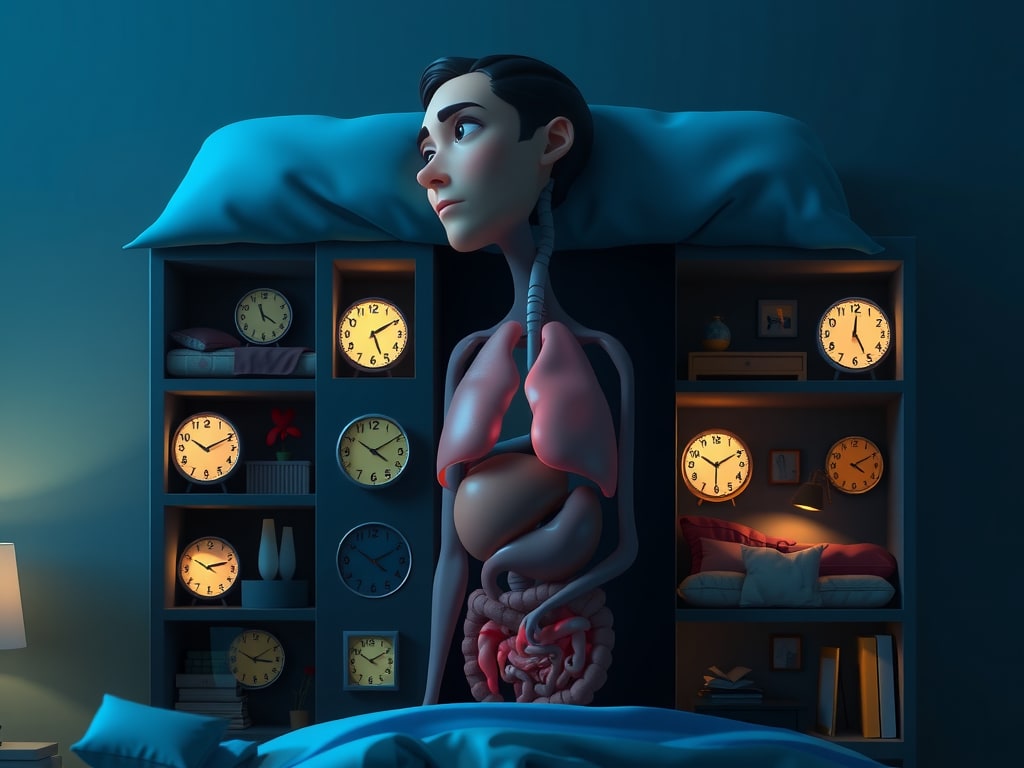
Take a biopsy of human fat, drop it in a petri dish, and it keeps ticking. That's not a metaphor. According to Harvard Medicine Magazine, the tissue will "rhythm away" on its own, no brain required. The same is true of cells pulled from the heart, skin, or liver — each one running its own 24-hour schedule.[5][9]
A Conductor, Not a Metronome

The system is hierarchical. A pinhead-sized bundle of nerve cells in the hypothalamus called the suprachiasmatic nucleus, or SCN, sits above where the optic nerves cross — a location that lets it read daylight directly. According to a review in PMC, the SCN orchestrates "numerous subsidiary oscillators throughout the body," while individual SCN neurons, if you isolate them, run on their own natural periods ranging from 20 to 28 hours. The network's trick is coupling: wired together, those sloppy individual clocks produce a precise, robust 24-hour rhythm that can persist indefinitely. Peripheral clocks in other tissues don't have that luxury. Isolated, they dampen and lose synchrony within days.[1][2][5][9]
At the molecular level, nearly every mammalian cell runs on autoregulatory transcription-translation feedback loops — genes and the proteins they encode, cycling and regulating each other. The first clock gene, period, was cloned in fruit flies in 1984 by Jeffery Hall and Michael Rosbash and Michael Young. The free-running period in constant conditions is close to 24 hours but rarely exactly 24 — which is why the word "circadian" exists at all, from the Latin for "about a day."[1][2][4]
Zeitgebers: The Time-Bringers
Environmental cues that reset the clock are called zeitgebers — German for "time bringer." Light is the strongest, but not the only one. Temperature, physical activity, and even redox cycles can influence circadian timing, according to a Wikipedia overview and a review in Knowing Neurons. The distinction matters because different zeitgebers act on different clocks. As NutritionFacts.org puts it, bright light synchronizes the central clock in the brain, while meal timing helps sync the clock genes throughout the rest of the body.[3][7][9]
The SCN translates light into a hormonal cascade. According to Harvard Medicine Magazine, it coordinates cortisol to rise during the night several hours after bedtime, preceded by melatonin release — which begins an hour or two before sleep and peaks in the middle of the night. Sleep itself feeds back into this. In one study described by Harvard Medicine, cortisol levels plunged when volunteers fell asleep later than usual, delaying the normal rise. The hormone wasn't following the clock alone. It was following the clock and the sleep, and the two had stopped agreeing.[5]
"Chronodisruption" — the state in which our central and peripheral clocks diverge out of sync — is implicated in conditions ranging from premature aging and cancer to mood disorders and obesity.
When the Clocks Stop Talking

Internal desynchrony is the gap between what your brain clock thinks and what your liver clock thinks. Travel across time zones and you'll feel it before entrainment finishes — that's jet lag, per Wikipedia's circadian rhythm overview. But you don't need a flight. Late-night eating misaligns the circadian clock, affecting neurotransmitter function, hormonal rhythms, and inflammatory pathways, according to a review in Physical Activity and Nutrition. In that research, late meals delayed melatonin onset, elevated nocturnal cortisol, disrupted serotonin and dopamine rhythms, and increased systemic inflammation — a cascade the authors link to emotional instability.[7][10]
This is why "just go to bed earlier" so often fails. You can move your sleep schedule. The PMC overview notes that a lack of synchrony within the internal environment is associated with impaired cognitive function, altered hormonal function, and gastrointestinal complaints — the constellation familiar to anyone who has worked nights or flown across an ocean. Feeling tired is the late symptom.[2][7]
The Night Shift Problem
Roughly 15 to 20 percent of workers in industrialized countries are employed in shift work, according to Wikipedia's shift work overview — a figure that includes both long-term night shifts and rotating schedules. The documented consequences are not subtle. Disruption to circadian rhythms may increase the probability of developing cardiovascular disease, cognitive impairment, diabetes, altered body composition, and obesity. An esmed.org review adds that a de-synchronised circadian system can contribute to a number of diseases, a point the authors frame as directly relevant to humans in the modern environment.[6][8]
The scheduling literature offers some practical findings. Evidence supports forward-rotating shifts — days to evenings to nights — as more adaptable for shift workers' circadian physiology than backward rotation. Mandating at least 10 hours between shifts helps workers get adequate sleep. Studies associate 12-hour shifts with increased occupational injuries and accidents, and algorithmic scheduling can produce "clopening" — closing one day, opening the next — with short rest in between. Allowing frequent breaks and scheduling 8- or 10-hour shifts instead of 12-hour ones can minimize fatigue and mitigate some negative health effects.[8]
What Actually Helps
The evidence points toward alignment rather than willpower. Keeping daily light, meals, movement, and sleep in step with the body's internal clock supports alertness, metabolism, and recovery, according to a YouTube talk on circadian rhythm and intermittent fasting. Evening light and late eating make it harder to fall asleep and may work against healthy glucose control. Aligning mealtimes with circadian rhythm improves sleep quality, neurotransmitter balance, and stress resilience, per the Physical Activity and Nutrition review. Time-restricted eating and earlier meal timing show promise, though that review is explicit that further research is needed to optimize the strategies.[10][12]
One more thing worth knowing: when you take medicines matters, because the body's response changes across the day. That's not a wellness slogan — it's a pharmacological variable. Travel and shift work will keep challenging these rhythms, but simple habits around light exposure, meal timing, and sleep can ease the strain.[12]
Sources
- Synchronization of stochastic coupled oscillators in the ... — diva-portal.org
- Overview of Circadian Rhythms — pmc.ncbi.nlm.nih.gov
- A Brief History of Circadian Rhythms - Knowing Neurons — knowingneurons.com
- The discoveries of molecular mechanisms for the circadian rhythm: The 2017 Nobel Prize in Physiology or Medicine — pmc.ncbi.nlm.nih.gov
- Health, Disease, and Chronobiology | Harvard Medicine Magazine — magazine.hms.harvard.edu
- The Evolution of Human Circadian Rhythms: An Ancient Defence Mechanism Impacting Modern Life-Styles | Medical Research Archives — esmed.org
- Wikipedia: Circadian rhythm — en.wikipedia.org
- Wikipedia: Shift work — en.wikipedia.org
- Syncing Your Central Circadian Clock to Your Peripheral Clock — nutritionfacts.org
- Physical Activity and Nutrition — e-pan.org
- Chrononutrition and Energy Balance: How Meal Timing and Circadian Rhythms Shape Weight Regulation and Metabolic Health — mdpi.com
- Circadian Rhythm and Intermittent Fasting for Healthy Lifespan — youtube.com
Reported with AI assistance using internet sources.