The Court That Made a Company Pay for a River
Before environmental agencies existed, judges decided who paid when a factory poisoned a stream — and the reasoning they invented still shapes every clean-air and clean-water act on the books.
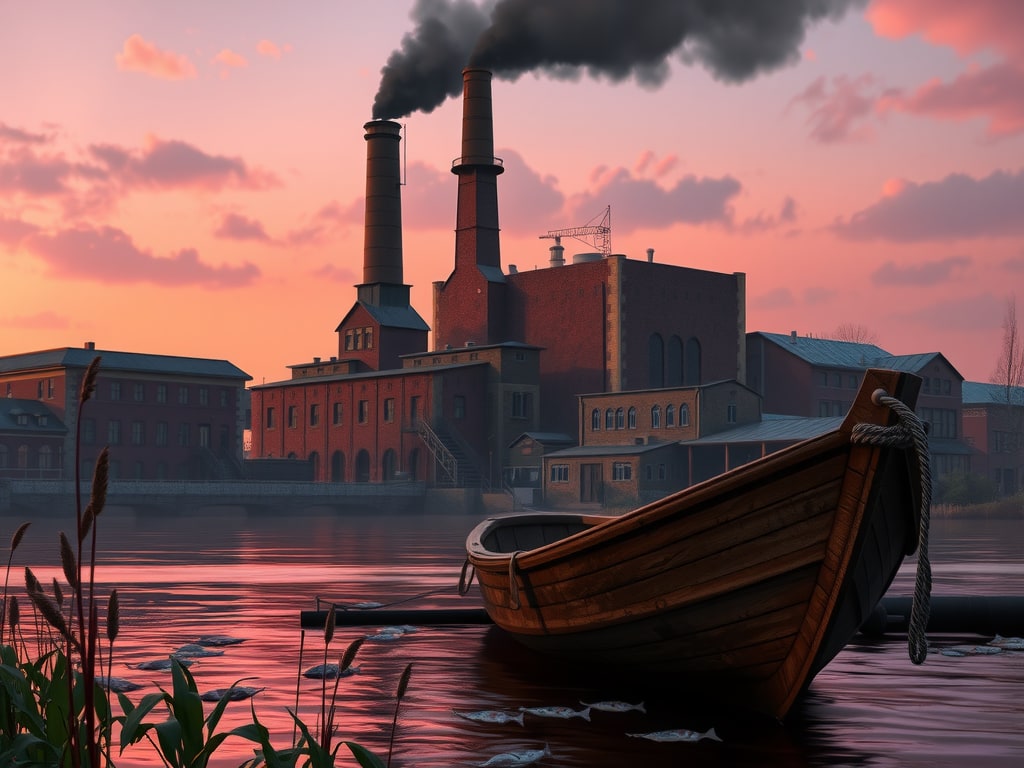
In 1860, a mill owner named Rylands built a reservoir in Lancaster County, England, to keep his mill running. Negligent work caused the reservoir to burst, flooded a neighboring mine, and forced the miner, Fletcher, to abandon his operation entirely. Eight years later, the House of Lords handed down a ruling on 17 July 1868 that made Rylands liable even though he had never been negligent. The case, Rylands v. Fletcher, established that a 'non-natural use' of land that damages a neighbor through dangerous things escaping creates strict liability — a new area of English tort law, per Wikipedia's account of the decision.[5][6]
Long before Rylands, English common law had developed riparian rights — property rights held by landowners whose land adjoins a waterway. Under the riparian principle, all such landowners have the right to make reasonable use of the water as it flows through or over their properties, according to Wikipedia's summary of the doctrine. That reasonableness is measured against other riparian owners, weighing one owner's rights fairly and equitably against the rights of adjacent owners.[1]
Who Owns the River?
In England and Wales, those rights include the right for water to flow onto land in its natural quantity and quality. Riparian owners also have duties: they must pass on the flow of water without obstruction, pollution, or diversion affecting the rights of others, according to Wikipedia. In the United States, riparian law treats water as a public good like air or sunlight — not owned by the government, the state, or any private individual. The reasonable use of an upstream owner is subject to the downstream owner's right to receive waters undiminished in flow and quality.[1]
The doctrine has deep roots: it traces to the Code Napoléon of 1804 and English common law, and has been applied primarily in states east of the Mississippi River, according to Penn State's EARTH 111 course materials. Early riparian provisions held that water returned to a stream must be equivalent to that removed in quantity and quality, and that riparian landowners must be compensated for illegal capture of water by others. In 1827, the U.S. Supreme Court interpreted riparian rights to give landowners the right to make 'reasonable' use of water in a stream, per the same course materials.[2]
By the late 19th century, the doctrine of riparian rights had become a basis for liability: a downstream landowner could sue an upstream owner who unreasonably used the water, according to a Drake University agricultural law journal article. That same article notes that trespass has also been used in pollution cases involving actual invasion of neighboring property by dust, smoke, or waste particles moving from one property to another.[4]
The reasonable use of the water by a riparian owner is subject to the downstream riparian owner's 'riparian right' to receive waters undiminished in flow and quality.
The Factory Wins, Then Loses
Rylands v. Fletcher did not arrive in a vacuum. The tort of nuisance had existed since the reign of Henry III, and for centuries it was 'rural, agricultural, and conservative,' in line with the economic status quo, according to Wikipedia's history of nuisance in English law. During the Industrial Revolution, courts began to expect a standard of care, with different standards applying to individuals and companies.[7]
In St Helen's Smelting Co v Tipping, several judges were explicit in suggesting they were affected by the adverse effect of a more draconian view on the economic welfare of the country's industrial cities, per Wikipedia. The result, as that source puts it, was that courts 'effectively emasculated the Law of Nuisance as a useful curb on industrial pollution.' Previously, once liability was established for interference with enjoyment of land, the defendant was liable however trivial the interference.[7]
The economic historian Michael W. Flinn asserted there was nothing approaching a consensus of opinion concerning laissez-faire and state intervention, according to Wikipedia. That matters because it complicates the story that courts alone invented pollution law. Judges were not philosopher-kings; they were reacting to the same political and economic crosscurrents as everyone else.[7]
Still, the courtroom gave pollution law a grammar. A successful nuisance plaintiff may recover monetary damages for the loss in value caused by the offending activities or may obtain an injunction against the continuation of the activity, according to the Drake journal article.[4]
From Courtroom to Statute Book
The common-law approach had a limit: it depended on a private landowner with standing and money to sue. Early American smoke ordinances and municipal air-pollution laws built on the nuisance framework but shifted enforcement to the public. The best practicable means standard — a legal standard for industrial pollution — originated in the Alkali Acts of 1874 and 1881 and the Rivers Pollution Prevention Act of 1876, according to a Cardiff University thesis by a researcher examining nuisance law and regulation. That standard was an early attempt to codify what courts had done case by case.[9]
But regulation brought its own problems. Critics such as Ogus argued that specification standards give manufacturers no incentive to reduce harmful effects or to research new, more efficient forms of abatement, according to the Cardiff thesis. In other words, telling a factory exactly what technology to install can freeze innovation at the regulatory minimum.[9]
The thesis makes a bolder claim: nuisance law, in its strict liability English form backed by the remedy of an injunction, facilitates the invention of pollution abatement technology prototypes. Regulatory law then renders the 'common law prototype' the 'industry archetype' where the competent regulatory body considers it expedient in the public interest.[9]
The Clean Water Act of 1972 offers a neat illustration of how far the riparian idea traveled. Federal environmental regulation of non-navigable waters under the Act was possible, according to Wikipedia, because all surface waters eventually flowed to the public ocean. The old riparian logic — that water is a public good and downstream users have rights — was stretched to national scale.[1]
The Limits of the Courtroom Story
The 'courtroom-invented' account oversimplifies in at least two ways. First, courts were often hostile to pollution claims when industrial welfare was at stake, as St Helen's shows. Second, the interplay between common-law nuisance and statutory regulation has been more circular than linear. The Cardiff thesis argues that nuisance scholarship itself seeded the notion of voluntarism that later appeared in regulatory law. And the cement industry, used as a case study in that thesis, demonstrates corporate and wider governmental resistance both to nuisance law and regulatory possibilities.[7][9]
Modern litigation shows the tension is still live. In a recent UK Supreme Court case, The Manchester Ship Canal Company Ltd v United Utilities Water Ltd (No 2), the court considered whether owners of watercourses can bring nuisance or trespass claims when water is polluted by foul-water discharges from statutory sewerage undertakers, absent negligence or deliberate misconduct. The question was whether such actions are barred as inconsistent with the legislative scheme of the Water Industry Act 1991, according to the Supreme Court's summary. The implication of the judgments below, the court noted, is that absent negligence or deliberate wrongdoing, no owner of any watercourse or body of water can bring a nuisance or trespass claim against any sewerage undertaker for polluting discharges, however frequent, voluminous, or damaging. The case is a reminder that the old riparian question — who owns the river? — has not gone away; it has simply moved into the age of statutory regulators.[8]
The legal tools invented in the 19th century — strict liability, nuisance, riparian rights, the injunction — were attempts to shift that burden onto the businesses that caused the harm.[4][7][9]
Sources
- Riparian water rights - Wikipedia — en.wikipedia.org
- Riparian Doctrine | EARTH 111: Water: Science and Society — courses.ems.psu.edu
- Diving into Water Rights - REALTORS® Land Institute > Voices > The Voices of Land blog — rliland.com
- RYLANDS v. FLETCHER REVISITED — aglawjournal.wp.drake.edu
- Rylands v Fletcher - Wikipedia — en.wikipedia.org
- Rylands v. Fletcher Case Brief Summary | Law Case Explained — youtube.com
- Wikipedia: Nuisance in English law — en.wikipedia.org
- The Manchester Ship Canal Company Ltd v United Utilities Water Ltd (No 2) - UK Supreme Court — supremecourt.uk
- Nuisance Law, Regulation, and the Invention of ... — orca.cardiff.ac.uk
- Special Master Report — supremecourt.gov
Reported with AI assistance using internet sources.